TrustRadius: an HG Insights company

Datadog

Score8.4 out of 10

239 Reviews and Ratings

What is Datadog?

Datadog is a monitoring service for IT, Dev and Ops teams who write and run applications at scale, and want to turn the massive amounts of data produced by their apps, tools and services into actionable insight.

Media

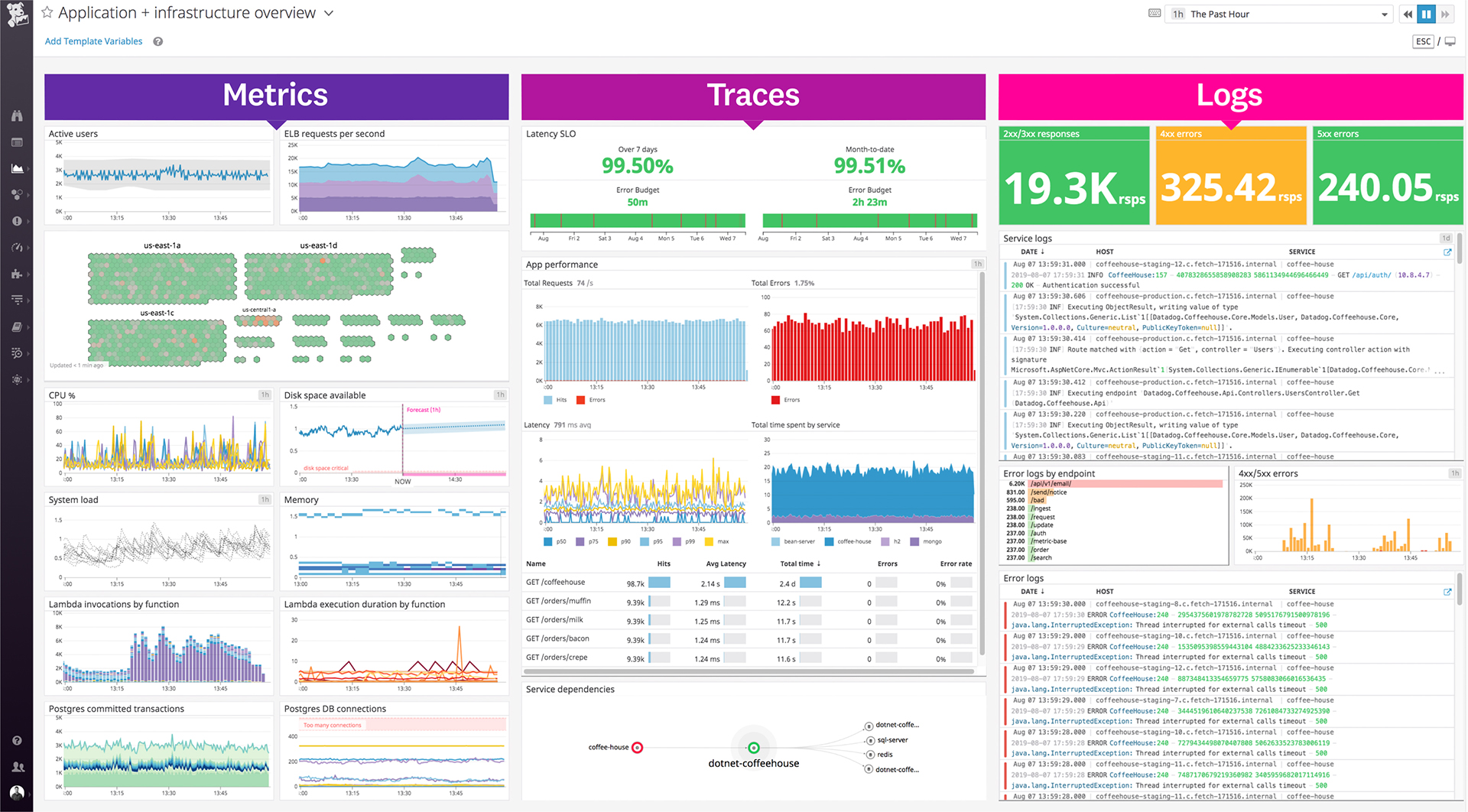
the out-of-the-box and customizable monitoring dashboards.
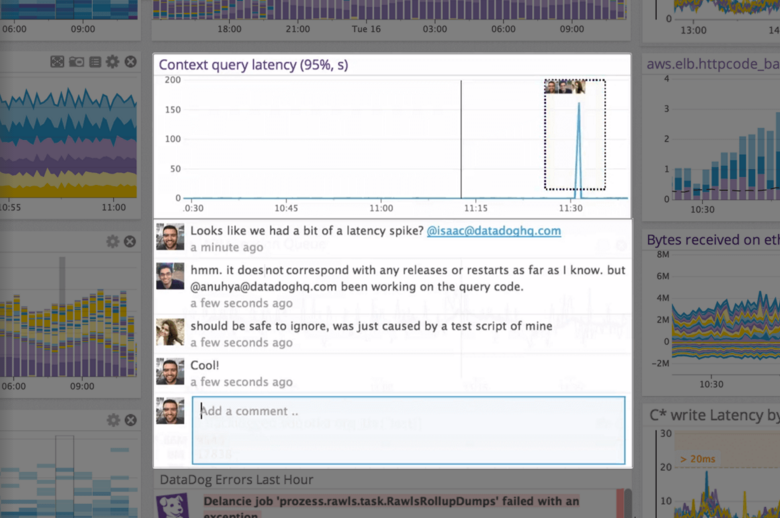
Datadog's collaboration features, where users can discuss issues in-context with production data, annotate changes and notify their teams, see who responded to that alert before, and discover what was done to fix it.
where Datadog unifies traces, metrics, and logs—the three pillars of observability.
some of Datadog's 400+ built-in integrations.
Datadog's Service Map, which decomposes an application into all its component services and draws the observed dependencies between these services in real time
centralized log data, pulled from any source.
Datadog's Host Map, which lets users see all hosts together on one screen, grouped and filtered as desired, with metrics made instantly comprehensible via color and shape.

1 / 7

Every dog has its day - Let's Datadog

Use Cases and Deployment Scope

we use Datadog to solve a wide range of business problems by gaining full-stack observability over its aplications and infrastructure. some of the business problems that this product address includes - Preventing system outages and performance bottlenecks. - improving Devops collaboration. - Accelerating cloud migration and modernization. - Enhancing customer experience.

Pros

  • accelerating cloud migration and modernization
  • proactive security monitoring and threat detection
  • improving digital experience and product analytics

Cons

  • complex and unpredictable pricing
  • steep learning curve and complex UI
  • without proper configuration, Datadog can be notorious for generating an overwhelming number of alerts.

Return on Investment

  • reduced mean time to resolution and mean time to detection.
  • improved operationl efficiency and automation
  • steep learning curve and management overhead.

Usability

Other Software Used

Grafana, Splunk Observability Cloud

Datadog Provides Comprehensive Easy-to-Use Monitoring for Modern Energy Systems.

Use Cases and Deployment Scope

At NLine Digital Solutions, I leverage Datadog to monitor our power systems and digital infrastructure, allowing me to identify problems early and optimize performance. Real-Time Insights and Alert on Business Problem Alerts that matters The Platform tackles business challenges such as Downtime, Resource Underutilization, Security Threats by giving you Real-Time insights and alert. I use it to monitor infrastructure, application and security to work efficiently with my team and guarantee everything is running smoothly.

Pros

  • Unified Monitoring Across Systems
  • Real-Time Data Visualization and Dashboards
  • Powerful Application Performance Monitoring
  • Seamless Integrations

Cons

  • Learning Curve and Lack of Documentation
  • Cost Transparency and Pricing
  • Real-Time Data Delays
  • Feature Gaps and Integration Limitations

Return on Investment

  • Efficiency and Optimization in the Operation Side
  • Enhanced Data-Driven Decision Making
  • Positive ROI Despite Cost Considerations
  • Scalability and Growth Enablement

Usability

Other Software Used

Microsoft Teams, Slack

Datadog is a great product to gain visibility into your systems

Use Cases and Deployment Scope

Datadog is used to provide detailed insight into our infrastructure and Saas applications across multiple environments. It is a single interface that brings all our data together into a combined view and allows us to analyze, troubleshoot, and monitor our systems both in production and other environments. We have recently added several of Datadog's security tools, which have enhanced our overall security posture and helped us improve how we manage security on our systems.

Pros

  • Correlate logs across multiple systems and technology
  • Provide tools for querying and analyzing logs
  • Combine infrastructure and application information into a single related view
  • Pull information from AWS and display it in meaningful dashboards

Cons

  • With all the information that Datadog gathers, you can sometimes get lost in a breadcrumb of screens as you drill into information.
  • Understanding how Datadog can impact your cloud costs by the extra load and queries it performs could be improved and made more transparent.

Return on Investment

  • This has improved the developer experience in troubleshooting issues, resulting in quicker resolutions and a better understanding of the root problem.

Usability

Other Software Used

Microsoft Visual Studio Code, monday.com, Microsoft Teams

Unified Monitoring with Datadog

Use Cases and Deployment Scope

in my org, Datadog is used to for monitoring the application performance, and managing logs across different environments. we use this for tracking latency, throughput, and errors in our microservices. We use it for creating custom dashboards and alerts on deployments. also for monitoring cloud resources and Kubernetes clusters. this makes debugging faster and cross team interaction is smooth.

Pros

  • Tracking Microservice Performance
  • managing the logs
  • Monitors Cloud and Kubernetes
  • Speeds Up Debugging and dashboards

Cons

  • costing incerease based on the logs volume.
  • Creating monitors, dashboards, or logs requires some context on Datadog syntax.
  • role based access needs to be more granular if someone has larger team members

Return on Investment

  • dashboards are making easier to find the pods going into crash loop due to memory issues
  • less time to debug and finding the RCA's
  • Increase the productivity of each developer.

Usability

Alternatives Considered

Prometheus and Grafana

Other Software Used

Grafana, Prometheus, OpenTelemetry

Datadog - Make debugging easier

Use Cases and Deployment Scope

Our use case crosses teams—DevOps, backend engineering, and QA. We use it for everything from monitoring system CPU and memory usage on our cloud instances to application-level error custom alerting. We also use it extensively for deployment alerting, real-time SRE dashboards, and even for long-term performance analysis.Overall, Datadog is now part of our observability stack. It makes us proactive about issues in the system, and not reactive.

Pros

  • Unified Observability (Metrics, Logs, Traces in One Place)
  • Real Time Dashboards
  • Good Alerting mechanism

Cons

  • learning curve for new users
  • Dashboards can sometimes be disorganized if not maintained properly
  • Alert configurations take time example user has to plug and play sometimes

Return on Investment

  • reduced the time in debugging and the team is more productive as RCA is easy to find
  • Decision making with live metrics is helpful by a lot
  • with help of llm even QA is able to find some memory issues and spikes by looking at the dashboards

Usability

Alternatives Considered

Grafana Loki

Other Software Used

Grafana, ClickHouse, New Relic