TrustRadius: an HG Insights company

monday.com

Score8.6 out of 10

4,830 Reviews and Ratings

What is monday.com?

monday.com Work OS is an open platform designed so that anyone can create the tools they need to run all aspects of their work. It includes ready-made templates or the ability to customize any work solution ranging from sales pipelines to marketing campaigns, CRMs, and project tracking.

Media

Work OS
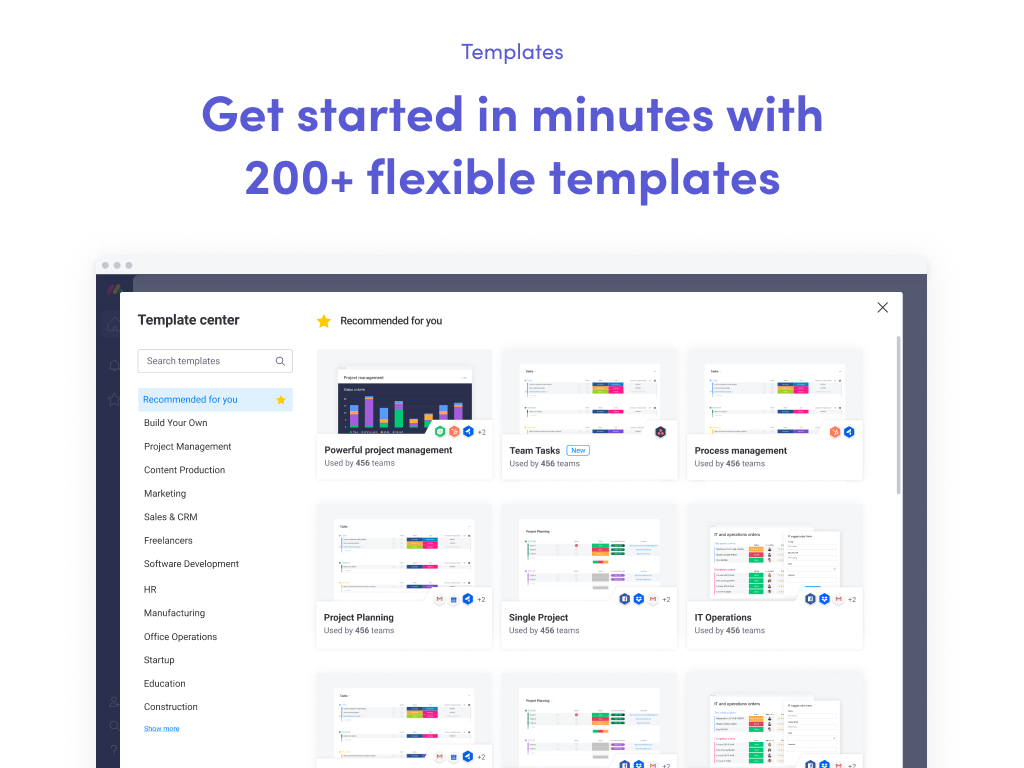
Ready-Made Templates
Mobile
Visual Boards
Real-time Notifications
Automations
Integrations
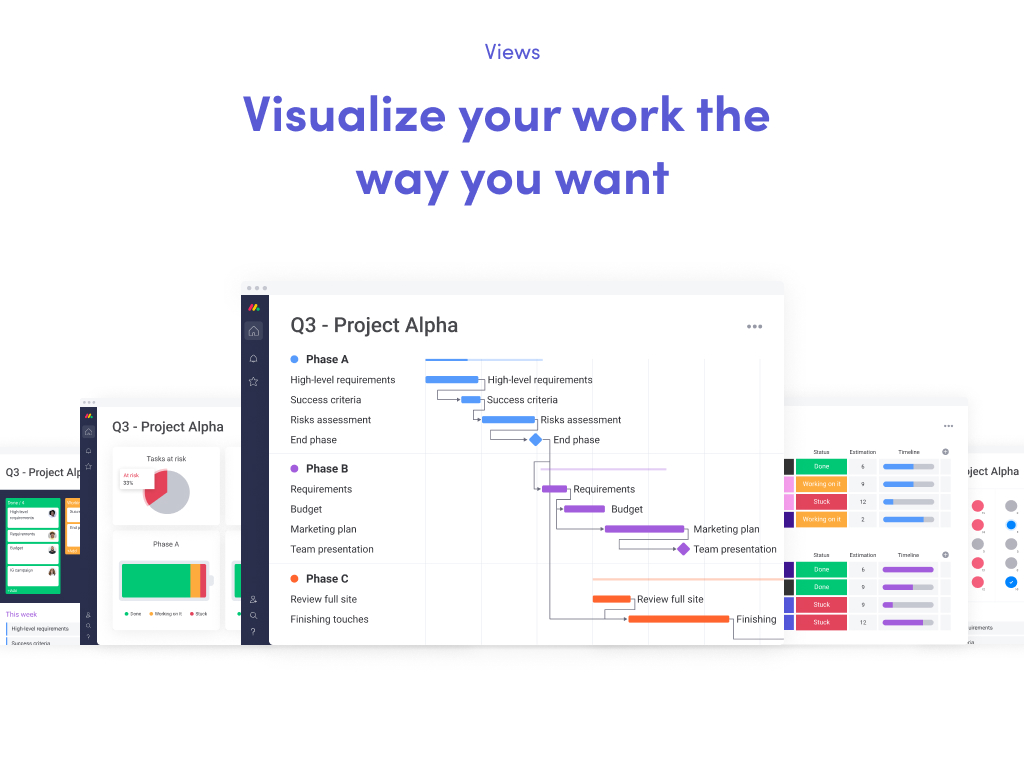
Views
File Sharing
Dashboards
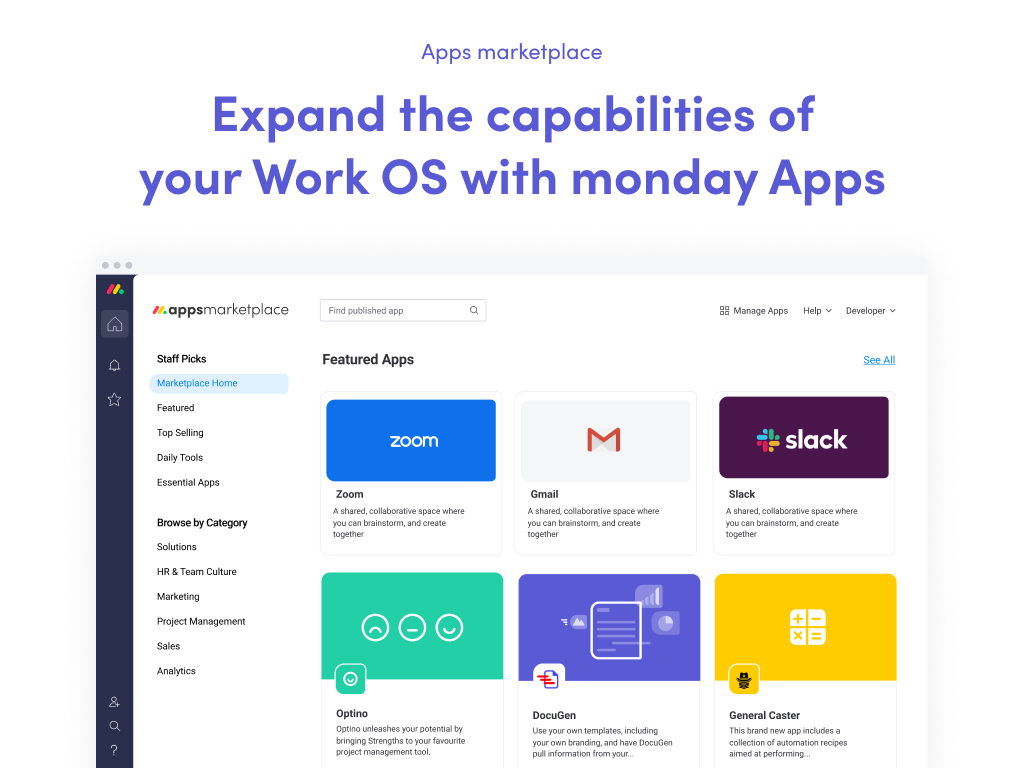
App Marketplace
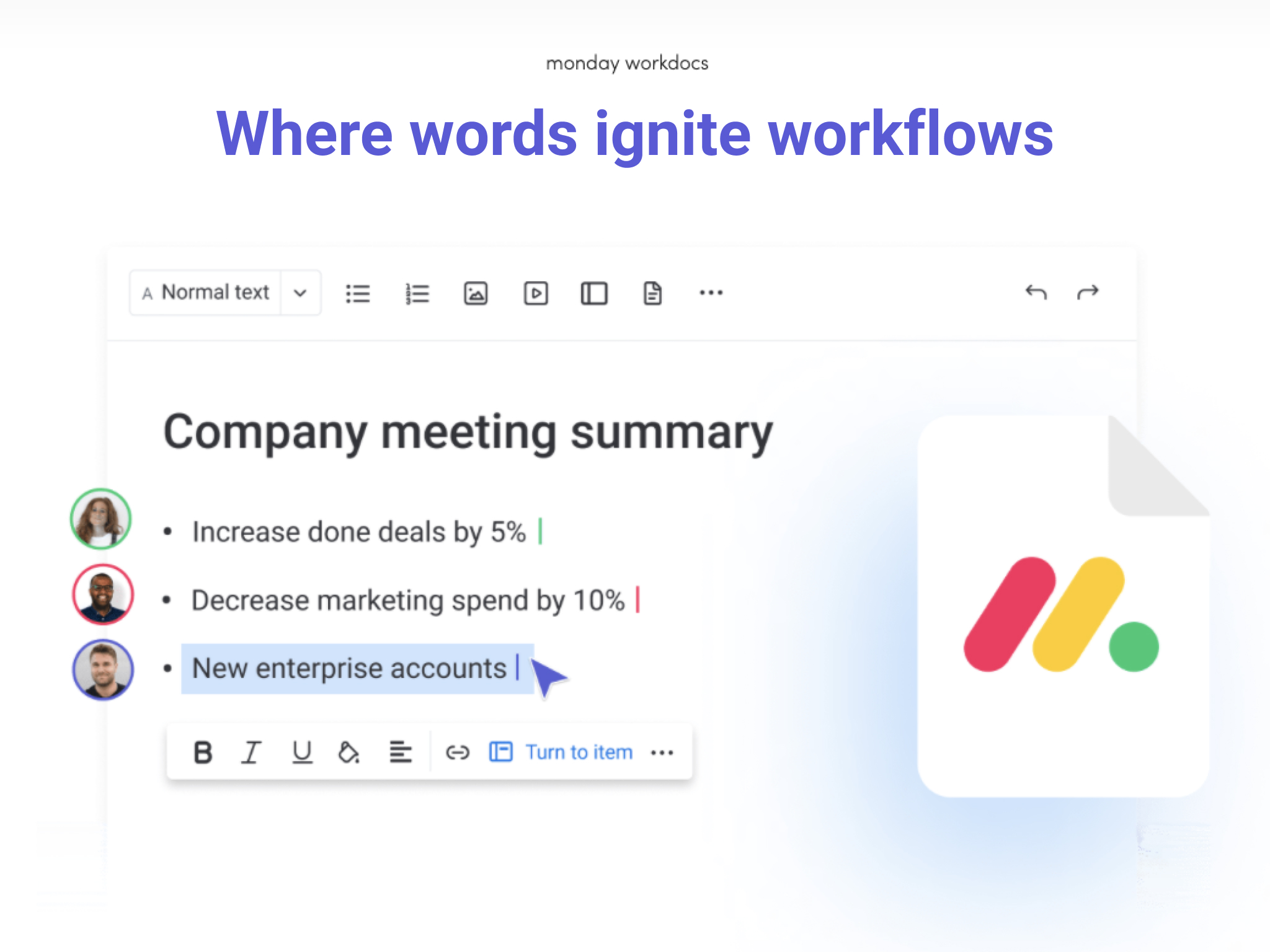
Docs

1 / 12

Top Performing Features

  • Quotes/estimates

    Ability to create, manage and send project fee proposals to customers

    Category average: 8.6

  • Project & financial reporting

    Ability to analyze project and financial data based on custom criteria to gather insights and improve business performance

    Category average: 8.4

  • Integration with accounting software

    Real-time, two-way sync with accounting or financial software to facilitate project and financial reporting

    Category average: 8.3

Areas for Improvement

  • Document Management

    Document management provides for centralized management of all project documents.

    Category average: 7.9

  • Gantt Charts

    Gantt charts are charts that show tasks or events along the y-axis displayed against time along the x-axis.

    Category average: 8.3

  • Support for Waterfall Methodology

    Waterfall methodology is a tradition development method that is linear and sequential.

    Category average: 7.9

Best Product Ever - Can't Function Without It

Use Cases and Deployment Scope

I use monday.com to manage projects, drive process efficiency, decrease inbox clutter, track productivity and allow for transparency across the organization. One of the biggest problems it addresses is transparency. By creating project boards that are shared across departments and the org. managers can easily see what it is teams are working on. Updates are at your fingertips. No wait time to get answers and no emails cluttering your inbox.

Pros

  • Project tracking
  • Organize to-dos
  • Automate workflows
  • Remind and keep people on track

Cons

  • Hate that you can't have different headers within the same board or between items and sub items

Return on Investment

  • It's hard to measure time saving but for sure it saves hundreds of hours reading emails
  • Visibility across teams
  • Improved workflow and process improvement

Usability

Other Software Used

Insperity

Visually pleasing and with great collaboration tools

Use Cases and Deployment Scope

Capacity planning, task management, project management, and some amount of finance calculations. Some teams also use it for knowledge management, as well. These aren't, or IMO, shouldn't be called "Business problems" they are more like business challenges in the day2day. My use case are mostly capacity, project management, and collaboration. We track tasks, stakeholders, resources and any material needed for the deliverables.

Pros

  • Team collaboration
  • easy to input data via email and templates
  • automations
  • link different parts of different projects

Cons

  • Notification system, not trustworthy for me
  • More tools to input data automatically, more functionality without having to do APIs
  • More calculation capabilities within the columns

Return on Investment

  • Positive overall, task management is easy to set up, easy to replicate, duplicate and modify.
  • Collaboration has all the standards by now, tagging, linking, messaging, etc.
  • Boards enable a fast organization of tasks, repositories, responsibilities and tracking with dates and notifications.
  • automations enable fast actions that provide no real value if done manually. Being able to autocreate, autoclose, and many others makes it easier to follow processes and make less mistakes.

Usability

Alternatives Considered

Asana, Microsoft Planner, Trello and Atlassian Confluence

Other Software Used

Microsoft 365, Microsoft Power BI, Atlassian Confluence

Tie Up All Your Loose Ends

Use Cases and Deployment Scope

We use monday.com as a way to keep track of our manufacturing process. From customer order until it is delivered monday.com helps us keep track of where it is and how long it will be until completion. It has many features like notes and status visuals that make it simple to use and very useful. I definitely recommend it for any company that manufactures goods and has a lot of moving parts to keep track of.

Pros

  • Inner company messaging
  • Keeps everything updated real time
  • Helps track inventory

Cons

  • Moving between workspaces can be confusing
  • The constant info bar at the top gets annoying though hardly an issue
  • I am really reaching here, all in all I can't say I'd change anything

Return on Investment

  • Time saving
  • Employee communication
  • Order tracking

Usability

monday.com to simplify cross organizational work

Use Cases and Deployment Scope

monday.com is managing cross team tasks and data flow between different engineering, product, and GTM teams

Pros

  • monday.com helps organize complex systems
  • monday.com simplify task management
  • monday.com remove barriers between different teams processes

Cons

  • At times monday.com can be more flexible
  • Defining specific columns types for automation can be limiting
  • monday.com support is great on the surface but can be improved for advance use cases

Return on Investment

  • Time saving
  • Filled gaps between parallel processes
  • Increase visibility of impact
  • Increased productivity

Usability

Alternatives Considered

Trello, Atlassian Jira and Asana

Other Software Used

Superset, Microsoft 365, Adobe Premiere Pro, AWS Backup

LoveHate Relationship Some Excellent Features and Some Baffling Shortcomings

Use Cases and Deployment Scope

I don't use monday.com in my own organization, but I've helped deploy and train users on it—plus build a bunch of monday.com automations to support their business processes—for my biggest client. That client benefits from the increased org-wide visibility into other teams' work and progress on shared tasks, and the ease of commenting on tasks and tagging others in context. They've adopted it for basic task management and collaboration, and I'm in the process of helping migrate several automated request intake and management systems into monday.com too.

The IT team has started using it to track computer inventory and assignments, the HR team for tracking new hire onboarding tasks, and more! Another client of mine uses it for tracking program participants and their medical claim status, as well as their staff and contractors' contact information and assignments.

Pros

  • Relational database functionality (via Connect Boards and Mirror Columns)
  • The UI is reasonably user-friendly - not too overwhelming, compared to other platforms in this space
  • Making automation more accessible to non-technical folks using natural language for the recipe builder

Cons

  • The sales process was rocky and almost felt like a bait-and-switch (rep promised various features we needed were possible natively, but ended up being wrong about some big ones)
  • The reliance on third-party apps to fill some fundamental functionality gaps is frustrating—monday.com support seems to think that if there's an app that does what the user is asking for, that's the solution (even when that app may carry its own cost and/or fail to meet security benchmarks). monday.com also pushes third-party apps far too much, popping up and recommending them to users "proactively" even in HIPAA-compliant orgs that cannot use them
  • It feels like monday.com nickels-and-dimes its customers—when a new feature is developed, it seems like the first thing they ask themselves is "how much extra can we get people to pay for this?" while other platforms take a more holistic approach to dividing features between subscription tiers
  • I feel the quality of support is usually terrible (at least for power users. I could see it being okay for new people with very basic questions)
  • The notification of an automation or workflow failing is severely lacking, and when you look at an automation's run history, virtually no helpful troubleshooting information is made visible
  • Its integrations are typically EXTREMELY limited and non-customizable, making many of them useless in practice

Return on Investment

  • Positive: makes it easier for different teams/departments to collaborate and provide visibility into task progress
  • Positive: connected boards allow for agile matching of static items with often-changing items (e.g., computer inventory with assigned users)
  • Negative: sometimes automations fail for no reason whatsoever, and there is insufficient notification when this happens. This can lead to something important falling through the cracks!
  • Positive: Dashboards make it very easy to display helpful metrics that update themselves in realtime—this wasn't possible at all for my client before adopting monday.com

Usability

Alternatives Considered

Asana, Basecamp, Microsoft Planner, Trello, Zendesk Suite and Slack

Other Software Used

Zapier, Microsoft Power Automate, Microsoft Teams, Slack, Google Workspace, FreshBooks