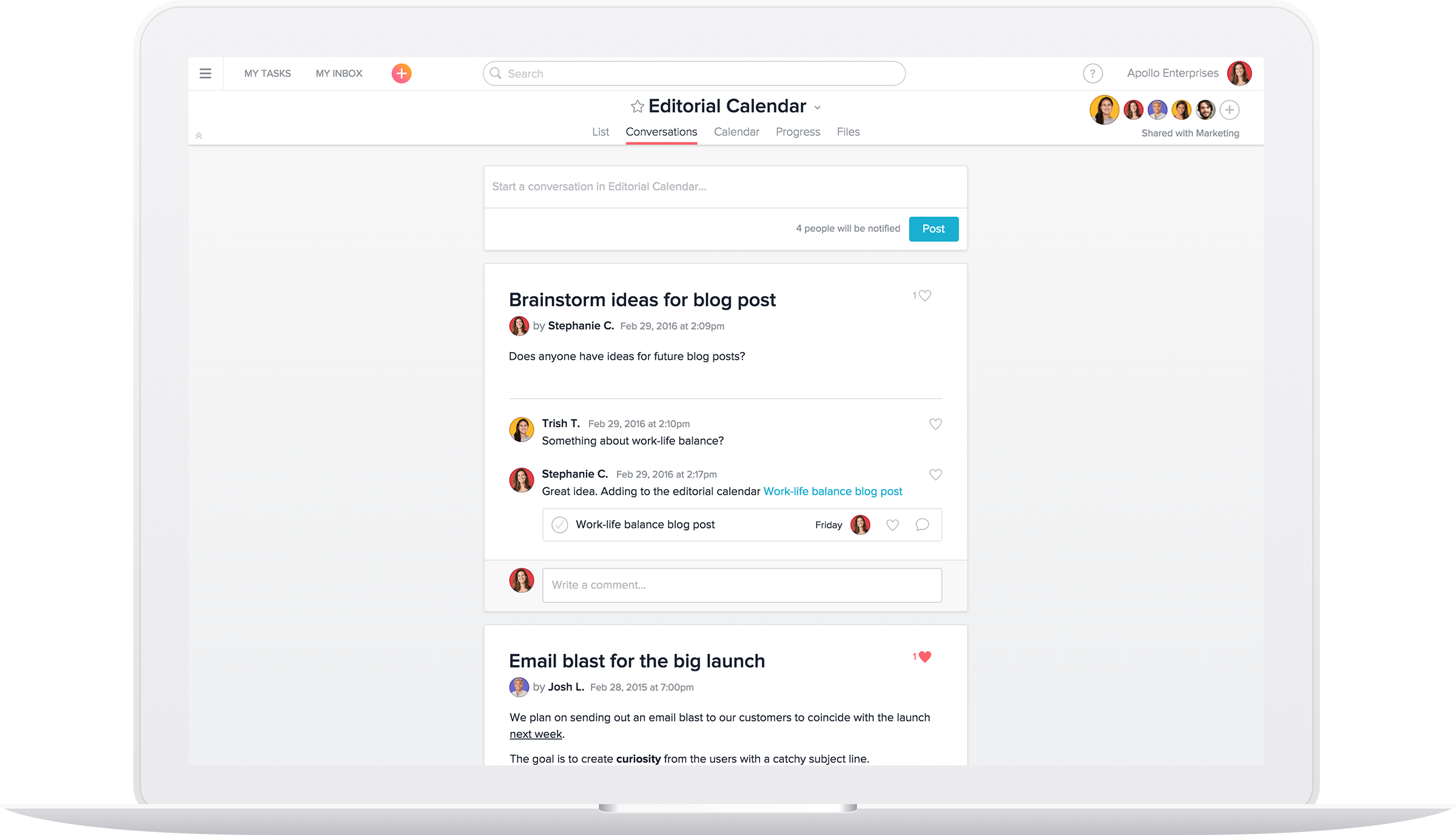
Asana is a web and mobile project management app. With tasks, projects, conversations, and dashboards, Asana lets an entire team know who's doing what by when, enabling workload balancing. Users can also add integrations for GANTT charts, time tracking and more.
$13.49
per month per user
monday.com
Score8.6 out of 10
Mid-Size Companies (51-1,000 employees)
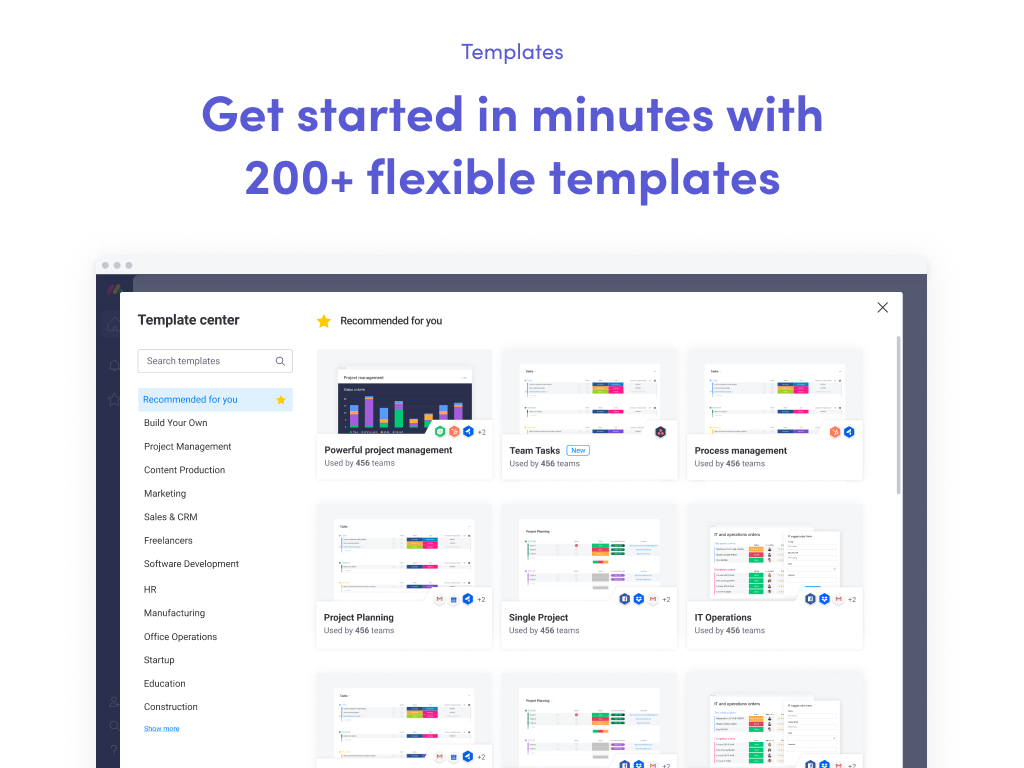
monday.com Work OS is an open platform designed so that anyone can create the tools they need to run all aspects of their work. It includes ready-made templates or the ability to customize any work solution ranging from sales pipelines to marketing campaigns, CRMs, and project tracking.
$36
per month (3 seats)
Pricing
Asana
monday.com
Editions & Modules
Starter
$13.49
per month per user
Advanced
$30.49
per month per user
Enterprise
Contact Sales
Personal
Free
Basic
$12
per month per user
Standard
$14
per month per user
Pro
$24
per month per user
Enterprise
Contact Sales
Contact us
Offerings
Pricing Offerings
Asana
monday.com
Free Trial
Yes
Yes
Free/Freemium Version
Yes
Yes
Premium Consulting/Integration Services
Yes
Yes
Entry-level Setup Fee
Optional
No setup fee
Additional Details
A discount is offered for annual billing.
Yearly plan: Save 18%
Monthly plan also available
More Pricing Information
Community Pulse
Asana
monday.com
Considered Both Products
Asana
Verified User
Chose Asana
Look and feel of monday.com is better, but Asana has more features and capabilities making it the better option.
A de minimis incentive was given to thank the reviewer for their time. The incentive was not used to bias or drive a particular response, nor was the incentive contingent on a positive endorsement. More Info
Owner and CEO at Western Independent Media Developers/BKThemes (Internet, 1-10 employees)
Chose Asana
Side by side with the other two Asana by far beats monday.com and is comparable and slightly better than ClickUp. Monday is completely browser-based and is hard to navigate and figure out how to set up. Asana and ClickUp are the exact opposite. Both are easy to set up and …
A de minimis incentive was given to thank the reviewer for their time. The incentive was not used to bias or drive a particular response, nor was the incentive contingent on a positive endorsement. More Info
Verified User
Chose Asana
We selected ASANA based on the feature set, and ease of rollout. monday.com had very good workflow automation but we found that ASANA was quicker and easier for staff to build a task eco-system that worked for them.
Zoho Projects was a very strong contender but was much more …
A de minimis incentive was given to thank the reviewer for their time. The incentive was not used to bias or drive a particular response, nor was the incentive contingent on a positive endorsement. More Info
Verified User
Chose Asana
I prefer Asana's user interface over monday.com. Asana's app is also incredibly helpful and I am not sure if monday.com's app is as loaded with features as Asana's is.
A de minimis incentive was given to thank the reviewer for their time. The incentive was not used to bias or drive a particular response, nor was the incentive contingent on a positive endorsement. More Info
Verified User
Chose Asana
Personally, I didn't have a say in this as I had not started at the company when the team decided on Asana. That said, I have used monday.com, and we also have JIRA, which is used by our dev team, and us occasionally if we need to. JIRA has too many bells and whistles and is …
A de minimis incentive was given to thank the reviewer for their time. The incentive was not used to bias or drive a particular response, nor was the incentive contingent on a positive endorsement. More Info
Audio Engineer/ Editor at VideoBranch (Media Production, 1-10 employees)
Chose Asana
Asana is simpler and easier to manage than Teamwork Projects and Wrike for smaller teams, but still offers more features than Basecamp and requires a lot less customization than monday.com.
A de minimis incentive was given to thank the reviewer for their time. The incentive was not used to bias or drive a particular response, nor was the incentive contingent on a positive endorsement. More Info
Verified User
Chose Asana
The pricing point my understanding is better, we do have the enterprise level
A de minimis incentive was given to thank the reviewer for their time. The incentive was not used to bias or drive a particular response, nor was the incentive contingent on a positive endorsement. More Info
Full-stack Software Engineer in Information Technology at Grameen Solutions (Information Technology & Services, 11-50 employees)
Chose Asana
Asana is a top-tier project management software that helps us organize and track projects from start to finish. It allows us to apply tasks/to-dos to multiple projects without duplication, divide complex projects into smaller tasks, and track project progress. It also helps us …
A de minimis incentive was given to thank the reviewer for their time. The incentive was not used to bias or drive a particular response, nor was the incentive contingent on a positive endorsement. More Info
Verified User
Chose Asana
Some features are better; some are too much. Not huge differences.
A de minimis incentive was given to thank the reviewer for their time. The incentive was not used to bias or drive a particular response, nor was the incentive contingent on a positive endorsement. More Info
Brand Development & Culture Specialist in Corporate at SIRIUScreator (Graphic Design, 1-10 employees)
Chose Asana
I like how extensive the capabilities are for Asana. With other softwares it seems there are many things lacking. I feel like Asana is also a very user friendly platform and aesthetically pleasing which is important in a modern office. We have many young people entering our …
A de minimis incentive was given to thank the reviewer for their time. The incentive was not used to bias or drive a particular response, nor was the incentive contingent on a positive endorsement. More Info
A de minimis incentive was given to thank the reviewer for their time. The incentive was not used to bias or drive a particular response, nor was the incentive contingent on a positive endorsement. More Info
Verified User
Chose Asana
Asana does well at the assignment of tasks and task management, but it is not a resource planning tool. Other tools do better at resource planning and some principles of agile/scrum. It is simple and easy to use within the mobile application and on desktop, but it doesn't have …
A de minimis incentive was given to thank the reviewer for their time. The incentive was not used to bias or drive a particular response, nor was the incentive contingent on a positive endorsement. More Info
Director of Human Resources in Human Resources at National School Project (Non-Profit Organization Management, 51-200 employees)
Chose Asana
Asana hit our sweet spot of easy to try, appropriate pricing for our mid size non-profit team, flexibility, and features. Lots of other platforms have very similar features organized in other ways, but Asana made sense and was fun to work with right off the bat. there were …
A de minimis incentive was given to thank the reviewer for their time. The incentive was not used to bias or drive a particular response, nor was the incentive contingent on a positive endorsement. More Info
Verified User
Chose Asana
Asana is more complex than other alternatives that we have used within the organization, but is great for organizations with upwards of 10 people inside a department
A de minimis incentive was given to thank the reviewer for their time. The incentive was not used to bias or drive a particular response, nor was the incentive contingent on a positive endorsement. More Info
Verified User
Chose Asana
Asana has a better user experience and user interface than other project management software I have used. It is much easier to learn than the other products, and I have been able to customize its use in better ways than I have accomplished with others. Much more than a to-do …
A de minimis incentive was given to thank the reviewer for their time. The incentive was not used to bias or drive a particular response, nor was the incentive contingent on a positive endorsement. More Info
Assistant Professor in Information Technology at Chitkara University (Education Management, 501-1000 employees)
Chose Asana
Asana stack over its various major competitors as its costing is quite under budget. The support to user is 24 x 7 and call centers available. The mail reply within 24 hours. Apart from it its user community is quite big and helps in the system to grow. It is widely accepted in …
A de minimis incentive was given to thank the reviewer for their time. The incentive was not used to bias or drive a particular response, nor was the incentive contingent on a positive endorsement. More Info
Verified User
Chose Asana
Asana is lightweight and relatively inexpensive. For our marketing and advertising team, it works great. For teams with stricter needs (development teams, product teams, and other scrum teams), looking at other options might be worthwhile.
A de minimis incentive was given to thank the reviewer for their time. The incentive was not used to bias or drive a particular response, nor was the incentive contingent on a positive endorsement. More Info
Senior Director of Product Experience in Research & Development at WuXi NextCODE (Biotechnology, 501-1000 employees)
Chose Asana
There were a combination of factors that led us to decide on Asana, including ease of use and external system integrations, but primarily we could use it across geographically distributed offices successfully and incorporate a variety of end user work flows based on global …
A de minimis incentive was given to thank the reviewer for their time. The incentive was not used to bias or drive a particular response, nor was the incentive contingent on a positive endorsement. More Info
Lead Graphic Design Specialist/ Social Media Marketer in Marketing at CyberCartel International Inc. (Retail, 51-200 employees)
Chose Asana
Asana and Monday are similar in that they are both task tracking softwares however I feel that Asana is a bit too simple for our team as opposed to Monday. Asana is great for a small to medium sized team, we are looking for a software that we can use across multiple departments …
A de minimis incentive was given to thank the reviewer for their time. The incentive was not used to bias or drive a particular response, nor was the incentive contingent on a positive endorsement. More Info
monday.com
Verified User
Chose monday.com
It's been a while since trying Asana, so it's hard to say. I think they are very similar from what I remember, but maybe monday.com has more reporting and customization possibilities?
A de minimis incentive was given to thank the reviewer for their time. The incentive was not used to bias or drive a particular response, nor was the incentive contingent on a positive endorsement. TR verified that a representative sample of customers was invited. More Info
Customer Operations Enablement Manager in Customer Service at Telesign (Computer Software, 501-1000 employees)
Chose monday.com
When I arrived at my org, I was initially disappointed to hear that we used something other than Asana for project management. Fast forward just a few months, and I became a complete monday.com convert. While its organization is similar to Asana's, it's user interface, …
A de minimis incentive was given to thank the reviewer for their time. The incentive was not used to bias or drive a particular response, nor was the incentive contingent on a positive endorsement. TR verified that a representative sample of customers was invited. More Info
Verified User
Chose monday.com
I would say this is one of my least favorite applications. I don't find it super user friendly due to the extreme amounts of customization. It feels like my information is in there somewhere, but I can never find it easily. I think that it looks a lot prettier than Asana which …
A de minimis incentive was given to thank the reviewer for their time. The incentive was not used to bias or drive a particular response, nor was the incentive contingent on a positive endorsement. TR verified that a representative sample of customers was invited. More Info
Verified User
Chose monday.com
monday.com seems to solve the issues and concerns for our marketing and graphics needs. I personally use Asana for my projects and tracking purposes and monday.com for my interations with Marketing and their needs.
A de minimis incentive was given to thank the reviewer for their time. The incentive was not used to bias or drive a particular response, nor was the incentive contingent on a positive endorsement. More Info
Verified User
Chose monday.com
I think monday.com is a more complete tool than Asana or Trello. It has many more features and help for many other things, such as integrations and automations.
I didn't select monday.com. The company where I work did it and I don't really know why.
A de minimis incentive was given to thank the reviewer for their time. The incentive was not used to bias or drive a particular response, nor was the incentive contingent on a positive endorsement. TR verified that a representative sample of customers was invited. More Info
Account Manager in Sales at Ancestra, Lda (Printing, 11-50 employees)
Chose monday.com
I didn't use Asana that much, and I kind of liked it, but the visuals of Monday.com are just way more appealing. Also, I found Monday's customisation and adaptability stronger and easier than Asana's.
A de minimis incentive was given to thank the reviewer for their time. The incentive was not used to bias or drive a particular response, nor was the incentive contingent on a positive endorsement. More Info
Marketing Operations in Marketing at Impartner Software (Computer Software, 51-200 employees)
Chose monday.com
Smartsheet does more than we needed it to do for our simple project management. JIRA is the same way. Asana and Trello are probably the closest comparisons for our needs. Both of these others are great, and I don't have any real complaints to compare on any of these. Monday.com …
A de minimis incentive was given to thank the reviewer for their time. The incentive was not used to bias or drive a particular response, nor was the incentive contingent on a positive endorsement. More Info
Data Czar in Engineering at Envisagenics, Inc. (Biotechnology, 11-50 employees)
Chose monday.com
Easier to use than JIRA. Assigning tasks and creating stories are easier. easier to view in Kanban compared to JIRA. Asana comparison is about the same. But more visibility with status of tasks than Asana. Interface is easier to use compared to Trello
A de minimis incentive was given to thank the reviewer for their time. The incentive was not used to bias or drive a particular response, nor was the incentive contingent on a positive endorsement. More Info
Founder+CEO in Corporate at Wild Me (Apparel & Fashion, 11-50 employees)
Chose monday.com
overall, the diverse views and customization put monday.com ahead of the other platforms because its tailored for each individual. Asana is a great to do list platform, but lacks features that are needed to manage a project. click up is a great free platform, but lacks the …
A de minimis incentive was given to thank the reviewer for their time. The incentive was not used to bias or drive a particular response, nor was the incentive contingent on a positive endorsement. More Info
Verified User
Chose monday.com
I like that monday.com has automations so that I can set myself a reminder if tasks are not completed by the due date. Monday.com also makes it easy to replicate or copy boards, as well as the customization opportunities. Monday.com makes it easy to break down a project into …
A de minimis incentive was given to thank the reviewer for their time. The incentive was not used to bias or drive a particular response, nor was the incentive contingent on a positive endorsement. More Info
Business Analyst Team Lead at Cloudpay (Financial Services, 1001-5000 employees)
Chose monday.com
monday.com offer much of the standard tools and seems to be ever evolving. They seem to take feedback and constantly upgrade the tools. If all the tools are there, the differentiating factor might be the cost, any integrations you may need, and the visual "chemistry". To me, …
A de minimis incentive was given to thank the reviewer for their time. The incentive was not used to bias or drive a particular response, nor was the incentive contingent on a positive endorsement. TR verified that a representative sample of customers was invited. More Info
Verified User
Chose monday.com
I also use the other selected. But I prefer monday.com because it is more clear (visually and intuitively), and also because I have been using it for longer than the others. However, there is the price factor that must be taken into consideration
A de minimis incentive was given to thank the reviewer for their time. The incentive was not used to bias or drive a particular response, nor was the incentive contingent on a positive endorsement. TR verified that a representative sample of customers was invited. More Info
Solution Engineer in Customer Service at Msquare Automation Solutions (Information Technology & Services, 11-50 employees)
Chose monday.com
As a developer, I have utilized the mentioned apps to integrate processes for clients, and I have found monday.com to be superior due to its abundance of features compared to others. Choosing monday.com provides enough capabilities for teams and managers to handle work in one …
A de minimis incentive was given to thank the reviewer for their time. The incentive was not used to bias or drive a particular response, nor was the incentive contingent on a positive endorsement. More Info
Managing Director in Professional Services at Insodus Technologies OÜ (Information Technology & Services, 1-10 employees)
Chose monday.com
I'd put monday.com and Asana on par, then ClickUp and lastly Jira. Jira would be more appropriate for exclusively technology engineering teams. Jotform offers better choices for forms use cases especially ones with complexity. Zoho makes more sense when you have the full suite, …
A de minimis incentive was given to thank the reviewer for their time. The incentive was not used to bias or drive a particular response, nor was the incentive contingent on a positive endorsement. More Info
Gerente de Projetos in Marketing at Escola de Investimentos (E-Learning, 11-50 employees)
Chose monday.com
Is far away the best!! With monday.com I find everything I need easily. As I said before, its user-friendly interface, which is intuitive and easy to navigate.
A de minimis incentive was given to thank the reviewer for their time. The incentive was not used to bias or drive a particular response, nor was the incentive contingent on a positive endorsement. More Info
Executive Pastor in Corporate at Bridge Church (Religious Institutions, 1-10 employees)
Chose monday.com
Although monday.com costs more than the other services, it can handle more as a platform. The functions, features, integrations, and automations allow you to do so much more than, than just keeping track of project & task deadlines.
A de minimis incentive was given to thank the reviewer for their time. The incentive was not used to bias or drive a particular response, nor was the incentive contingent on a positive endorsement. TR verified that a representative sample of customers was invited. More Info
A de minimis incentive was given to thank the reviewer for their time. The incentive was not used to bias or drive a particular response, nor was the incentive contingent on a positive endorsement. TR verified that a representative sample of customers was invited. More Info
Verified User
Chose monday.com
Monday.com makes team collaboration very easy and smooth.
A de minimis incentive was given to thank the reviewer for their time. The incentive was not used to bias or drive a particular response, nor was the incentive contingent on a positive endorsement. More Info
Verified User
Chose monday.com
We have tried many other project management programs. In the end, we were able to customize Monday more easily to fit our team's needs and handle more things in Monday than the others. It's nice to have everything in one place (campaign planning, team task lists, upcoming …
A de minimis incentive was given to thank the reviewer for their time. The incentive was not used to bias or drive a particular response, nor was the incentive contingent on a positive endorsement. More Info
A de minimis incentive was given to thank the reviewer for their time. The incentive was not used to bias or drive a particular response, nor was the incentive contingent on a positive endorsement. More Info
Energy Efficiency Consultant in Engineering at SEMCO (Renewables & Environment, 51-200 employees)
Chose monday.com
Basecamp has some very nice project management features but Monday.com really focuses on task management and keeping teams accountable/organized. We fell in love with the visual task boards that Monday.com offers and that's why we chose to go with it. We also really enjoyed …
A de minimis incentive was given to thank the reviewer for their time. The incentive was not used to bias or drive a particular response, nor was the incentive contingent on a positive endorsement. More Info
Marketing Content Manager in Marketing at Impartner Software (Computer Software, 51-200 employees)
Chose monday.com
Monday.com has a lot of functionality and visibility that the other tech we've used did not. the notifications and ease of adding new tasks and projects are also better than the other tech we have used.
A de minimis incentive was given to thank the reviewer for their time. The incentive was not used to bias or drive a particular response, nor was the incentive contingent on a positive endorsement. More Info
Web designer in Information Technology at EstrenarVivienda.com (Information Technology and Services, 1-10 employees)
Chose monday.com
monday.com includes the basic features from most project management apps: task management, collaboration, boards, messaging and so on. Also, the app excels in making multiple technical tools available in a single app, like Gantt, Kanban, and task management. Where you cannot …
A de minimis incentive was given to thank the reviewer for their time. The incentive was not used to bias or drive a particular response, nor was the incentive contingent on a positive endorsement. More Info
Verified User
Chose monday.com
Monday.com is much easier to use and isn't as complex. We didn't need a complex project management tool for what we are using it for, and monday.com is perfect for that.
A de minimis incentive was given to thank the reviewer for their time. The incentive was not used to bias or drive a particular response, nor was the incentive contingent on a positive endorsement. More Info
Verified User
Chose monday.com
Candidly, we still use both as monday.com and Smartsheet, as monday.com only recently added dependencies, and that was integral to our proposal and pricing process.
A de minimis incentive was given to thank the reviewer for their time. The incentive was not used to bias or drive a particular response, nor was the incentive contingent on a positive endorsement. More Info
The usability of Asana is broad since it's available in a variety of platforms that are widely used nowadays. I think that it would be great for people who are constantly on the move and switching devices, since it has allowed me to work from my phone, too. I also think that Asana has proven itself to handle a large quantity of work
The platform is very well suited for our nonprofit programs that serve low-income clients who need diapers, wipes, and period products. It has helped us run our programs, capturing information and allowing us to view the data for reporting purposes. The ability to filter data is very helpful by allowing us to categorize information to get a better picture of the progress of our programs.
A de minimis incentive was given to thank the reviewer for their time. The incentive was not used to bias or drive a particular response, nor was the incentive contingent on a positive endorsement. TR verified that a representative sample of customers was invited. More Info
Through it, we were able to communicate and cooperate with the rest of the team to complete the work in the required manner and at the appropriate time.
I like summary of subitems, especially with subitasks as subitems and add item tracking for each subtask it can show total tracked in parent item. Similar with other columns, like numbers, status, date.
Dashboard features, Many kinds of dashboard view available, we can utilize on the basis of requirements.
monday.com workform is very powerful, easily share form link when submitted it will create line item in board with provided data.
monday.com automation is very helpful in order to automate steps with specific rules and easy setup.
monday.com also provides integrations in order to automate processes if need to integrate multiple app together. or need to transfer data between multiple apps.
A de minimis incentive was given to thank the reviewer for their time. The incentive was not used to bias or drive a particular response, nor was the incentive contingent on a positive endorsement. More Info
The desktop app for Mac seems to have a few issues with visual glitches appearing on screen, it only seems to go away when I close the tool and reopen it
Subtasks don't show on the individual users to-do list, only main level tasks
A de minimis incentive was given to thank the reviewer for their time. The incentive was not used to bias or drive a particular response, nor was the incentive contingent on a positive endorsement. TR verified that a representative sample of customers was invited. More Info
A de minimis incentive was given to thank the reviewer for their time. The incentive was not used to bias or drive a particular response, nor was the incentive contingent on a positive endorsement. More Info
Teams involved in content creation, such as marketing or editorial teams, could use monday.com to manage the entire content lifecycle. Boards might track content ideas, assignments, drafts, reviews, approvals, and publication schedules, helping teams collaborate and keep content production on track.
A de minimis incentive was given to thank the reviewer for their time. The incentive was not used to bias or drive a particular response, nor was the incentive contingent on a positive endorsement. More Info
I give monday.com a 10/10 because I almost never encounter any lag or connectivity issues despite all of the many templates, boards, and automations we have. As a matter of fact, I feel like the last issue I encountered was over a year ago... and I'm in monday.com every single work day. Not only is monday trustworthy, it is easy to find what I'm looking for... making the overall usability extremely hard to beat.
A de minimis incentive was given to thank the reviewer for their time. The incentive was not used to bias or drive a particular response, nor was the incentive contingent on a positive endorsement. TR verified that a representative sample of customers was invited. More Info
A de minimis incentive was given to thank the reviewer for their time. The incentive was not used to bias or drive a particular response, nor was the incentive contingent on a positive endorsement. More Info
Everything performs fairly well. Every now and then there are user errors where an employee will not click "ok" on a note they've created and simply exit out (I do wish that something was in place to prevent this, such as a pop "are you finished?")
A de minimis incentive was given to thank the reviewer for their time. The incentive was not used to bias or drive a particular response, nor was the incentive contingent on a positive endorsement. More Info
I haven't had to use their support so I can't rate it. The fact that I haven't needed them reflects the ease of use of the product. I would recommend that any new users schedule a complete demo of the product to ensure that they are using it to it's fullest (there's a lot of useful features).
A de minimis incentive was given to thank the reviewer for their time. The incentive was not used to bias or drive a particular response, nor was the incentive contingent on a positive endorsement. More Info
monday.com only really care about accounts that have 20 seats or more. While this is great for monday.com, it pushes smaller organisations to evaluate alternatives. We rate monday.com highly in our organisation because key staff have already got good experience with the application and we know we will get to 20+ seats one day. But, till then the billing model and lack of permanent enterprise features is a dread.
A de minimis incentive was given to thank the reviewer for their time. The incentive was not used to bias or drive a particular response, nor was the incentive contingent on a positive endorsement. More Info
To have someone walk you thru the features and capabilities of Monday.com is priceless. Someone also coming along later in the contract to see if you are maximizing the program to suit your company needs is beyond helpful. The staff that have provided this training are fun, creative and very patient.
A de minimis incentive was given to thank the reviewer for their time. The incentive was not used to bias or drive a particular response, nor was the incentive contingent on a positive endorsement. More Info
We signed up for the accounts. Created the accounts. Ran the trial version and tested it live while we were running multiple projects and found that it was fitting our needs perfectly. When the trial ended and we were asked to purchase the full version, we did. We have found other ways to use it and it's a breeze.
A de minimis incentive was given to thank the reviewer for their time. The incentive was not used to bias or drive a particular response, nor was the incentive contingent on a positive endorsement. More Info
Asana is a top-tier project management software that helps us organize and track projects from start to finish. It allows us to apply tasks/to-dos to multiple projects without duplication, divide complex projects into smaller tasks, and track project progress. It also helps us organize work on Kanban boards or linear lists. It stands out from the crowd in a big way compared to the competition.
monday.com is simpler and easier to grasp, apply and navigate than ClickUp, but the ClickUp free version has so much more functionality available than the monday.com free / low-cost options (sorry, but it's true!). Google Tasks is really simple and I shouldn't really compare them - it's just really nice to be able to see my tasks right next to my Google Calendar or Gmail (widget) - the "all on one" view on the screen is really nice ease of access, but the power of monday.com outweighs the nice-to-have of an all-in-one screen layout - it feels clumsy to bring in all my Calendar items from Google to monday.com, so an integration app to the Google screen where you can see monday.com tasks would be amazing.
A de minimis incentive was given to thank the reviewer for their time. The incentive was not used to bias or drive a particular response, nor was the incentive contingent on a positive endorsement. More Info
For it to work across multiple departments and sites, I would like to see improvements made with integrations and automation. For this question, I am acknowledging not only the addition of internal triggers/automation, but also an expansion on external ones.
A de minimis incentive was given to thank the reviewer for their time. The incentive was not used to bias or drive a particular response, nor was the incentive contingent on a positive endorsement. More Info
A de minimis incentive was given to thank the reviewer for their time. The incentive was not used to bias or drive a particular response, nor was the incentive contingent on a positive endorsement. More Info
A de minimis incentive was given to thank the reviewer for their time. The incentive was not used to bias or drive a particular response, nor was the incentive contingent on a positive endorsement. More Info