Cisco ThousandEyes empowers organizations to assure every digital experience across every network, everywhere, every time.
N/A
PingPlotter
Score9.3 out of 10
N/A
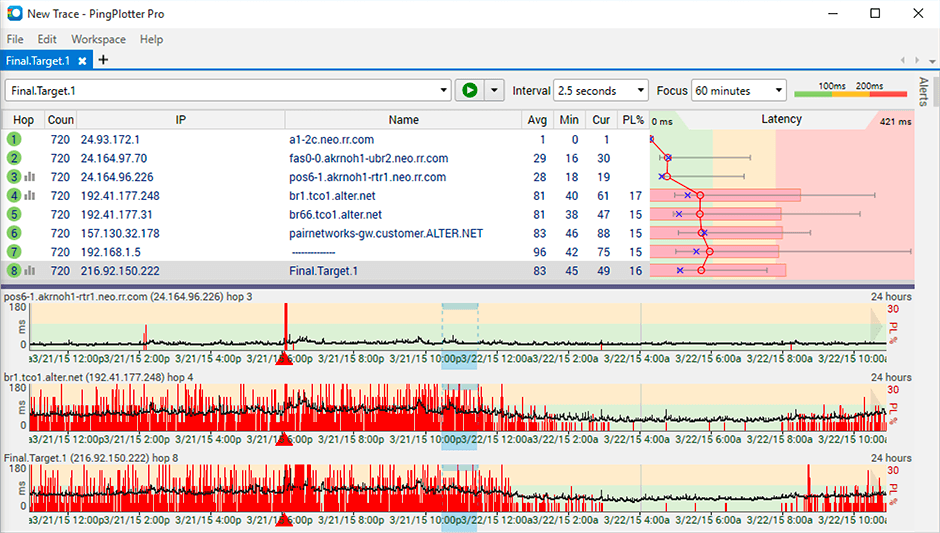
PingPlotter is a graphical traceroute and ping tool that visualizes network performance in a way that makes identifying the source of problems quicker and easier for everyone from online gamers and video streamers to VoIP admins and IT pros. Features for remote deployment, network monitoring, scripting, and a web interface are included along with several additional capabilities.
A de minimis incentive was given to thank the reviewer for their time. The incentive was not used to bias or drive a particular response, nor was the incentive contingent on a positive endorsement. More Info
Unified communications real-time analysis is one of the biggest points of the solution. You can see your traffic path and find issues before, during and after the calls. This is very useful for analyzing VoIP and video conferencing problems like in WebEx, Microsoft Teams and Zoom. It helps to see network issues like packet loss, jitter, or latency that can make call quality bad. Another good use case is checking cloud apps and SaaS services. Many companies use external platforms like Microsoft Azure, 365, Salesforce, or AWS. It lets Networking teams see the network path from users to these services so they can find if problems come from the company network, the internet provider, or the cloud service. Also, it is good for companies using mix of on-prem and cloud. It shows how traffic moves between different parts of the network, so IT teams can see where a problem happens and fix it faster. There are different types of agents that we can use in Cisco ThousandEyes. Enterprise agents can be use for a relative big amount of synthetic test. Endpoint agents are install in user PC or MAC laptops to check network quality from the client side. WebEx devices also have built-in agents that help to see performance problems in meetings, making it easy to find what is causing a bad call. Maybe it's not the best solution if what you want to measure is not HTTPs based or hasn't an API. Also if your scenario is Zoom Rooms, you won't have the same level of integration that it has for WebEx and Microsoft solutions.
A de minimis incentive was given to thank the reviewer for their time. The incentive was not used to bias or drive a particular response, nor was the incentive contingent on a positive endorsement. More Info
It is well suited for performing monitoring and testing from a single device. It is less appropriate if you have to monitor from multiple different endpoints. That type of deployment would be more of an enterprise application. If you are looking for an end user monitoring solution then PingPlotter is the one for you.
A de minimis incentive was given to thank the reviewer for their time. The incentive was not used to bias or drive a particular response, nor was the incentive contingent on a positive endorsement. More Info
Cisco ThousandEyes does the holistic discovery of the end components, the network components, and it's really fast at identifying where the issue is, which is not normally identified by the classic monitoring tools. So it's quite a fast identifying the issue of the networks and Cisco ThousandEyes also provides a very good real user end user monitoring experience for the end customers. So those are the two real life and also very good examples for Cisco ThousandEyes.
A de minimis incentive was given to thank the reviewer for their time. The incentive was not used to bias or drive a particular response, nor was the incentive contingent on a positive endorsement. More Info
The elephant in the room is going to be cost. ThousandEyes is a great tool, but you will pay for it. There are other services that do a good job at providing a smaller subset of features compared to ThousandEyes. If all you need is that particular subset of features, ThousandEyes may not make fiscal sense for your organization.
As a subset of the cost issue, within the last 18 months or so the pricing on enterprise (local) agents has been modified in a way that seems not to benefit the customer. Previously enterprise agents had a flat monthly cost associated with them with unlimited test usage (the only limit on test usage was based on concurrent tests running at any given point in time). This meant that instead of using a cloud agent and paying per-test, you had the option of spinning up an cheap Digital Ocean droplet and creating your own cloud agent for external testing without using Cloud Agents. When the change was made they eliminated the flat per-agent cost and instead treated the pricing the same as that of the cloud agents but cutting the number of "cloud units" per test in half for tests run from enterprise agents. For organizations with under-utilized enterprise agents, this may be helpful financially, but for organizations that push their local agents to the limit, the cost skyrocketed.
BGP monitor peering sessions have been less than reliable. The data doesn't seem to be an issue, but the sessions seem to bounce or fail altogether on a fairly consistent basis. The routers or servers with which your routers peer sit behind some firewalls that have caused issues in the past.
A de minimis incentive was given to thank the reviewer for their time. The incentive was not used to bias or drive a particular response, nor was the incentive contingent on a positive endorsement. More Info
Its a little confusing to see which targets are currently running pings and which ones are displayed in the plots.
Starting and stopping pings requires a right click and that would be better with a play/pause button I think.
Ability to drag and drop the graphs to reorder them.
more columns to show which targets are running and which are displayed. Currently this is done with symbols so you cant sort by just the running targets for example I've found.
A de minimis incentive was given to thank the reviewer for their time. The incentive was not used to bias or drive a particular response, nor was the incentive contingent on a positive endorsement. More Info
We will definitely renew and maybe even extend our usage of ThousandEyes. We have been using ThousandEyes now for a couple of years and it has shown us major benefits. With the new options it offers for SD-WAN for us it is a no brainer to renew our current licenses
A de minimis incentive was given to thank the reviewer for their time. The incentive was not used to bias or drive a particular response, nor was the incentive contingent on a positive endorsement. TR verified that a representative sample of customers was invited. More Info
There is definitely a learning curve to ThousandEyes, but once you understand how the client deployment works and how to set up monitoring, things go pretty smoothly. I think the initial setting up of clients on endpoints can be a little tricky though.
A de minimis incentive was given to thank the reviewer for their time. The incentive was not used to bias or drive a particular response, nor was the incentive contingent on a positive endorsement. More Info
I installed it and it just started working. I realized I could then tweak it to show what I needed but didn't have to spend a long time configuring it before use, editing YAML files etc. Maybe that's fine for a network professional, but I only need this software if something goes wrong, and then need it to work quickly out of the box.
A de minimis incentive was given to thank the reviewer for their time. The incentive was not used to bias or drive a particular response, nor was the incentive contingent on a positive endorsement. More Info
A de minimis incentive was given to thank the reviewer for their time. The incentive was not used to bias or drive a particular response, nor was the incentive contingent on a positive endorsement. More Info
A de minimis incentive was given to thank the reviewer for their time. The incentive was not used to bias or drive a particular response, nor was the incentive contingent on a positive endorsement. More Info
You have online support from the tool itself 24/7 and they are very responsive. We also have a specific account manager and specific engineer assigned to help us with very specific questions for our environment. The level of response to our requirements is always super high. We have requested specific features to be added and these have been developed and introduced very quick tot he product (within weeks). Their DevOps and agile approach seems to pay off.
A de minimis incentive was given to thank the reviewer for their time. The incentive was not used to bias or drive a particular response, nor was the incentive contingent on a positive endorsement. More Info
I have not had much contact with the PingPlotter support, only one time have I went to them and it was a positive experience. The questions I had were answered quickly and professionally. I have no issue with the experience I had with the Support team. This was from before and after the purchase of the product.
A de minimis incentive was given to thank the reviewer for their time. The incentive was not used to bias or drive a particular response, nor was the incentive contingent on a positive endorsement. More Info
Our Cisco reps actually had someone teach us a few things about the functionality of ThousandEyes, and it helped a lot. The training was good and we had follow-up assistance as well when we had questions about the monitoring and reporting functions. Overall, we were satisfied with the training and support.
A de minimis incentive was given to thank the reviewer for their time. The incentive was not used to bias or drive a particular response, nor was the incentive contingent on a positive endorsement. More Info
Our implementation was pretty straightforward, with some issues loading clients on endpoints. We didn't have any notable issues, and I don't really have any additional insights.
A de minimis incentive was given to thank the reviewer for their time. The incentive was not used to bias or drive a particular response, nor was the incentive contingent on a positive endorsement. More Info
Kentik Synthetics is a newer competitor of Cisco ThousandEyes. Both do very similar things but Cisco ThousandEyes currently is the more mature platform. However, the pricing of Synthetics is very attractive. It does not have the robustness of Cisco ThousandEyes or the off-net test leveraging (# of outside companies partnered with them) but has made many improvements in the past 2 years.
A de minimis incentive was given to thank the reviewer for their time. The incentive was not used to bias or drive a particular response, nor was the incentive contingent on a positive endorsement. TR verified that a representative sample of customers was invited. More Info
A balance of a generic tool vs a network equipment product is necessary when investigating network incidents or disruptions. Need to train the engineer to use both tools to perform their analysis and to dive down to the issues as fast as they can. Experience with the tools will continue to play a part if we were to adopt PingPlotter
A de minimis incentive was given to thank the reviewer for their time. The incentive was not used to bias or drive a particular response, nor was the incentive contingent on a positive endorsement. More Info
A de minimis incentive was given to thank the reviewer for their time. The incentive was not used to bias or drive a particular response, nor was the incentive contingent on a positive endorsement. More Info
I think this product would be infinitely scalable since it's all cloud hosted and can support thousands of endpoints if needed. We are only using it for a limited number of endpoints, so we never really considered scalability.
A de minimis incentive was given to thank the reviewer for their time. The incentive was not used to bias or drive a particular response, nor was the incentive contingent on a positive endorsement. More Info
Building the trust from our Merchants is core when you come to renewal time. Trust builds partnerships, builds stickiness and allows for easier upsells or contract renewals.
Having a champion in IT that touts your service is important to the business, it removes a large portion of friction in the business to get services implemented and working to its peak.
Flexibility in pricing can be better. How they measure the number of agents being used can get thorny. When you build and tear down virtual servers a lot it can appear there are more agents running than there are. Once we understood how they measure we were able to better utilize the product efficiently.
A de minimis incentive was given to thank the reviewer for their time. The incentive was not used to bias or drive a particular response, nor was the incentive contingent on a positive endorsement. More Info
A de minimis incentive was given to thank the reviewer for their time. The incentive was not used to bias or drive a particular response, nor was the incentive contingent on a positive endorsement. More Info