TrustRadius: an HG Insights company

OCI

Score8.9 out of 10

359 Reviews and Ratings

What is OCI?

Oracle Cloud Infrastructure (OCI) is Oracles's infrastructure-as-a-service (IaaS) platform which combines the utility of public cloud with the granular control, security, and predictability of on-premises infrastructure.

Media

Oracle Cloud Infrastructure Global Footprint
2-5x Faster Performance vs On-premises and Other Clouds (Storage Review)
One Cloud for the Most Intensive Enterprise and Infra-heavy Workloads
Gen 1 vs Gen 2 Cloud Advantage
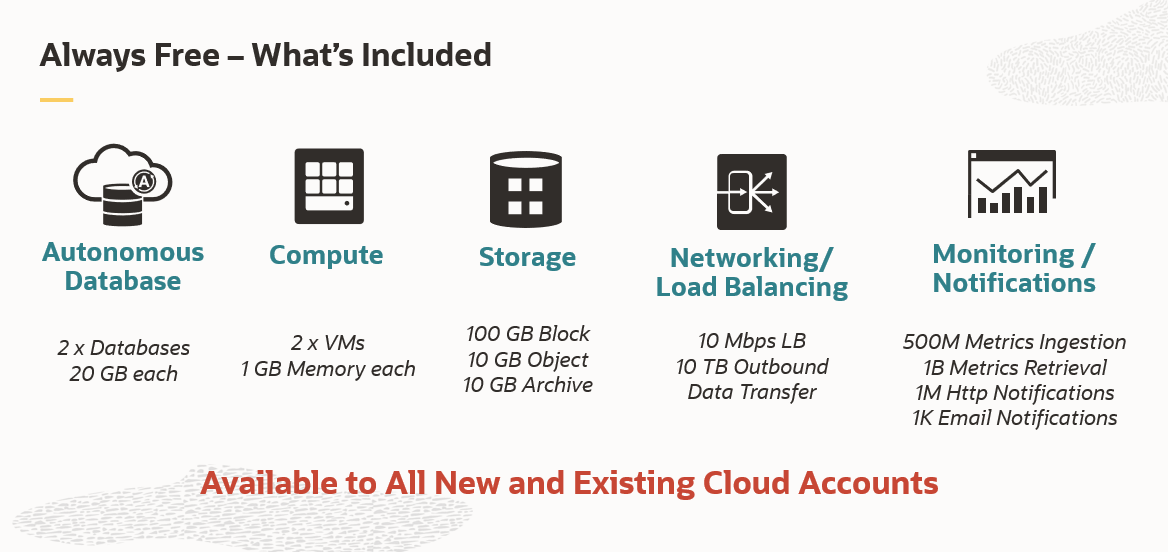
Always Free Services

1 / 5

Top Performing Features

  • Elastic load balancing

    Automatic balancing and distribution of resources across multiple virtual computers

    Category average: 8.5

  • Service-level Agreement (SLA) uptime

    The service uptime as a percentage defined in the SLA

    Category average: 8.6

  • Monitoring tools

    Monitoring tools provide alerts when problems are detected

    Category average: 7.9

Areas for Improvement

  • Security controls

    Compliance with security protocols like SSL and AES

    Category average: 8.1

  • Operating system support

    Range of operating systems available as pre-configured images

    Category average: 7.9

  • Pre-configured templates

    Pre-defined templates for virtual machines

    Category average: 7.6

Oracle Cloud Infrastructure

Use Cases and Deployment Scope

I am fairly new to using Oracle Cloud Infrastructure in my team. I started learning and using it when the requirement in my team was raised for many reason like scalability, pricing flexibility and security for oracle servers. We use Oracle Cloud Infrastructure for the pre-prod and Prod servers. Oracle provides a nice feasibility to manage VM instance and solutions for the resolving issues and growing need of business. So far its been a great experience.

Pros

  • Sacalibitly
  • Management
  • Availability
  • Cost Saving

Cons

  • Support team
  • Guide Documents

Return on Investment

  • OCI maintains an extensive compliance program
  • Data is encrypted for each customer
  • Customers can control the data they store

Other Software Used

Jenkins, Red Hat Ansible Automation Platform, Microsoft Visual Studio

Oracle Cloud Infrastructure - The Best Cloud Partner in todays world

Use Cases and Deployment Scope

We use Oracle Cloud Infrastructure as our cloud provider for one of the biggest supply chain provider organizations in the world. All our 500+ customers are hosted on Oracle Cloud Infrastructure, and everything is going as expected with it. Initially, we never had our own infra so we were dependent on customers' owned infra and managing each infrastructure from customer to customer for us was a critical task. So with Oracle Cloud Infrastructure, we hosted all our applications in one place and we are giving them as a SAAS product.

Pros

  • More Reliability and especially Oracle Database
  • Pricing is really impressive
  • UI is very easy to manage and has explanation for each step
  • Easily integrated to other clouds as well

Cons

  • They should introduce messaging queue like pub/sub or sqs
  • When major outage comes we see delay in communication from them
  • Customer support needs an improvement
  • MySQL and some more services

Return on Investment

  • First it generated a lot of income as we provide full service as SAAS.
  • Since we have all customers on one cloud, managing and applying fixes is very easy for us.
  • Customers are also happy because they had to spend a lot of money on having their own infra and managing that.

Alternatives Considered

Google Cloud Platform, AWS Cloud9 and Azure Cloud Services

Other Software Used

Azure Cloud Services, Splunk AppDynamics, Google Kubernetes Engine, IBM Cognos Analytics, IBM webMethods, Jenkins

Usability

Exploring New Horizons: Navigating Innovation with Oracle Cloud Infrastructure

Use Cases and Deployment Scope

We use the Oracle Cloud Infrastructure (OCI) as a virtualized environment to provide a save environment for testing new and emerging communication services like Virtual Private Network (VPN), Unified Communications (UC), or other tailored service offerings, which promotes rapid and agile service innovation and deployment leading to enhanced customer experiences and operational efficiency improvements.

Pros

  • Oracle Cloud Infrastructure Network Function Virtualization provides a secure and scalable environment for experimentation which enable performance and feasibility assessment of a service
  • Robust Security Features, including Identity and Access Management (IAM) and encryption
  • Ability to scale resource up or down on-demand eliminating significant upfront costs

Cons

  • Uniformity in design and user experience across all services to improve usability
  • more comprehensive step-by-step guides and usecase-specific tutorials
  • built-in cost monitoring enhancement for more proactive and control in expenses management

Return on Investment

  • Utilizing Oracle Cloud Infrastructure we can reduce time-to-market for new services by 30%
  • Oracle Cloud Infrastructure automation tools improves profitability by reducing operating costs by 25%
  • Oracle Cloud Infrastructure robust security controls and compliance certifications are instrumental in mitigating risk which evidence with a 40% decrease in security incicents-related costs

Alternatives Considered

Amazon Web Services, Google Cloud Platform and Microsoft Azure

Other Software Used

Red Hat OpenShift, Docker, Apache Spark, GitLab, Microsoft Power BI, Promethium Data Navigation System

Best in class for cloud services

Use Cases and Deployment Scope

We are extensively using Oracle Cloud Infrastructure in our organization which includes IaaS, SaaS and PaaS services. With Oracle Cloud Infrastructure we are easily able to deploy the applications without much involvement of other infrastructure team. With Oracle Cloud Infrastructure management of Databases is very easy and with autonomous databases, we don't have to worry about maintenance work like patches, backups etc.

Pros

  • Autonomous operations of databases without much human interventions.
  • Easy scalability of infrastructure like, compute, storage etc.
  • Highest security because of data encryption and data masking.

Cons

  • Oracle Cloud Infrastructure could provide better integration with third-party tools and applications.
  • Migration from legacy system is challenging with Oracle Cloud Infrastructure
  • Oracle Cloud Infrastructure is expensive for mid cap companies

Return on Investment

  • Less human resources are required to manage databases decreasing the overall IT budget.
  • With instant scalability, we dont have to make a projection about the requirement prior.
  • Easy to create and destroy instances saves overall infrastructure costs.

Alternatives Considered

Google Cloud Platform and Amazon Web Services

Other Software Used

Amazon Web Services, Microsoft Azure, Google Cloud Platform

Cost-effective cloud platform for Scalable Solutions

Use Cases and Deployment Scope

We used Oracle Cloud Infrastructure for Oracle Autonomous Data Warehouse for querying large datasets and its Database service for managing relational databases.

Business Problem Solution:

Handling changing traffic was a challenge for us and for this we needed dynamically scalable storage resources, which was achieved using Oracle Cloud Infrastructure.

We currently operate on environment where we are using Oracle Cloud Infrastructure for our new projects while also migrating the legacy systems.

Pros

  • Oracle Cloud Infrastructure helps you dynamically scale the compute and storage resources.
  • It offers competitive prices when compared to other providers, which is great plus. Also, the free tier is available which comes handy for running smaller instances or personal projects.
  • Oracle Autonomous Data Warehouse also integrates well with Oracle analytics and is useful for exploring and visualizing data fast.

Cons

  • Initial setup is time consuming and can be complex, there a longer learning curve for first timers.
  • Documentation provided is vast, which can seem inconsistent and also confusing at times.
  • The user interface could be improved to make it more user-friendly

Return on Investment

  • Using OAC has decreased the time in decision making, it has improved responsiveness of the investors.
  • There is a reduced dependency on Business teams for creating reports and manual analysis.
  • Support for scalable growth has reduced the total cost, since pricing based on consumption makes it cost-effective

Alternatives Considered

AWS Lambda and Amazon Elastic Compute Cloud (EC2)

Other Software Used

Amazon Elastic Compute Cloud (EC2), AWS Lambda