TrustRadius: an HG Insights company

IBM Turbonomic

Score9.2 out of 10

280 Reviews and Ratings

What is IBM Turbonomic?

IBM Turbonomic is a performance and cost optimization platform for public, private, and hybrid clouds used by cloud, infrastructure operations, and architecture to assure application performance while eliminating inefficiencies by dynamically resourcing applications through automated actions.


One of the key features of IBM Turbonomic is its ability to continuously adjust application resources in real time. By monitoring resource utilization and application performance, Turbonomic prevents performance degradation and overprovisioning. This dynamic adjustment ensures that applications receive the necessary resources when needed, which is crucial for maintaining optimal performance levels. Additionally, the platform automates resource decisions such as scaling and placement, allowing organizations to focus on strategic initiatives rather than manual resource management tasks.


IBM states that Turbonomic customers report an average 33% reduction in cloud and infrastructure waste without impacting application performance, and return-on-investment of 471% over three years over not using a cloud cost optimization solution. For organizations practicing FinOps, IBM Turbonomic helps accelerate the Optimize and Operation phases of the FinOps journey.


https://ibm.biz/Turbonomic_product_page


Media

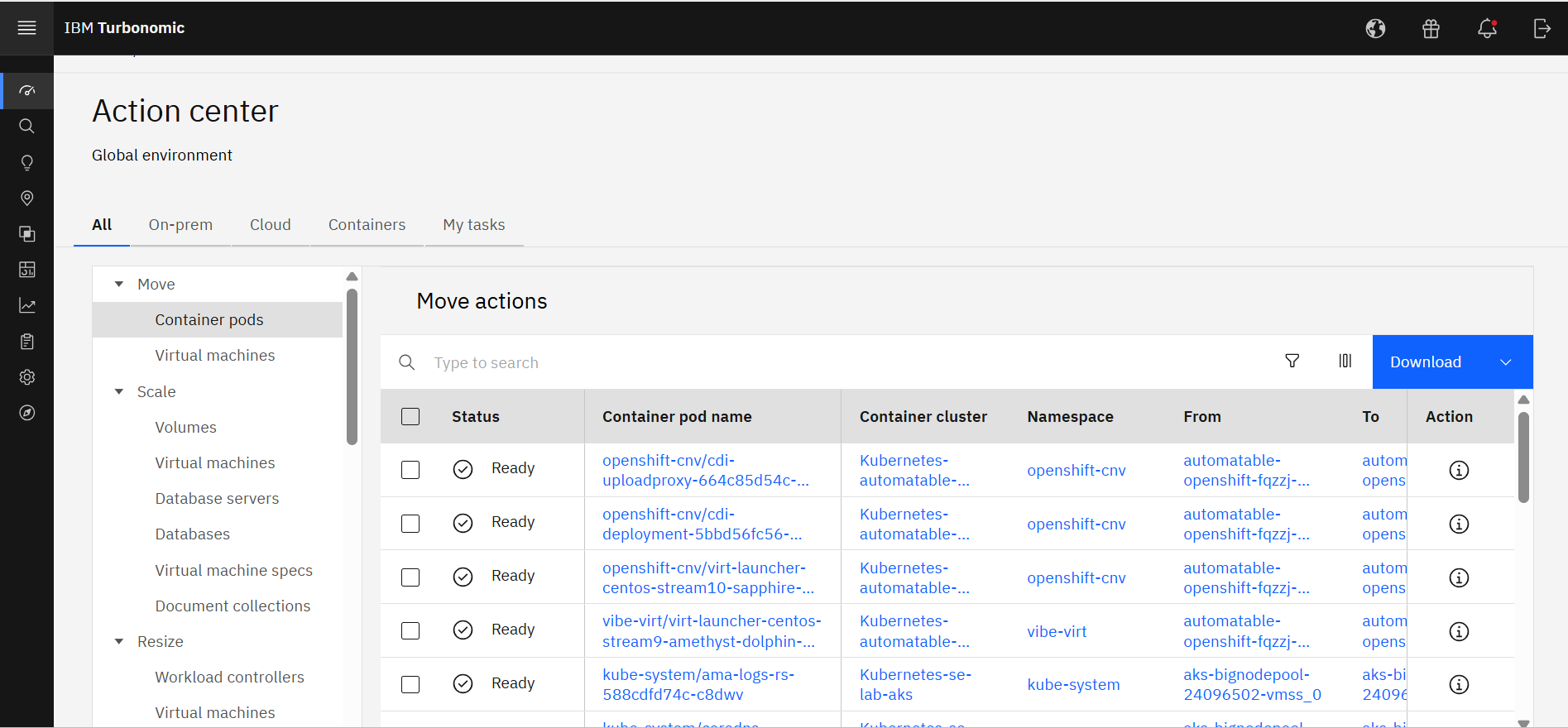
IBM Turbonomic Action Center, where it shows the list of optimization actions across the global environment—on-prem and cloud—that should be taken to minimize cost while assuring performance.
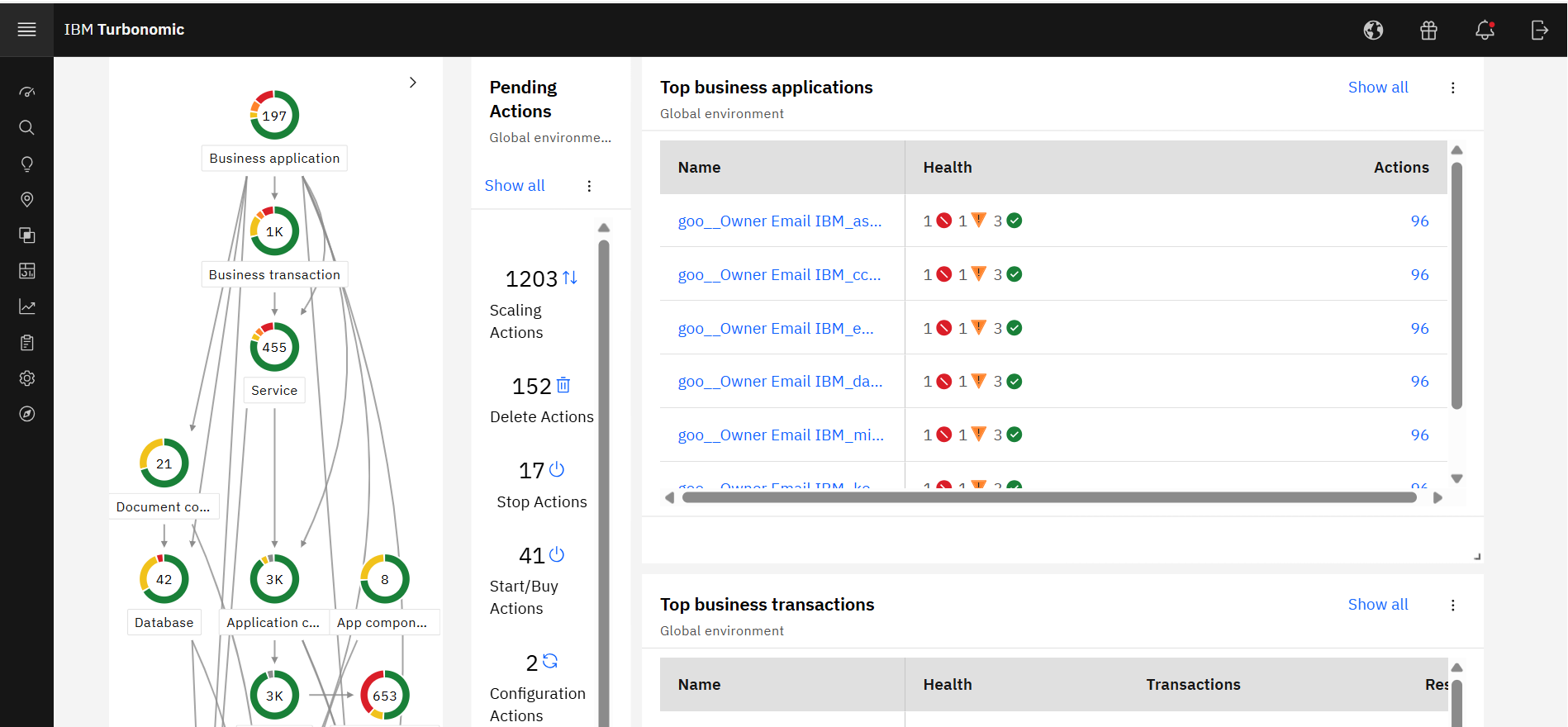
IBM Turbonomic Application, a view that shows the global environment across private and public infrastructure from the context of individual application components. Users can optimize one application at a time by viewing each app's pending actions. The Supply Chain at left shows all of the entities across applications and their interdependencies.
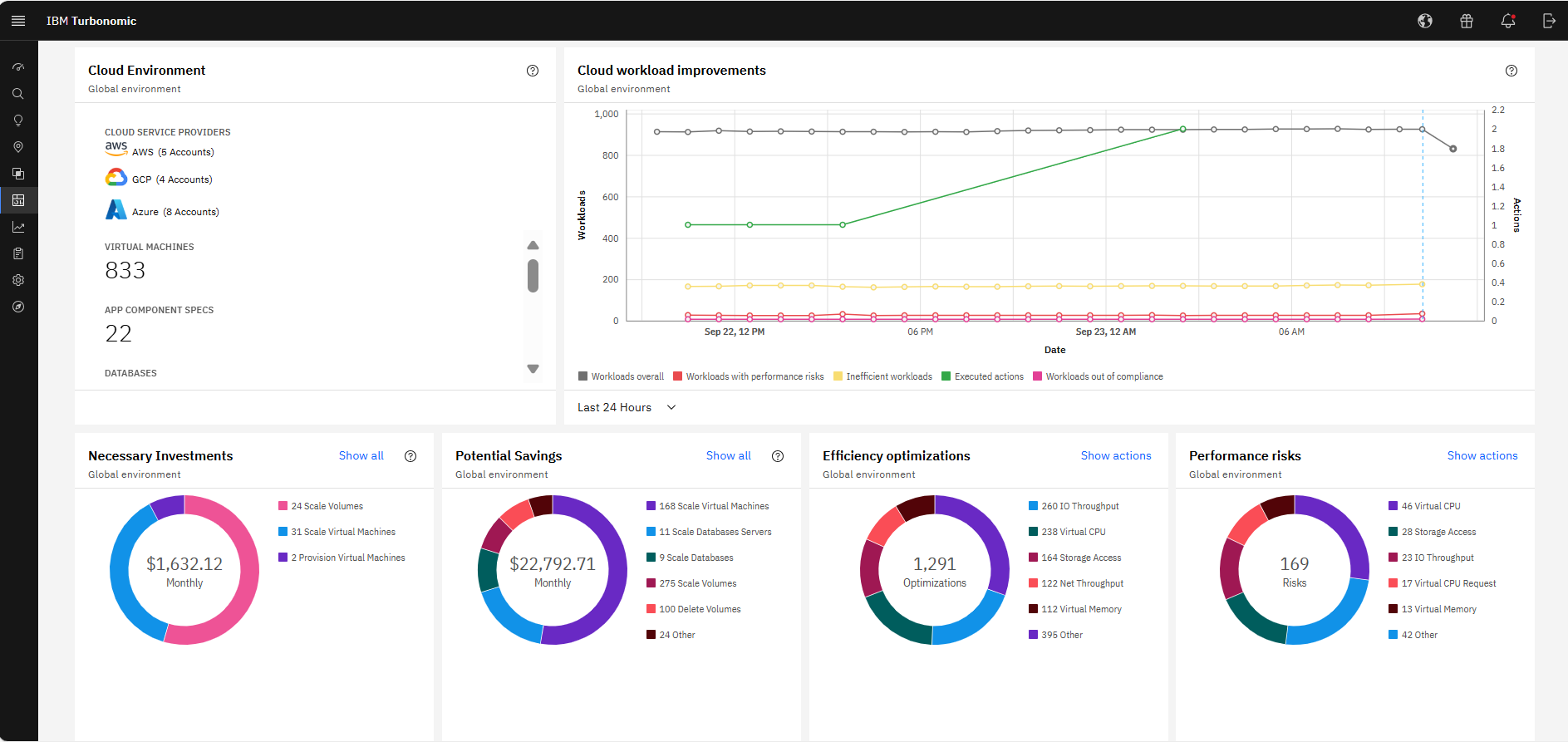
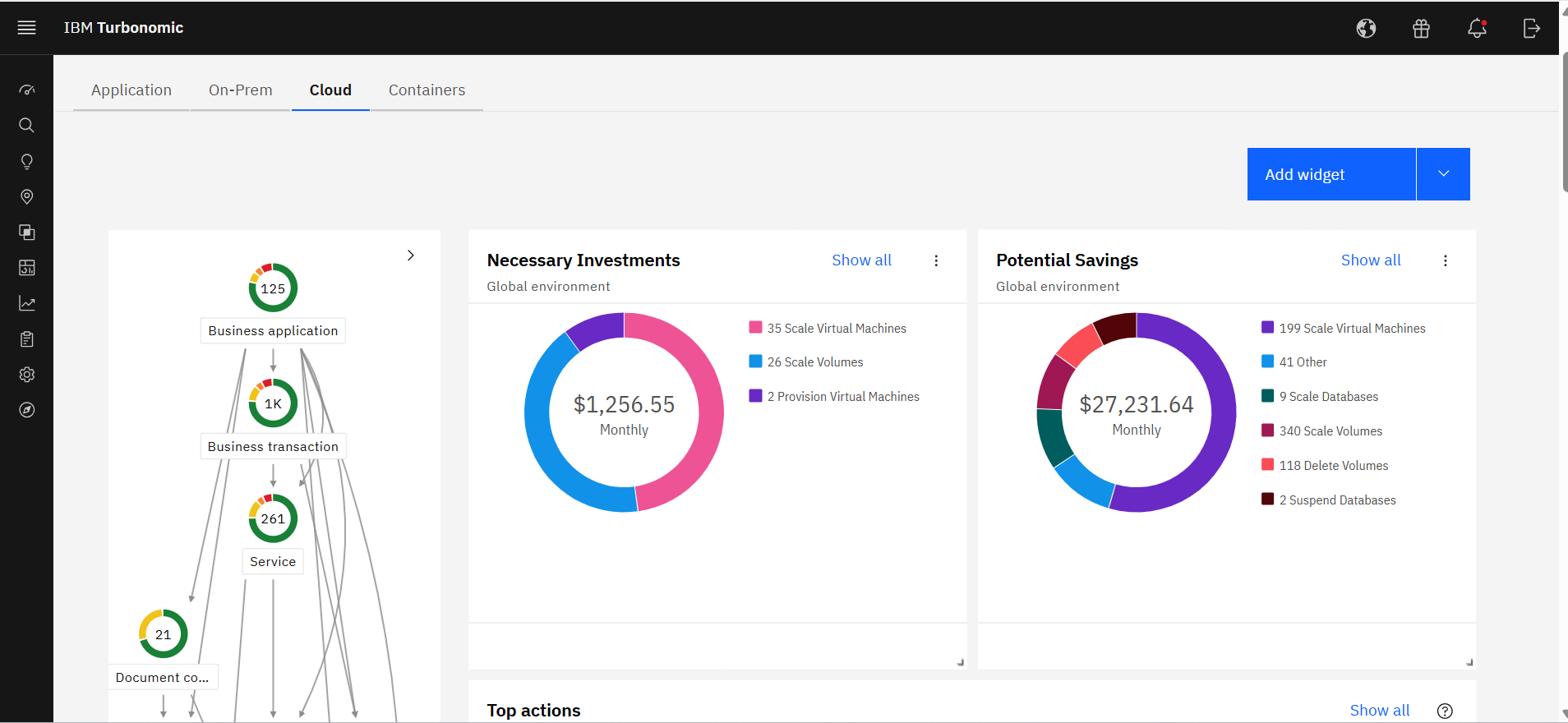
The IBM Turbonomic Cloud Executive Dashboard, an out of the box dashboard that allow users to rapidly communicate value to executives. This view shows the cloud cost savings opportunities realized and not yet realized over any time period.
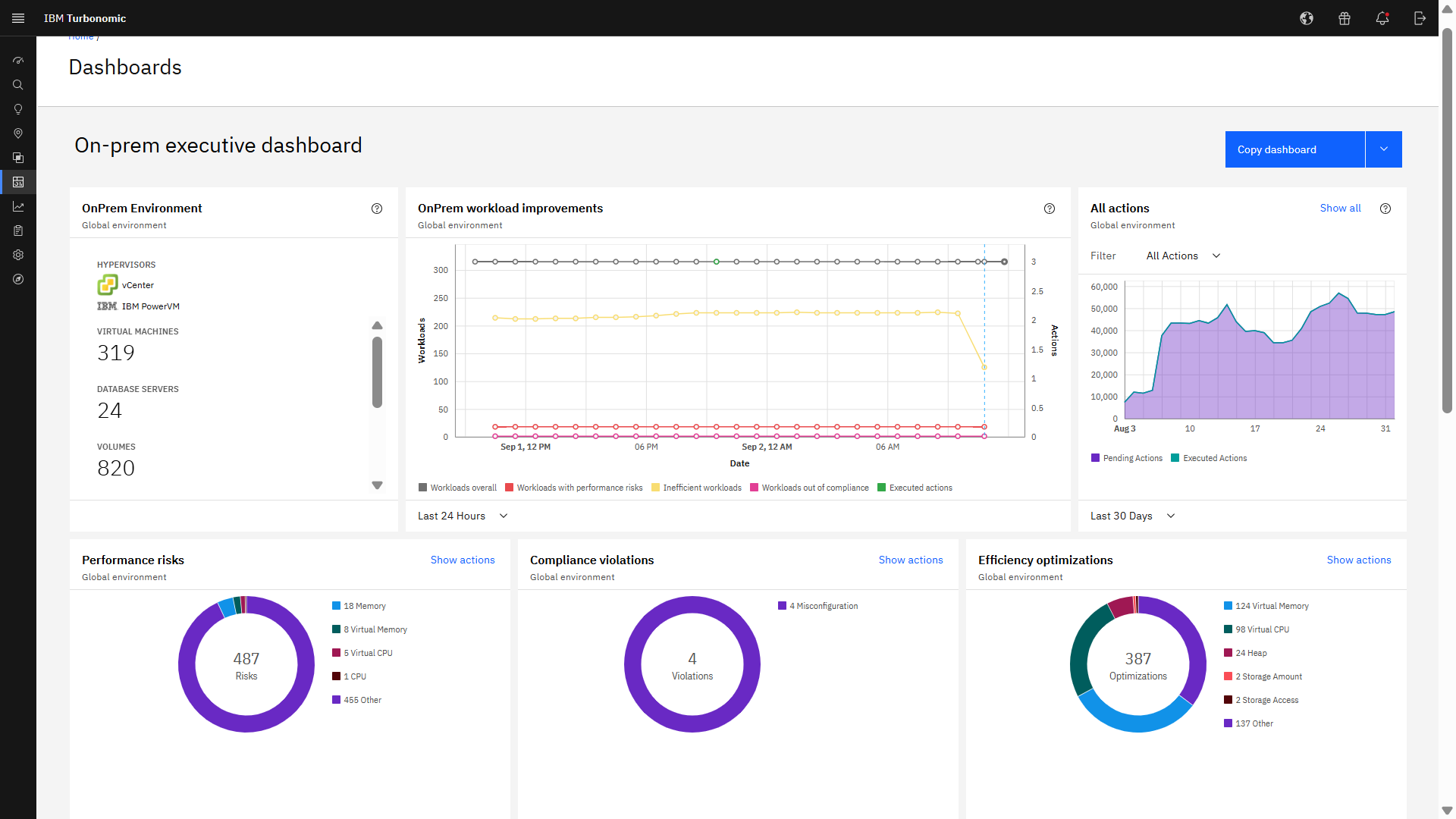
The IBM Turbonomic On-prem Executive Dashboard, an out of the box dashboard that allow users to rapidly communicate value to executives. This view shows the savings opportunities realized and not yet realized over any time period.
an IBM Turbonomic Cloud view, where the public cloud environment(s) and all of the pending actions required to bring them into an efficient, performant state. The Supply Chain at left shows all of the entities in the public cloud(s) and their interdependencies.
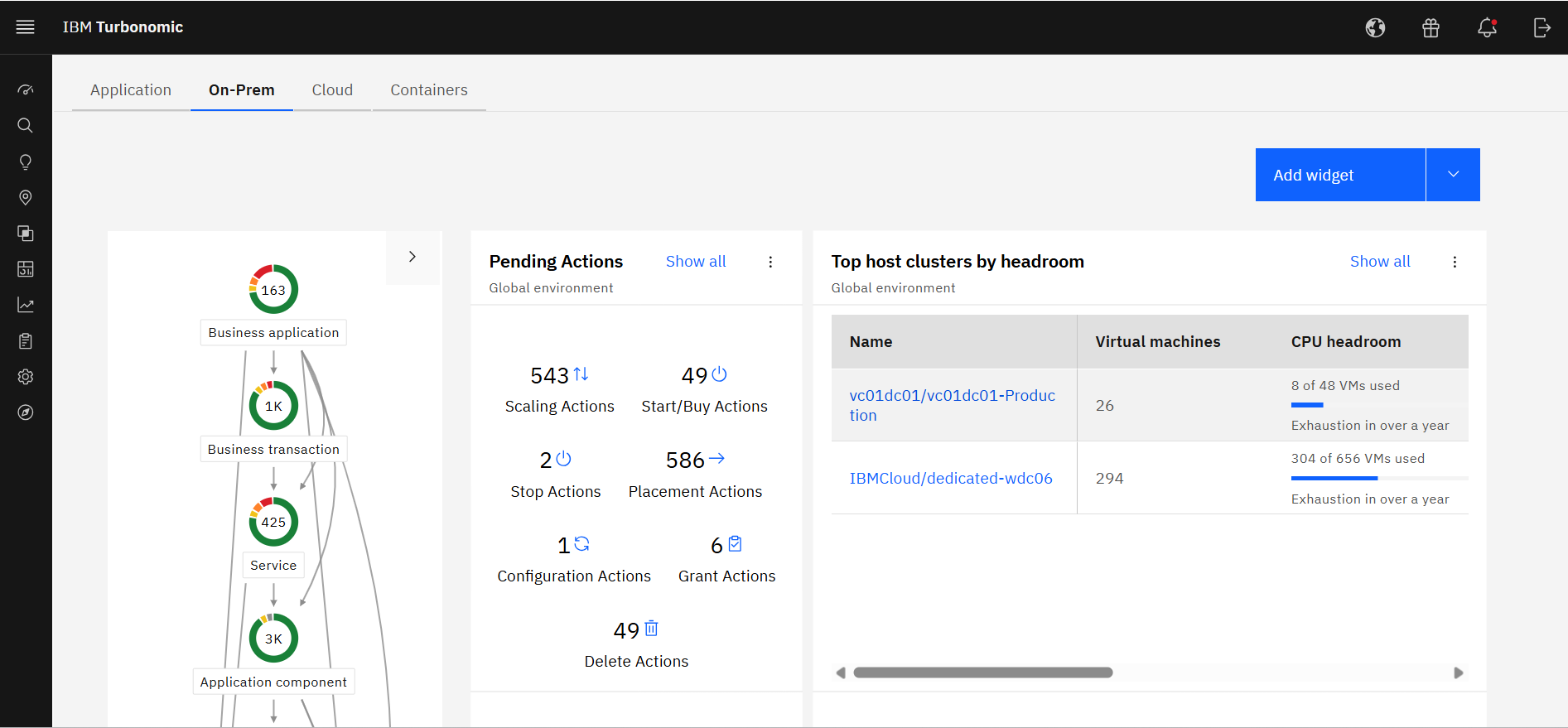
The IBM Turbonomic On-Prem view that shows the user's private data center environment(s) and all of the pending actions required to bring them into an efficient, performant state. The Supply Chain at left shows all of the entities in data center(s) and the interdependencies between them.
IBM Turbonomic Action Center displaying the Top Actions widget, which highlights the best actions delivering the highest value, top performance, and top savings.

1 / 7

Top Performing Features

  • Cost Management

    Provision of tools for cloud instance rightsizing and user chargeback and billing

    Category average: 8.4

  • Resource Management

    Ability to manage and deliver cloud resources such as resource discovery and tagging, asset and license management and cloud-to-cloud migration

    Category average: 8.8

  • Cloud Management Performance Monitoring

    Monitoring of storage, network and application performance metrics to achieve business service levels

    Category average: 8.5

Areas for Improvement

  • Cloud Management Security

    Provision of various security capabilities such as Identity Access Management, encryption, and endpoint security

    Category average: 8.1

  • Automation and Orchestration

    Provision of automated services for application migration, VM images, and configuration management

    Category average: 8.2

  • Systems Integration

    Integration of internal and external systems to support multi-cloud management

    Category average: 8.3

IBM Turbonomic and Its Functionality

Pros

  • Automatically adjusts compute, storage, and network resources to maintain application performance without manual intervention or guesswork.
  • Continuously identifies and eliminates overprovisioned resources, helping reduce cloud and data center costs across hybrid environments.
  • Integrates with Kubernetes, VMware, and public clouds to deliver real-time, policy-driven automation for dynamic workloads.

Cons

  • Reporting customization is somewhat rigid, making it harder to tailor dashboards to specific business KPIs or stakeholder needs.
  • The user interface, while functional, feels dated and can be unintuitive for new users navigating complex resource relationships.

Return on Investment

  • Automated resource management reduced manual monitoring efforts by over 60%, freeing up IT staff for strategic initiatives.
  • Rea ttime performance optimization led to a 25% decrease in application downtime, enhancing service reliability for logistics operations.
  • Predictive analytics enabled smarter capacity planning, aligning infrastructure growth with business demand more accurately.
  • Improved overall operational efficiency and improved ROI.

Alternatives Considered

Dynatrace

Other Software Used

IBM watsonx.ai, IBM SevOne, Microsoft 365 Business Premium

IBM Turbonomic visibility for the enterprise

Use Cases and Deployment Scope

We use Turbonomic in our Power environment for AIOPS and balancing our SAP workloads. It provides recommendations for workload placement in order to optimise our compute, storage and network resources. It gives us real time monitoring and maps relationships amount applications and resources. We use it to automatically scale during peak times and maintain our performance requirements.

Pros

  • Full stack visibility
  • Performance assurance at scale
  • Automation

Cons

  • Lack of 3rd party Integrations
  • High costs can be tough for organisations with small budgets
  • The learning curve can be very steep

Return on Investment

  • Better ROI
  • Time spent by Administrators manually adjusting resources
  • Increased performance and workload optimisation

Alternatives Considered

IBM Power Virtual Server, IBM PowerHA SystemMirror, IBM Spectrum Virtualize, IBM Storage Ceph, IBM Spectrum Control, IBM Storage Protect Plus and IBM Storage Scale

Other Software Used

IBM PowerVM

see my review

Use Cases and Deployment Scope

We use IBM Turbonomic for resource optimization, automation and performance incident resolution.

Pros

  • Automation
  • Capacity Plan
  • AI for Upsize and Downsize actions in Virtual machines

Cons

  • Expand your targets for other providers
  • Indicate since when the shares have been recommended

Return on Investment

  • Time
  • Cloud cost
  • Reduce VMware license

Other Software Used

Red Hat OpenShift, IBM Apptio

Application Resource Optimization

Use Cases and Deployment Scope

IBM Turbonomic helps optimize cloud resources both performance and savings issues (increase or decrease resources like CPU, memory or even changing cloud families ) across cloud environments. Our SRE today have only to review generated actions with the application owners to apply or modify IBM Turbonomic policies so next actions be more accurate. Integrating with Service now its a plus since we can track down all actions with correct workflows.

Pros

  • Cloud Optimization
  • On-premise Optimization
  • Kubernetes Optimization
  • Automatic Actions
  • IBM portfolio integration

Cons

  • more clouds support like Oracle OCI
  • Multi-currency support
  • Use "on-the-fly" kubernetes CPU and mem change (beta on kubernetes)

Return on Investment

  • Direct savings from Cloud
  • Teams spend less time with debugging
  • Application performance guarantee

Alternatives Considered

IBM Instana, IBM Concert, IBM Cloudability and Flexera ONE

Other Software Used

IBM Instana, Flexera ONE

IBM Turbonomic Review

Use Cases and Deployment Scope

IBM Turbonomic is basically an ARM automation tool to monitor if the purchased resources are overprovisioning or underutilized and to monitor cost across hybrid and multi cloud environments.

Our organization is moving from a centralized network to de centralized zones and each zones have there own cloud service providers and few on Hybrid as well. Using the IBM Turbonomic tool we monitor and optimize the performance of cloud devices and monitor the cost as the AI tool automatically allocates/Deallocates the resources

Pros

  • Cost optimization
  • Application performance as resources is allocated depending upon the demand/Traffic
  • Real time monitoring to improve operational efficiency.

Cons

  • Initial Set up and configuration
  • License cost
  • Does not integrate well with other monitoring tools

Return on Investment

  • Positive impact on our ROI as the cost significantly decreased
  • Manual monitoring is not needed as the resources are allocated depending upon the traffic
  • Prevented downtime of our applications by dynamically assigning resources.

Other Software Used

BeyondTrust Remote Support, BitTitan MigrationWiz