Prezi’s advantage over static slides is that its interactive, zoomable canvas shows the relationship between the big picture and the fine details. The vendor’s value proposition is that this puts ideas in context, and makes them more likely to resonate, motivate, and be remembered.
$3
per month
Storylane
Score 10.0 out of 10
N/A
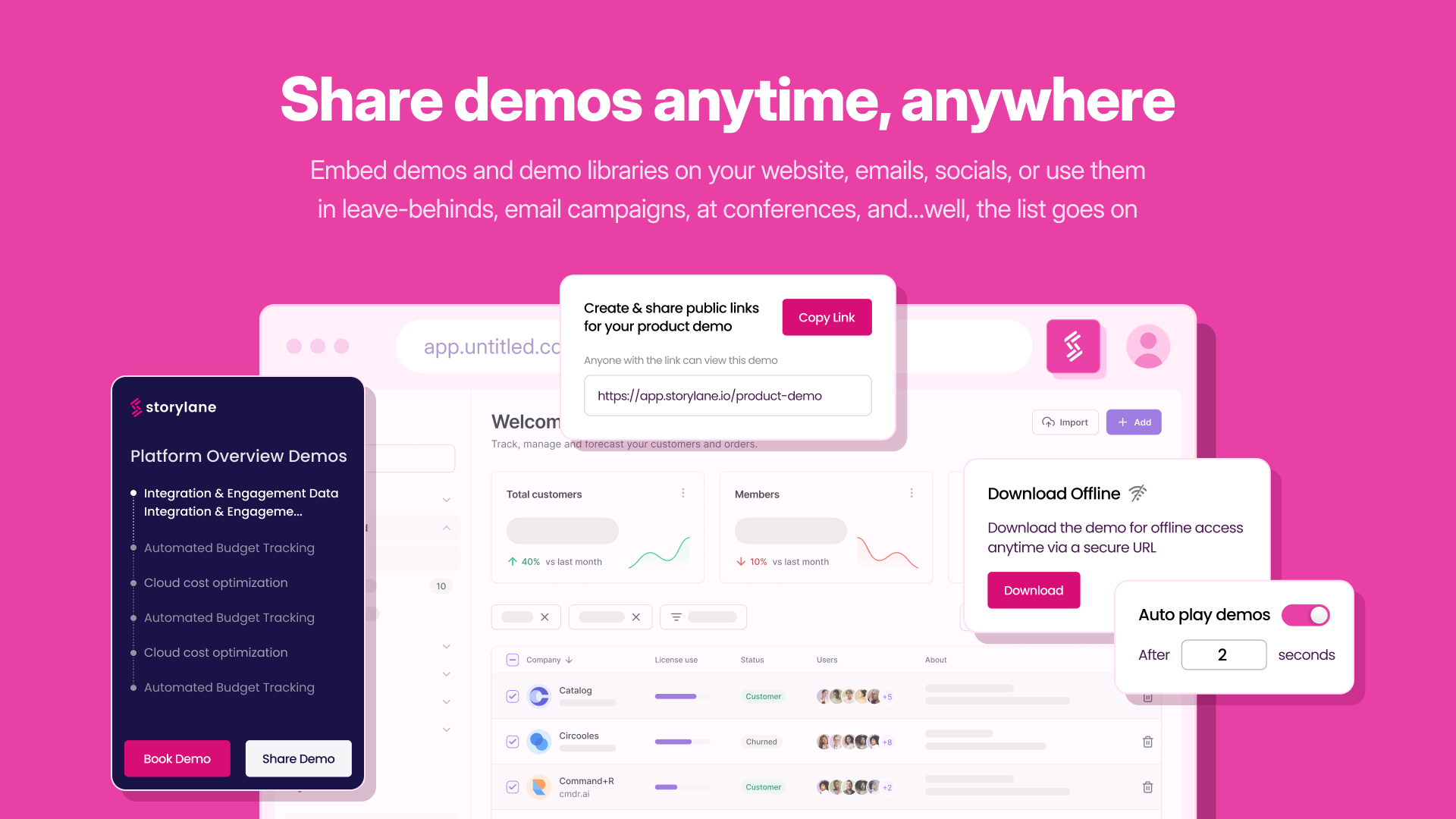
Storylane, headquartered in Santa Clara, helps companies build interactive product demos in minutes with their eponymous no-code tool. Marketing users can embed guided product tours on their websites, landing pages , blogs or share them in email campaigns. Sales users can replicate the product and build custom demos tailor made for conversation. Storylane's no code editor enables users to personalize anything in the demo.
$50
per month per seat
Pricing
Prezi
Storylane
Editions & Modules
Students & Educators - EDU Plus
$3
per month
Individual - Standard
$5
per month
Basic - Plus
$15
per month
Individual - Plus
$15
per month
Business - Plus
$15
per month
Individual - Premium
$59
per month
Business - Premium
$59
per month
Basic - Free
Free
Students & Educators - Basic
Free
Students & Educators - EDU Teams
Contact sales team
Business - Teams
Contact for quote
Starter
$50
per month per seat
Growth
$625
per month 5 seats included + $125 per additional seat
I believe Prezi is well suited when an author wants to create a more compelling presentation. It is also most useful when using it to explain processes, flows, and/or other visual elements. From another perspective, when it is necessary to create something more quickly, Prezi may not be the right solution, when compared to PowerPoint, for example. There are nice templates, but the creation process may not be so fast and simple.
Basically if you want to provide a walk-through of a website, then Storylane is well suited. I can't think of a scenario where it is less appropriate unless you are trying to use it for something it isn't intended for. I'm not sure if it will work with a WASM page, so if you are working with WASM, you should at least test that out.
Prezi can provides a literal "big picture" view of the presentation content. This helps the audience understand what the presentation is ultimately all about.
Prezi is anything but bland. It animates the content and makes it feel like you are "in" the material.
Prezi presentations can incorporate video, images, text and more. There are many options to present content to an audience.
Hard to create something quick and simple, so even after we gained experience we still had a hard time using it to deliver a presentation overnight.
Can be slow to load a presentation, so we always setup 5-10 minutes before our actual presentation time and made sure everything is loaded and ready to go.
Learning to use Prezi and create new presentations is very simple and easy to do. It does not require new skills or a long training process, since in general the use is quite intuitive (and if you have any questions there are many videos on how to use it). Its operation in both the browser version and the app is very good and fluid, managing to perform all the tasks you want properly.
It is a modern and easy-to-use tool (after a while) that allows you to make dynamic and trained presentations without the need to be an expert user. It has allowed me to improve the attention and motivational processes of my students. In addition, it has many [community users] who make videos and teach the many uses that you can use Prezi. And because, despite the restrictions of the free version, everyone can access and make use of Prezi and thus improve their boring ppt and inject some vitality into them.
We also tried Powerpoint and Visio to prepare hierarchical presentations, but it was not as easy, and it was kind of difficult to edit. Prezi provided built-in zoom-pan animation, which made it easier. Also, there were many samples from the Prezi community that one could learn from. Finally, Prezi Classic was free and there was not any limitation in using the free version.
They are both good products and pretty similar. Navattic definitely had some strong features, but with Storylane, they were incredibly responsive to requests for help and feature requests and it just "looked" better. Storylane also "felt" better in terms of working with it. There were some design flow decisions made with Navattic that I found to be a bit counterintuitive.