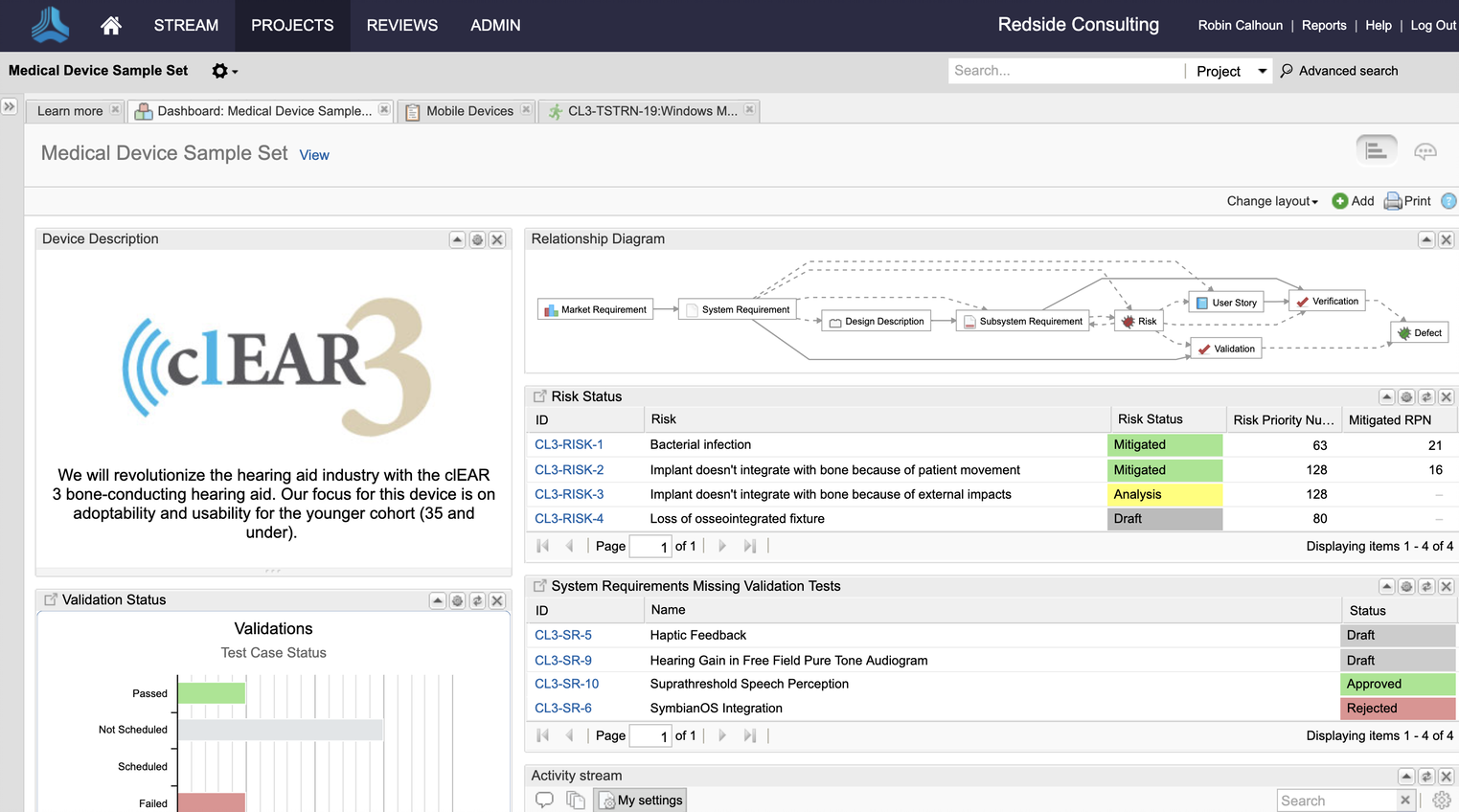
Jama Connect® is a Requirements Management software and Requirements Traceability solution. Jama Software enables teams to manage product requirements and enable Live Traceability™ across the development process, in order to reduce cycle times and improve product quality.
N/A
Polarion ALM
Score9.8 out of 10
N/A
Polarion ALM is an application requirement management software platform now owned and supported by Siemens since the 2015 acquisition. It is available on the cloud (Polarion X) and on-premise. Polarion connect teams and projects to improve application development processes with
a single, unified solution for requirements, coding, testing and release.
$42
per month per user
Pricing
Jama Connect
Polarion ALM
Editions & Modules
No answers on this topic
Polarion X Base
$42
per month per user
Polarion ALM
Contact Sales
one or more years per user/concurrent
Polarion Requirements
Contact Sales
one or more years per user/concurrent
Polarion QA
Contact Sales
one or more years per user/concurrent
Offerings
Pricing Offerings
Jama Connect
Polarion ALM
Free Trial
Yes
Yes
Free/Freemium Version
No
No
Premium Consulting/Integration Services
Yes
Yes
Entry-level Setup Fee
No setup fee
Optional
Additional Details
—
—
More Pricing Information
Community Pulse
Jama Connect
Polarion ALM
Considered Both Products
Jama Software
Verified User
Chose Jama Connect
Focused on Requirements Engineering. Intuitive User Interface
A de minimis incentive was given to thank the reviewer for their time. The incentive was not used to bias or drive a particular response, nor was the incentive contingent on a positive endorsement. More Info
A de minimis incentive was given to thank the reviewer for their time. The incentive was not used to bias or drive a particular response, nor was the incentive contingent on a positive endorsement. More Info
Verified User
Chose Jama Connect
Jama Connect is more straightforward than these systems but not quite as versatile or comprehensive. I would choose those other systems if I were at a very large company working on very complex systems (which I am not).
A de minimis incentive was given to thank the reviewer for their time. The incentive was not used to bias or drive a particular response, nor was the incentive contingent on a positive endorsement. More Info
Verified User
Chose Jama Connect
Polarion did not have the outside sales support that Jama Connect has. Polarion seems better suited for an Agile development lifecycle rather than an evergreen repository of requirements, design features, and verifications.
A de minimis incentive was given to thank the reviewer for their time. The incentive was not used to bias or drive a particular response, nor was the incentive contingent on a positive endorsement. More Info
A de minimis incentive was given to thank the reviewer for their time. The incentive was not used to bias or drive a particular response, nor was the incentive contingent on a positive endorsement. More Info
Verified User
Chose Jama Connect
Ease of access. I've used so many test management tools. So far the user friendliness with Jama was top notch. Anyone can easily understand the flow of the application. It's best in tracking the status and checking the version of the final test case. Currently I'm using Q test …
A de minimis incentive was given to thank the reviewer for their time. The incentive was not used to bias or drive a particular response, nor was the incentive contingent on a positive endorsement. More Info
A de minimis incentive was given to thank the reviewer for their time. The incentive was not used to bias or drive a particular response, nor was the incentive contingent on a positive endorsement. More Info
For the past year, I had taken on the Jama Administrator role for my client and was able to quick learn how to configure the system to meet requirements and expectations of ASPICE, Functional Safety, and Automotive Cybersecurity as well as ISO 9001 and IATF 16949 standards focused on quality. Jama Connect is one of the most powerful engineering tools I've ever had a chance to use. It not only does exactly what's advertised and the customer service and technical support are Best-in-Class. For those who are searching for a Requirements Management Tool, I highly recommend you give Jama a try. They've got everything down to a science from the moment you start interacting with a Jama representative, to the training and the on-boarding. The learning curve was very quick for me, in large part due to the amazing technical support that I was able to receive from Jama's subject matter experts. Every person whom I spoke with about the tool and its capabilities was absolutely top-notch. If you really want to level-up your game, try Jama Connect Advisor. Get yourself a free demo. You won't find any better tool for Requirements Management!
The question is actually not trivial to answer in 200 words. To summarize, I can say that we have had consistently positive experiences with all customers where we have used Polarion ALM. The sector in which the customer operates only played a subordinate role. We use Polarion ALM in almost all sectors: Medical technology, pharmaceuticals, aerospace, agriculture, automotive and many others. It is also interesting to note that in the beginning we were mostly active in the development of products, systems or software. Over time, this has changed more and more for some customers and risk management or projects for lessons learned have taken up more space. This enabled us to banish a seemingly endless number of Excel lists. Who doesn't know this problem: at first there is only one Excel list on the drive. Day by day there are more. Some with a date in the file name. Others with an employee abbreviation. In the end, nobody can tell which is the current and complete list. The really good thing about Polarion ALM is that it is extremely flexible to use and the configuration determines what the project is used for in Polarion ALM. It is customizable to my situation and not rigid.
Focus in the content without loosing the track of the evolution of the items by maintaining the exchange of information between the users inside the Tool.
The possibilities to integrate this tool within our IT-landcape and with our other engineering tools is for us a leverage to success.
A de minimis incentive was given to thank the reviewer for their time. The incentive was not used to bias or drive a particular response, nor was the incentive contingent on a positive endorsement. More Info
Polarion ALM provides a centralized repository for capturing and managing requirements. Teams can define, organize, and link requirements to other artifacts like test cases and development tasks.
Test Management:
Polarion ALM facilitates end-to-end test management. Teams can create detailed test cases, manage test execution, and track test results.
Traceability and Impact Analysis:
Polarion ALM ensures traceability across all phases of the development lifecycle. Users can establish links between requirements, test cases, development tasks, and other artifacts. This traceability helps in impact analysis, allowing teams to understand how changes in one area may affect other parts of the project.
Customization and Adaptability:
Polarion ALM is highly customizable to fit the unique needs of different organizations and industries. Users can create custom workflows, define custom fields, and adapt the tool to their specific development processes.
The 'filtering' capabilities in Jama are not as good as they could be. In particular, the ability to "nest" filters is quite limited. I have certain seen much better capabilities in other tools. ('Cradle' is an example of a tool with excellent "nested filters" capabilities.)
From an administrative point of view, the 'License' admin view is pretty disappointing. The particular thing that I'd like to be able to find out from it is the peak number of 'Float Creator' licenses in concurrent use on each day. If there's a way to get to that information, I haven't found it yet.
A de minimis incentive was given to thank the reviewer for their time. The incentive was not used to bias or drive a particular response, nor was the incentive contingent on a positive endorsement. More Info
More robust engine as far as the actual took is concerned. There are navigation components in trace to reporting which we feel can be improved especially when dealing with cross global accessing of the tool. It slows us down a bit so it's backend driven optimization as well as some front end "clunkiness" that can be improved.
Improve some filtering capabilities especially in creating custom reports and generally all around the ALM components of the tool.
As of the version we have, the ability to enhance replationship types in traceability is limited.
A de minimis incentive was given to thank the reviewer for their time. The incentive was not used to bias or drive a particular response, nor was the incentive contingent on a positive endorsement. More Info
Jama is really easy to use and operate compared to other tools. This allows a process owner to get easier buy-in from the organization to see value early. My experience with this tool was very positive and we were able to see value early in its introduction
A de minimis incentive was given to thank the reviewer for their time. The incentive was not used to bias or drive a particular response, nor was the incentive contingent on a positive endorsement. More Info
There is too much at stake to go into a new system. But with everything else being promised as far as newer more innovative products, the justification to not renew is a huge risk so that is not a concern
A de minimis incentive was given to thank the reviewer for their time. The incentive was not used to bias or drive a particular response, nor was the incentive contingent on a positive endorsement. More Info
The requirements and baseline parts are easy to use. The review centre is very useable and understandable, once you understand/set up the moderation. (This last part could use some refinement.) Integration/connectability (the Connect part of Jama) is quite possible, but the useability could use some love as well.
A de minimis incentive was given to thank the reviewer for their time. The incentive was not used to bias or drive a particular response, nor was the incentive contingent on a positive endorsement. More Info
Polarion ALM can be used individually and what I do with Polarion ALM is decided by my configuration. Lesson-learned, operational risk management, product, system or software development or customer management .... doesn't matter at all. I decide with my configuration what I will do with Polarion ALM. Of course, you can also use Polarion ALM out-of-the-box for your development because it comes with a large set of project templates.For this reason, I would also recommend not to just get started. A suitable consultant will show you the right templates and customize them according to your needs. Having Polarion ALM is like having a car. You know exactly how to operate the car. You've done it a thousand times before. The details are in the configuration: did I have a navigation system installed or not? Do I have a lane departure warning system or not? Do I have cruise control or not? Unlike when buying a vehicle, almost all functions are already available and can be used, usually at no extra cost. However, if something is missing, it can be obtained via the manufacturer's extension portal. Individual extensions are subject to a charge. Polarion ALM - easy to deploy and easy to use.
It has always been available, except for preventative maintenance which is announced beforehand. Nonetheless, we experienced one day shortage over a miscommunication about payment.
A de minimis incentive was given to thank the reviewer for their time. The incentive was not used to bias or drive a particular response, nor was the incentive contingent on a positive endorsement. More Info
A de minimis incentive was given to thank the reviewer for their time. The incentive was not used to bias or drive a particular response, nor was the incentive contingent on a positive endorsement. More Info
With performance compared to JIRA, I do recommend Jama in this case. Jama provides very good performance, it loads immediately for any of the items and searches any item immediately. Performance is really good in all of the operations including creating stories, epics, item types or other support operations or report generation.
A de minimis incentive was given to thank the reviewer for their time. The incentive was not used to bias or drive a particular response, nor was the incentive contingent on a positive endorsement. More Info
They typically answer within minutes of posting a ticket, and then you have a clear expectation of what the issue is, how to diagnose it, how long will it take to get resolved, and in which version a given problem is resolved, or if there is a patch for hosted services. They have a number of support people, and all of them are top-notch.
A de minimis incentive was given to thank the reviewer for their time. The incentive was not used to bias or drive a particular response, nor was the incentive contingent on a positive endorsement. More Info
A de minimis incentive was given to thank the reviewer for their time. The incentive was not used to bias or drive a particular response, nor was the incentive contingent on a positive endorsement. More Info
Helpful and exhaustive and tailorable for our needs. Instructor was well versed and engaged. Material was a good reference and was up to date with tool. Overall, in person training was valuable for tool introduction. Trainer was an active user of the tool and worked closely with other clients. So, very knowledgeable.
A de minimis incentive was given to thank the reviewer for their time. The incentive was not used to bias or drive a particular response, nor was the incentive contingent on a positive endorsement. More Info
A de minimis incentive was given to thank the reviewer for their time. The incentive was not used to bias or drive a particular response, nor was the incentive contingent on a positive endorsement. More Info
Easy to reference and understand. Updated routinely to include new topics. Online training evolves to include more advanced topics and how to guides. Online training includes videos and reference guides that make it easy to perform more complex tasks. Online training is free and can be accessed from any computer.
A de minimis incentive was given to thank the reviewer for their time. The incentive was not used to bias or drive a particular response, nor was the incentive contingent on a positive endorsement. More Info
A de minimis incentive was given to thank the reviewer for their time. The incentive was not used to bias or drive a particular response, nor was the incentive contingent on a positive endorsement. More Info
Jama 2015.5 implementation is very smooth and no need for much manual work. Jama 8 has many challenges and we can not install it as smoothly as Jama 2015.5. Initially, Jama didn't provide the Jama 8's installer files or zip files and they were just providing docker files to everyone (which was really strange). It is the worst that they don't provide all the files at a time. Why should they tell us where we should deploy, and why only a dockerfile? I am not very satisfied with Jama implementation.
A de minimis incentive was given to thank the reviewer for their time. The incentive was not used to bias or drive a particular response, nor was the incentive contingent on a positive endorsement. More Info
A de minimis incentive was given to thank the reviewer for their time. The incentive was not used to bias or drive a particular response, nor was the incentive contingent on a positive endorsement. More Info
It’s easier to use, easier to trace requirements and verification and has a better UI These other tools feel more like glorified excel sheets whereas Jama actually feels intentional with being an ALM tool.
As stated before tracing is much faster, creating the tracing matrix/workflow is easy like using a Miro workflow.
A de minimis incentive was given to thank the reviewer for their time. The incentive was not used to bias or drive a particular response, nor was the incentive contingent on a positive endorsement. TR verified that a representative sample of customers was invited. More Info
Polarion ALM has the best usability, extensibility and reactiv product management. The support is also very good compared to other companies. Or in other words it is closer to the customer. Codebeamer is for sure also a good ALM tool with a great feature set, but existing customers are often neglected. We will see, what PTC as the new owner of codebeamer will change at this point.
A de minimis incentive was given to thank the reviewer for their time. The incentive was not used to bias or drive a particular response, nor was the incentive contingent on a positive endorsement. More Info
There is no horizontal scalability available in Jama, we have only one choice to scale it vertically. But vertical scalable applications always have limitations to grow. In this case, Jama doesn't support horizontal scalability functions like multi-node architectures with a shared drive for the home directory.
A de minimis incentive was given to thank the reviewer for their time. The incentive was not used to bias or drive a particular response, nor was the incentive contingent on a positive endorsement. More Info
One experience that converted an engineer to using Jama Connect was an electronics engineer that was writing test plans. I showed them about how to write "unit" or very discrete tests and then showed them an automatic export to get the document. Thus the authoring of the document effort was taken away, they could focus on defining the test
Unfortunately I have very much struggled to embed systems engineering, requirements management and Jama Connect as part of the 'ways of working' outside the systems and electronics teams.
A de minimis incentive was given to thank the reviewer for their time. The incentive was not used to bias or drive a particular response, nor was the incentive contingent on a positive endorsement. TR verified that a representative sample of customers was invited. More Info
A de minimis incentive was given to thank the reviewer for their time. The incentive was not used to bias or drive a particular response, nor was the incentive contingent on a positive endorsement. More Info