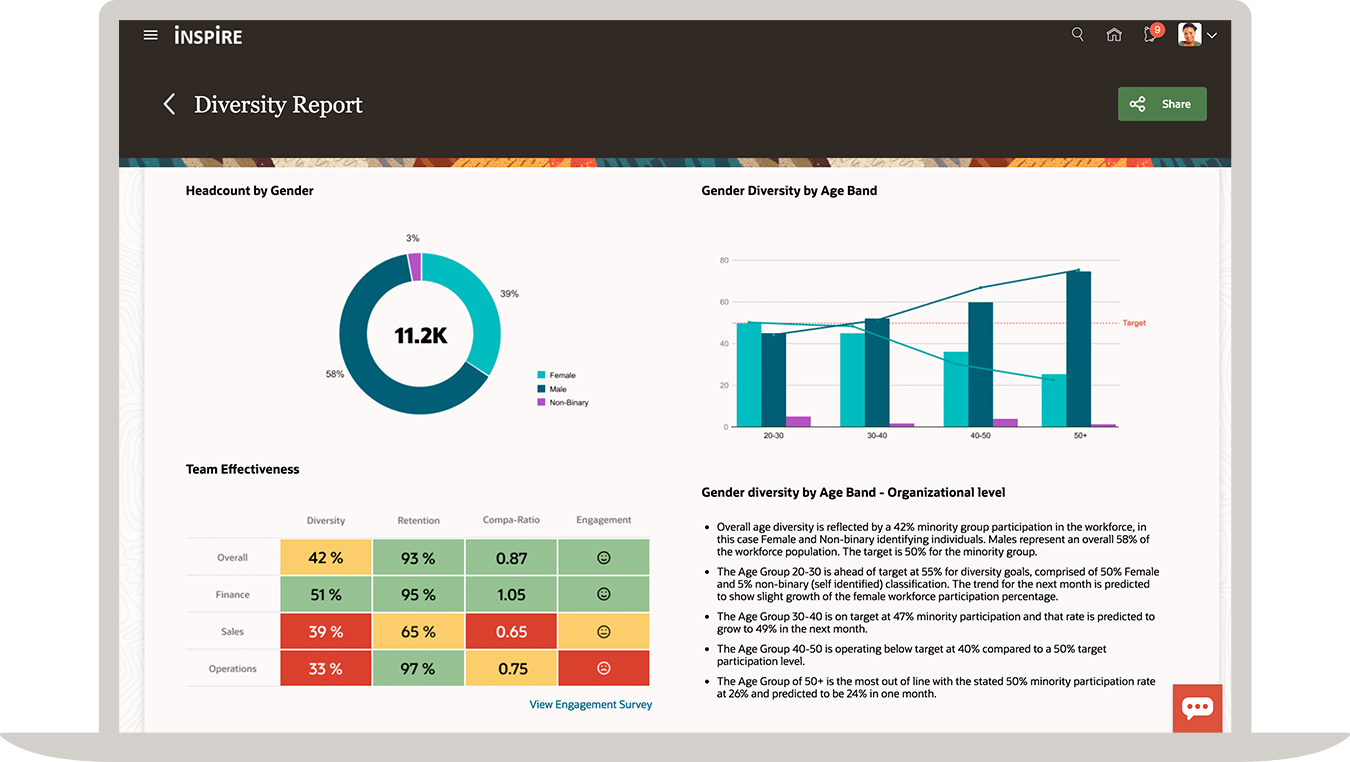
Oracle Fusion Cloud HCM, or Oracle Taleo, is a cloud HCM solution with Talent Management solutions. Its talent management solution includes Recruiting, Onboarding, Learning, Career Development, Opportunity Marketplace, Performance Management, Compensation, Succession Planning, etc.
$4
Per Employee Per Month
Paycom
Score 7.4 out of 10
N/A
Paycom supports HR and payroll with automated, employee-first technology that supports every stage of employment. Its single database enables seamless data management, to reduce errors, endless data entry and time-consuming administrative tasks.
N/A
Pricing
Oracle Fusion Cloud HCM
Paycom
Editions & Modules
Help Desk
$4.00
Per Employee Per Month
Talent Management
$10.00
Per Employee Per Month
Global HR
$15.00
Per Employee Per Month
No answers on this topic
Offerings
Pricing Offerings
Oracle Fusion Cloud HCM
Paycom
Free Trial
No
No
Free/Freemium Version
No
No
Premium Consulting/Integration Services
No
No
Entry-level Setup Fee
Required
No setup fee
Additional Details
Contact Oracle HCM for detailed pricing information at +1.800.392.2999
Oracle HCM is very much helpful and well suited in the recruitment and placement process and HR data. It makes it easier for HR in [organizations] to keep track of who is in and out of the [organization]. Improvement can be made by allowing employees to record their own data and update it as and when necessary without having to go through HR first.
It's very mobile friendly, especially for people that aren't tech savvy. We have an aged workforce where we were really concerned about how they would adapt, going from the comfort of using paper to a mobile and online application. But the training was really easy and the adaptation has been simple for us as a company.
I think that it's just really user friendly on both sides, the employer and the employee side. I think from the employer side, once you get a niche of it and how it works, it's really easy to troubleshoot on your own. At least from my experience, you rarely have to call your contact because it's just so easy to try to figure out on your own. And on the employee side, I feel like the fact that we get to see what employees see, but before we put anything out really helps us help them if they are running into any issues. But typically when we do send something out, we just did our performance reviews, no issues whatsoever. It kind of takes you step by step. I feel like it just does a really good job of seamlessly taking people step by step in every process throughout whatever they're doing in Paycom.
Government entities share data readily on applicants and HCM doesn't make it easy to have applications transferred between organizations. If applicants could apply once and send that application to multiple entities that would really make it more appealing to clients. This is a niche that is currently filled with NEOGOV, however Oracle's analytics are far superior to those in NEOGOV
There are no customizations allowed so clients need to work within the configuration standards or create a bolt on. Many times your greatest asset is also one of your biggest weaknesses.
Oracle is a large company and sometimes it can be hard to navigate the support matrix that they have set up. They also have tiers of support so you can pay more to get more, which isn't optimal from a customer point of view.
We wish that Paycom would offer more hands-on help. A lot of our specialist is great in helping us to resolve whatever issues that we have. However, it's just a list of steps to get there. It's not necessarily like, "hey, here you go, here's the resolution to your problem." So if we don't already understand how to do something, providing steps doesn't necessarily clear that understanding up or provide any clarification.
Additionally, I find that for our organization in particular, we have specific niches within it that Paycom doesn't really address or has any solution on how to address it. It just remains unresolved to this day and we continue to have errors in that area.
Taleo does what we need it to do and based on the costs from both a time and money perspective, I don't see us changing anytime soon. If anything I think we will look to leverage the capabilities available that we may not already be using.
Because it has everything that we need and as we grow, we are learning how robust Paycom can actually be but we need to be willing to spend the money. It's not expensive but we, as a company, are not used to spending that much on a system for HR and payroll.
After the initial training's, it was quite intuitive to use the application. The application is based upon best practices and the overall flows are quite logical. The train stop approach also ensures that users understand where they are in the process cycle. Also, the number of clicks have been greatly rationalized to ensure that there is more streamlined experience.
The interface is very intuitive, you can navigate it pretty well. Everything's pretty much spelled out and the features just flow really well. They make it easy for you to go back and forth with the UX/UI type of interface. So I think it was built pretty well.
It works well. However we recently discovered that it no longer is supported on Internet Explorer so we had to change the default browser for everyone in our organization to MS Edge.
The rating is based upon our current level of support. The overall experience has vastly changed since we moved into product paid support. 'Also, with Oracle going with the model of quarterly patches, it makes sense to have the product company provide support to the overall application thereby eliminating the problems of bugs.
Our TSR has been wonderful to work with. Every step of the way he was quick to respond and answer any questions we had. I knew I could reach him at any time (day or night) and he would be available to assist. Implementing a new HRIS system is obviously a huge task and I contribute all our success to our rep Kurt! Of course, with any implementation, there were bumps along the way and issues. But I always knew we would work as a team to get those issues figured out. Working in the Paycom system has been smooth and easy to learn and I enjoy the employee self-service interface. Our managers have had positive things to say and are all excited about the changes we have been able to make to our organization due to Paycom being implemented.
It was good, but hard to know what questions you need to ask until you actually get in there and start working with a live product. But Paycom is also very helpful every time I call and can't figure something out. Nathan has been very friendly and helpful no matter what I call him about. He is always eager to help out.
There is a lot of potential on Fusion. We have reaped about 10% of potential benefits. Especially on Workforce Intelligence, the opportunities are huge. The reason why we do not use the solution at its full potential is not in the product (which is simple and transparent). A roadmap is under construction to bring more of its potential to the end user.
Not at all satisfied it was a nightmare we spent over 8 months with the implementation team having issues after issues all related to the Puerto Rico regulations (half my employees are in Puerto Rico) and at the end we were moved over from the implementation team to the production team without all the issues being resolved
Our prior experience was Evolution Payroll but it didn't meet up our expectations and the kind of excellence we wanted from it. But I would say that Evolution Payroll is another option for those who don’t want to avail multiple tasking and automated employment facilities like the way Oracle HCM Cloud offers.
We really only had Paychecks and that was our biggest problem is that with several different companies, it was very hard If you had a salary employee and didn't terminate them in the prior company, they get paid twice, so this has really been definitely a big help for us.
We were not good at tracking any numbers around recruiting so now this last year we have been able to set the benchmark that we now can work toward improving.
At any given time, we could not say how many open positions we had. Now we are able to keep track of that.
We do a much better job with communicating with candidates now, especially the ones not selected. This will help us maintain a better reputation and attract the candidates back for other jobs they may be a better fit for in the future.
I would think the most time would come from applicant tracking and I don't think that's a Paycom issue necessarily. I think it was a training issue during implementation. I would say that that has improved now that we had onsite training. But initially the applicant tracking piece can be difficult when you're used to just using an ATS. That's specifically for talent acquisition because there's a lot of nuances that goes into the system that Paycom bills.