Microsoft Intune (formerly Microsoft Endpoint Manager), combining the capabilities of the former Microsoft System Center Configuration Manager, SCCM or ConfigMgr, is presented as a unified endpoint management option. Microsoft Intune is an endpoint management solution for mobile devices, an MDM solution that allows the user to securely manage iOS, Android, Windows, and macOS devices with a single endpoint management solution. The component Endpoint Configuration Manager (the…
$5
per user/per month
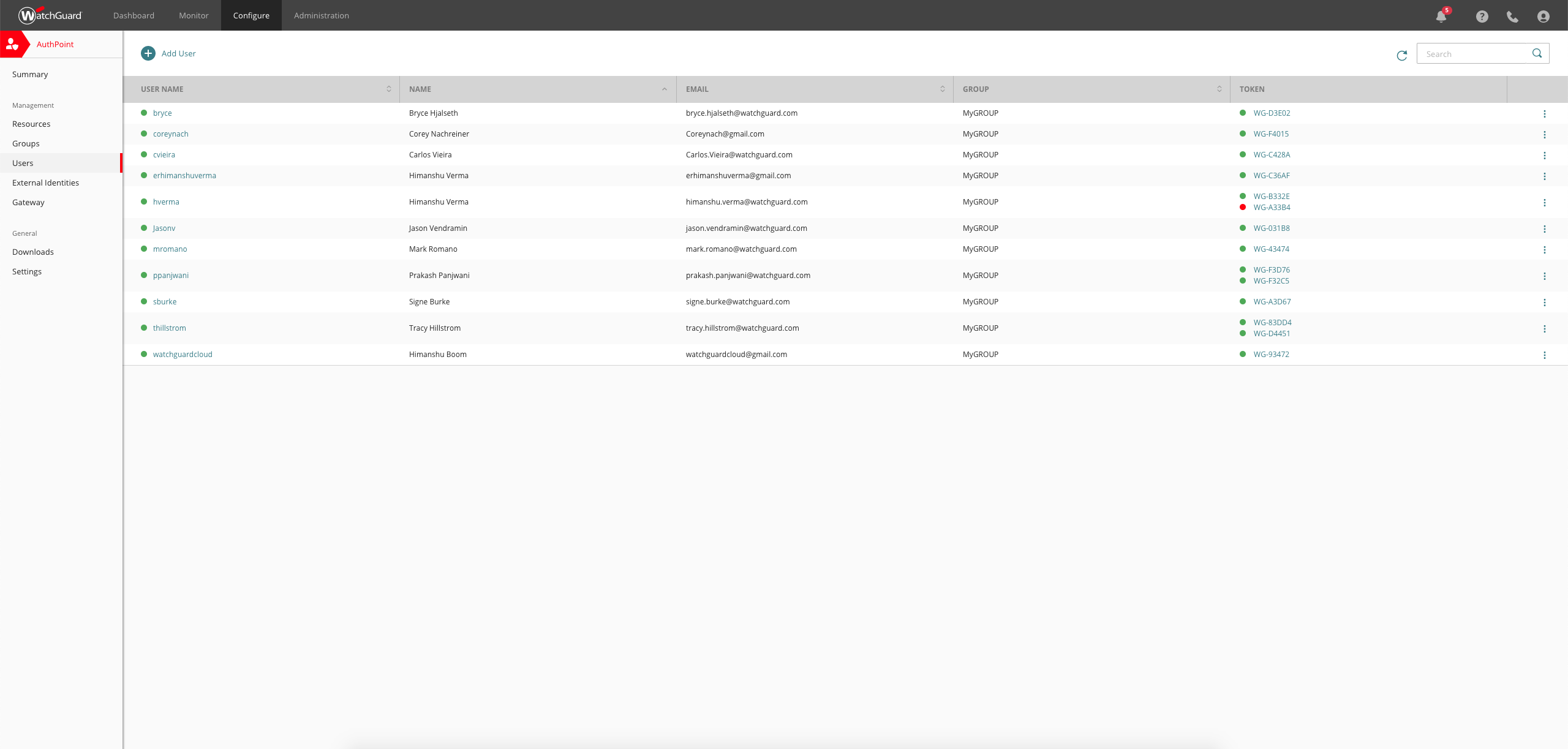
WatchGuard AuthPoint
Score 9.1 out of 10
N/A
AuthPoint Total Identity Security provides businesses with a solution to protect user accounts and credentials. With
multi-factor authentication and dark web credential
monitoring, AuthPoint mitigates the risks associated with workforce credential
attacks. AuthPoint adds an extra layer of security by monitoring for
potential credential exposure in the dark web for both personal and corporate
accounts.
Windows Autopilot makes provisioning user Windows PC laptops a breeze. A user only needs to turn on the laptop, join it to their local WiFi, login with their O365 account then sit back and let Windows Autopilot handle the app installations required for work, configure the laptop settings to meet my organization requirements. I have seen this all completed in less than 30 minutes depending on how fast the internet connection is. Where Microsoft Intune needs to improve I think is the part where it can push out software updates to 3rd party apps. Right now I have to use Automox to fill in this gap.
While I cannot speak of the functionalities that we do not use, the 2nd factor authentication has been great. It's actually secure, I can control it all remotely, users don't mind the extra step, and management feels more at ease knowing that we have full access control. The VPN for remote connections is fast and stable, it stays connected during network oddities and has plenty of bandwidth.
[Microsoft Endpoint Manager (Microsoft Intune + SCCM)] helps to speed up the deployment of patches/software throughout our environment. I can easily build a package and then deploy across all endpoints.
The ability to supercede software is also quite handy. This automates the removal of old versions and replacing them with newer versions.
The Intune Autopilot option is very useful if you want to deploy software to devices straight out of the box. You can configure them to download software when a user opens a new PC and turns it on for the first time.
Works well with the free Authpoint client and the OpenVPN clinet.
Token management is simple and hosted completely in the cloud to reduce overall complexity
Setup was simple and and staighforward
Suppports several authentication methods we have used both RADIUS and SAML effectively, but ADFS, IDP, RDWeb, and RESTful API, and other custom apps are supported.
Geofencing for RDP has been very useful as it is independant of our firewall geofencing. This is quite useful for organizations like us who do not Geofence at at the firewall level so as to provide global access to resources on the DMZ.
Installation is very laborious and complicated. The number of things to manually configure during the installation is incredible.
OS deployment is hard to configure and troubleshoot. The Microsoft article on deploying Windows 10 via System Center Configuration Manager in a test environment takes 44 minutes to read (Microsoft's estimate, not mine -- check here: https://docs.microsoft.com/en-us/windows/deployment/windows-10-poc-sc-config-mgr). If something goes wrong, there are multiple log locations to check on both the server and client, making troubleshooting difficult.
The management console looks old, and its performance isn't great. It is often hard to find settings in the console, and it refreshes slowly. The old name for System Center Configuration Manager, SMS, comes to mind often. "Slowly Moving Software."
Integration with on-premise AD is not working, even after speaking with the support team, it could not get resolved. There is no better documentation on this topic as well
Integration with Azure AD is not supported without the presence of on-prem AD
Logs information is not precious, it provides a generic code in some cases, making it harder to troubleshoot.
The Watchguard AuthPoint App in AppStore has some issues, after it's activated there is no approval request being sent to the phone, and there is no way to troubleshoot this, the only way to make it work is by uninstalling the app and reinstalling it again.
Mascom Wireless is a Microsoft shop and SCCM has proved to be helpful in keeping our Microsoft products up to date every month without fail. We also have a Microsoft Enterprise Agreement which we renewed for three years ending 2022. The remote access utility works wonders for the organisation and have saved travel bills including subsistance allowance. We have been able to fulfill security audits both internal and external. We have been able to keep a robust inventory of our computer assets and nothing falls of the cracks
We are very happy with Authpoint and see no reason to make any change to it. If only there was a policy to set minimum password strength requirements and to force users change their password every xx days, then it would be a 10!!!
Overall, Microsoft Intune is very usable. While help documentation can be lacking, once setup and configured, Intune does all the work that used to be manual. There is a lot of automation and advanced features and manufacturer integrations you don't get anywhere else. These are absolutely game changers when managing IT workloads.
After initial setup, it practically runs itself. Onboarding new users is fast and easy as it should be. The AuthPoint mobile app is small and simple to use. The only reason I do not give it a 10 is that I frequently get complaints from end users that the AuthPoint app is "constantly downloading". In fact, it's not downloading anything and that what the users are seeing in the app is a timer for the 6-digit code that changes every minute.
It's a 'heavy' system, which demands a lot of resources form the datacenter perspective. So, make sure you followed the requirements to avoid frustration in the future. From the 'client' perspective, it's fine. I've never had any issue with that.
Being a Microsoft product, support was good. Out interaction was limited to our in-house IT team which was installing the Intune app in our mobile device. The installation was smooth and we haven't faced any difficulties with the app while using it. Provides a smooth and secure access to all Office 365 apps in mobile while separating the personal and professional data.
WatchGuard support is always quick and reliable. They have urgency levels that you are able to select when creating your support ticket, and they respond in accordance to the severity that you have set. I have never had an issue with getting someone on the phone in the same business day, even for very low priority issues.
It was an Onsite demo at the ditributor with the benefits of Watchguard Authpoint. Was very nice to see the abilities of the product. This Demo was a few years back, since then Authpoint changed allot. It is very nice for partners that you can get this demo without any aditional cost.
We use the online training for all our employees. There are both sales and technical trainings available and there even is a technical certification. You can use this for the Watchguard Partner Program which can give you aditional benefits. Every now and then you have a webinar that discusses multiple Watchguard products.
Work with a "test group" of users who you have a good relationship with so that when things don't work properly they understand! Work with your partner nicely without forcing things especially timelines as you are bound to make mistakes and create oversights in the project Management can also interfere with the implementation (which can cause delays) if you make too many mistakes which takes me back to having a "test group" where you have good relations
the first time it takes more effort. It is helpful to already understand how each authentication type works. Then it's much easier to understand the MFA solution that you implement. It is useful to check the release notes from time to time and update the key parts of the Watchguard Authpoint. Authpoint Gateway, Logon App, RDWeb... Also, it's useful to set up notifications when something goes wrong or sometimes check the statistics of how many requests are being approved/denied, etc.
Microsoft Intune is more robust as far as fine-tuning security controls. It also allows for software installs, folder access controls, updating PCs, and other features simply not found in previous products we have used. Because it is rolled into MS 365 it's very cost effective. It's also a single pane of glass for managing user PCs and personal devices
WatchGuard AuthPoint is easier to manage on a company-wide scale than Google Authenticator. We do use AuthPoint in conjunction with the Microsoft Authenticator but for different services. WatchGuard also has other features available, like dark web monitoring and device management, should we decide to move further services over to WatchGuard, with Google Authenticator does not have
The positive impact it's had was it has been really beneficial in having an all-in-one Systems Management solution to be able to manage all endpoints across the organization. This has saved both time and costs from having to search/setup/manage other System Management applications and also have saved money from having to purchase a license for other commercial products.
Another positive impact it has had was in being able to easily remote into computers/endpoints, and also being able to provide remote assistance to end-users.
The negative impact has been it is not being fully utilized by most of the IT staff, as it is a more complicated platform to learn/master. This would require funding for IT staff to take training in learning the product, or require time to consult the documentation in the use of the product. As a result, this may hurt productivity in being able to have to work on other things.
We currently have 300 users on Authpoint, and most of them use insecure passwords. Authpoint gives us peace of mind that we don't have to police individual employee passwords.
In line with the comment above, with so many people in our organization using insecure passwords, I'm sure that Authpoint has already saved us from many potential security breaches.
Security breaches can cost a lot of money. Preventing them saves the company money and helps to achieve our bottom line.