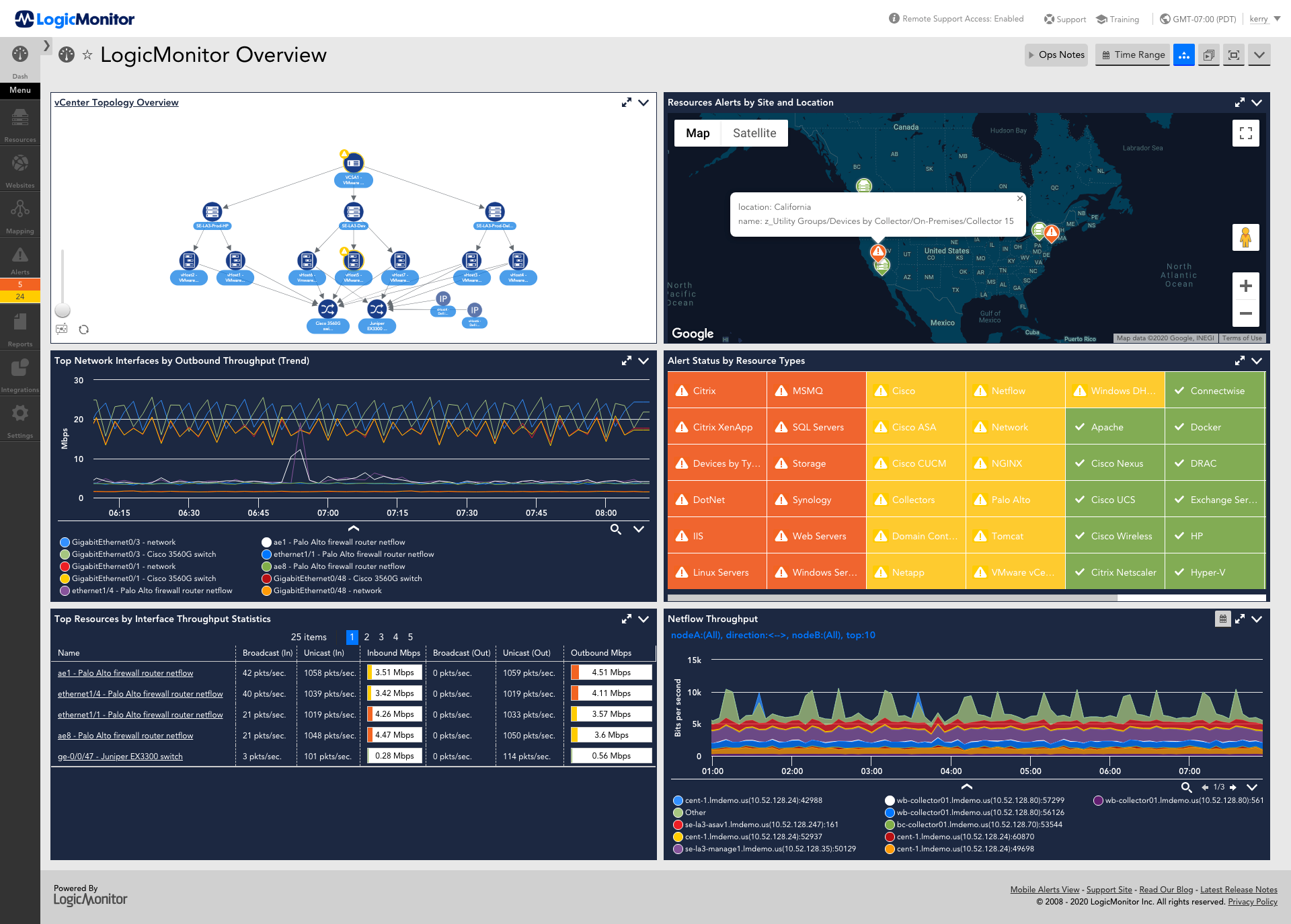
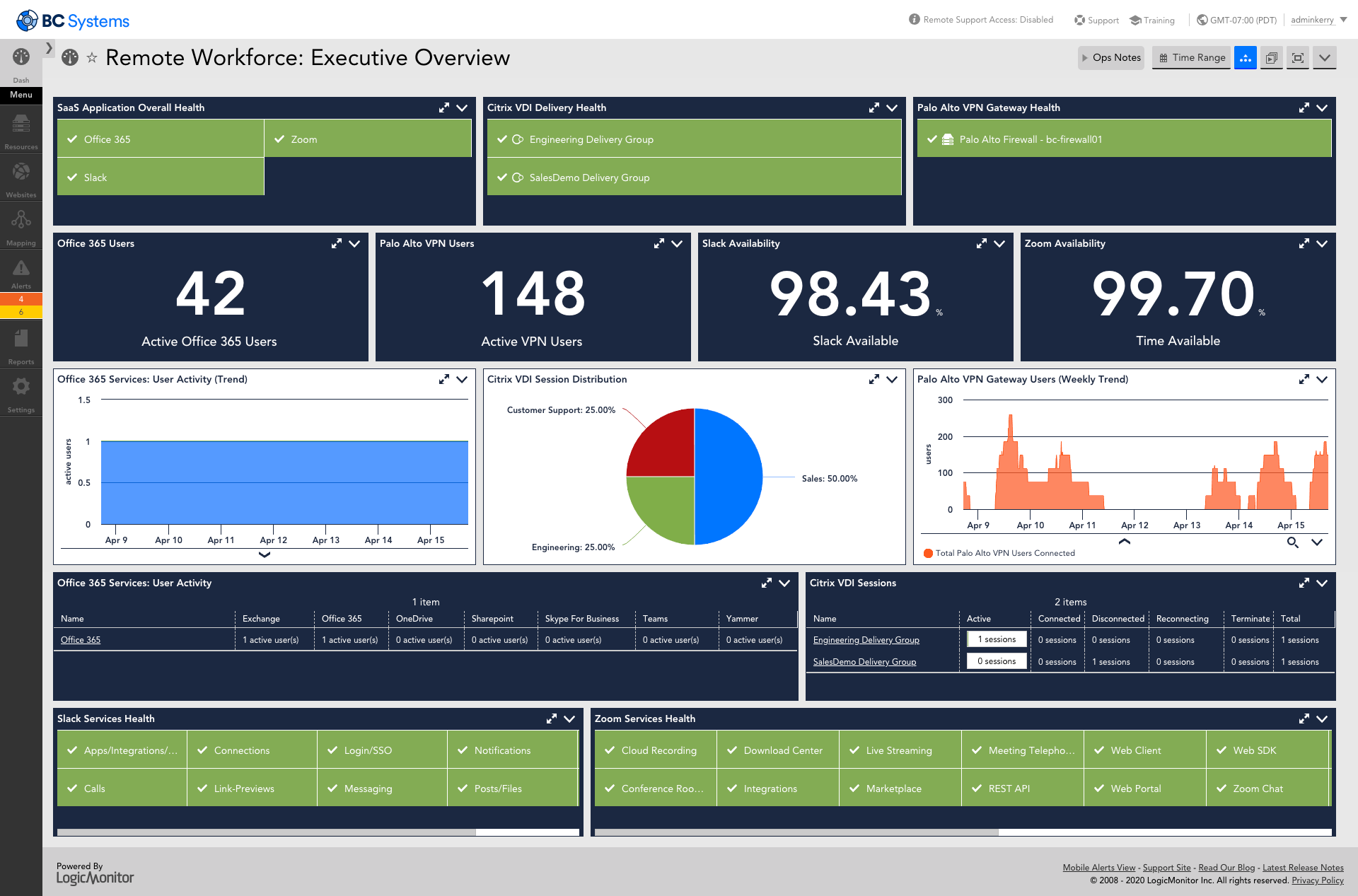
LogicMonitor’s SaaS-based platform, LM Envision, enables observability across on-prem and multi-cloud environments. It provides IT and business teams operational visibility and predictability across their technologies and applications.
N/A
Logstash
Score8 out of 10
N/A
N/A
N/A
Pricing
LogicMonitor
Logstash
Editions & Modules
Enterprise
Contact sales team
Website Monitoring
Contact sales team
No answers on this topic
Offerings
Pricing Offerings
LogicMonitor
Logstash
Free Trial
Yes
No
Free/Freemium Version
No
No
Premium Consulting/Integration Services
Yes
No
Entry-level Setup Fee
No setup fee
No setup fee
Additional Details
Our platform is broken down into Pro and Enterprise Pricing. Pro includes monitoring for all of your cloud, hybrid, and on-premises infrastructure. Our Enterprise package includes all of this, plus our AIOps and Machine Learning functionality that provides dynamic thresholds, root cause analysis, anomaly detection and more!
LogicMonitor only charges by the device. What is considered a device? A device is anything with an IP address that you want to monitor, including a physical device or a cloud resource. This means multiple data sources under the same IP address can be monitored for the same price. Unlike some monitoring platforms. we don’t charge per node, interface, or metric.
The example I will give will explain my rating for it. One employee left our company due to a personal issue, and at that time, our team was working on a highly secure project. He wanted to take revenge on our company, so he began hacking our systems from the outside. Since it appears that someone without authorization is attempting to access our systems, LogicMonitor simultaneously alerted our team to the problem. We stopped that threat with LogicMonitor.
A de minimis incentive was given to thank the reviewer for their time. The incentive was not used to bias or drive a particular response, nor was the incentive contingent on a positive endorsement. More Info
Perfect for projects where Elasticsearch makes sense: if you decide to employ ES in a project, then you will almost inevitably use LogStash, and you should anyways. Such projects would include: 1. Data Science (reading, recording or measure web-based Analytics, Metrics) 2. Web Scraping (which was one of our earlier projects involving LogStash) 3. Syslog-ng Management: While I did point out that it can be a bit of an electric boo-ga-loo in finding an errant configuration item, it is still worth it to implement Syslog-ng management via LogStash: being able to fine-tune your log messages and then pipe them to other sources, depending on the data being read in, is incredibly powerful, and I would say is exemplar of what modern Computer Science looks like: Less Specialization in mathematics, and more specialization in storing and recording data (i.e. Less Engineering, and more Design).
A de minimis incentive was given to thank the reviewer for their time. The incentive was not used to bias or drive a particular response, nor was the incentive contingent on a positive endorsement. More Info
A de minimis incentive was given to thank the reviewer for their time. The incentive was not used to bias or drive a particular response, nor was the incentive contingent on a positive endorsement. TR verified that a representative sample of customers was invited. More Info
Logstash design is definitely perfect for the use case of ELK. Logstash has "drivers" using which it can inject from virtually any source. This takes the headache from source to implement those "drivers" to store data to ES.
Logstash is fast, very fast. As per my observance, you don't need more than 1 or 2 servers for even big size projects.
Data in different shape, size, and formats? No worries, Logstash can handle it. It lets you write simple rules to programmatically take decisions real-time on data.
You can change your data on the fly! This is the CORE power of Logstash. The concept is similar to Kafka streams, the difference being the source and destination are application and ES respectively.
A de minimis incentive was given to thank the reviewer for their time. The incentive was not used to bias or drive a particular response, nor was the incentive contingent on a positive endorsement. More Info
A de minimis incentive was given to thank the reviewer for their time. The incentive was not used to bias or drive a particular response, nor was the incentive contingent on a positive endorsement. More Info
This product has met virtually all of our needs. It was easy to implement and has been simple to support. Customization has been intuitive with many options available. They keep adding features and expanding available options. The future of LogicMonitor looks even better than it is today which is very promising. The management and support teams at LogicMonitor are always helpful
A de minimis incentive was given to thank the reviewer for their time. The incentive was not used to bias or drive a particular response, nor was the incentive contingent on a positive endorsement. More Info
Set up is super easy. Just stand up a small Linux or Windows server to act as a collector. There are no agents to install on monitored devices and all you need is SNMP or WMI access. When creating dashboards, all you have to do is find the widget on the device you want to show up and choose the menu option to add it.
A de minimis incentive was given to thank the reviewer for their time. The incentive was not used to bias or drive a particular response, nor was the incentive contingent on a positive endorsement. More Info
As I said earlier, for a production-grade OpenStack Telco cloud, Logstash brings high value in flexibility, compliance, and troubleshooting efficiency. However, this brings a higher infra & ops cost on resources, but that is not a problem in big datacenters because there is no resource crunch in terms of servers or CPU/RAM
The sales team support we received was top notch. They worked hand in hand to make sure the product met all expectations. So far we have not really had to work with support that much; we have worked with setup team after purchase to deploy product fully. No issues so far and we are four weeks in.
A de minimis incentive was given to thank the reviewer for their time. The incentive was not used to bias or drive a particular response, nor was the incentive contingent on a positive endorsement. More Info
A de minimis incentive was given to thank the reviewer for their time. The incentive was not used to bias or drive a particular response, nor was the incentive contingent on a positive endorsement. More Info
A de minimis incentive was given to thank the reviewer for their time. The incentive was not used to bias or drive a particular response, nor was the incentive contingent on a positive endorsement. More Info
I did not truly dedicate myself to implementing LogicMonitor. However, I overheard the IT team members explain that "LogicMonitor is perfect for us as it has made most of the work automated, and implementation and training sessions were perfect for us." Thus, I can state that everything went smoothly with our implementation.
A de minimis incentive was given to thank the reviewer for their time. The incentive was not used to bias or drive a particular response, nor was the incentive contingent on a positive endorsement. TR verified that a representative sample of customers was invited. More Info
Basically, we did not have any idea about it and how to choose, but we asked one of our former bosses, as they were very experienced with it, so they helped us by clarifying a few things between New Relic and LogicMonitor, as they told us that if you are looking for an automated option, then there is no better option than LogicMonitor.
A de minimis incentive was given to thank the reviewer for their time. The incentive was not used to bias or drive a particular response, nor was the incentive contingent on a positive endorsement. TR verified that a representative sample of customers was invited. More Info
Logstash can be compared to other ETL frameworks or tools, but it is also complementary to several, for example, Kafka. I would not only suggest using Logstash when the rest of the ELK stack is available, but also for a self-hosted event collection pipeline for various searching systems such as Solr or Graylog, or even monitoring solutions built on top of Graphite or OpenTSDB.
A de minimis incentive was given to thank the reviewer for their time. The incentive was not used to bias or drive a particular response, nor was the incentive contingent on a positive endorsement. More Info
Pricing seems to be getting more and more aggressive, I worry that it's going to turn into ServiceNow or SAP and everything minor feature will be an extreme cost that prices out us and our customers
A de minimis incentive was given to thank the reviewer for their time. The incentive was not used to bias or drive a particular response, nor was the incentive contingent on a positive endorsement. More Info
Haven't really used it but our initial onboarding PS was disappointing. Felt like we were being told what we needed to cover as opposed to what we wanted to cover. In addition, we were pushed into using the PS in tight time frames and we were not ready to do so.
A de minimis incentive was given to thank the reviewer for their time. The incentive was not used to bias or drive a particular response, nor was the incentive contingent on a positive endorsement. More Info
A de minimis incentive was given to thank the reviewer for their time. The incentive was not used to bias or drive a particular response, nor was the incentive contingent on a positive endorsement. TR verified that a representative sample of customers was invited. More Info
Positive: LogStash is OpenSource. While this should not be directly construed as Free, it's a great start towards Free. OpenSource means that while it's free to download, there are no regular patch schedules, no support from a company, no engineer you can get on the phone / email to solve a problem. You are your own Engineer. You are your own Phone Call. You are your own ticketing system.
Negative: Since Logstash's features are so extensive, you will often find yourself saying "I can just solve this problem better going further down / up the Stack!". This is not a BAD quality, necessarily and it really only depends on what Your Project's Aim is.
Positive: LogStash is a dream to configure and run. A few hours of work, and you are on your way to collecting and shipping logs to their required addresses!
A de minimis incentive was given to thank the reviewer for their time. The incentive was not used to bias or drive a particular response, nor was the incentive contingent on a positive endorsement. More Info