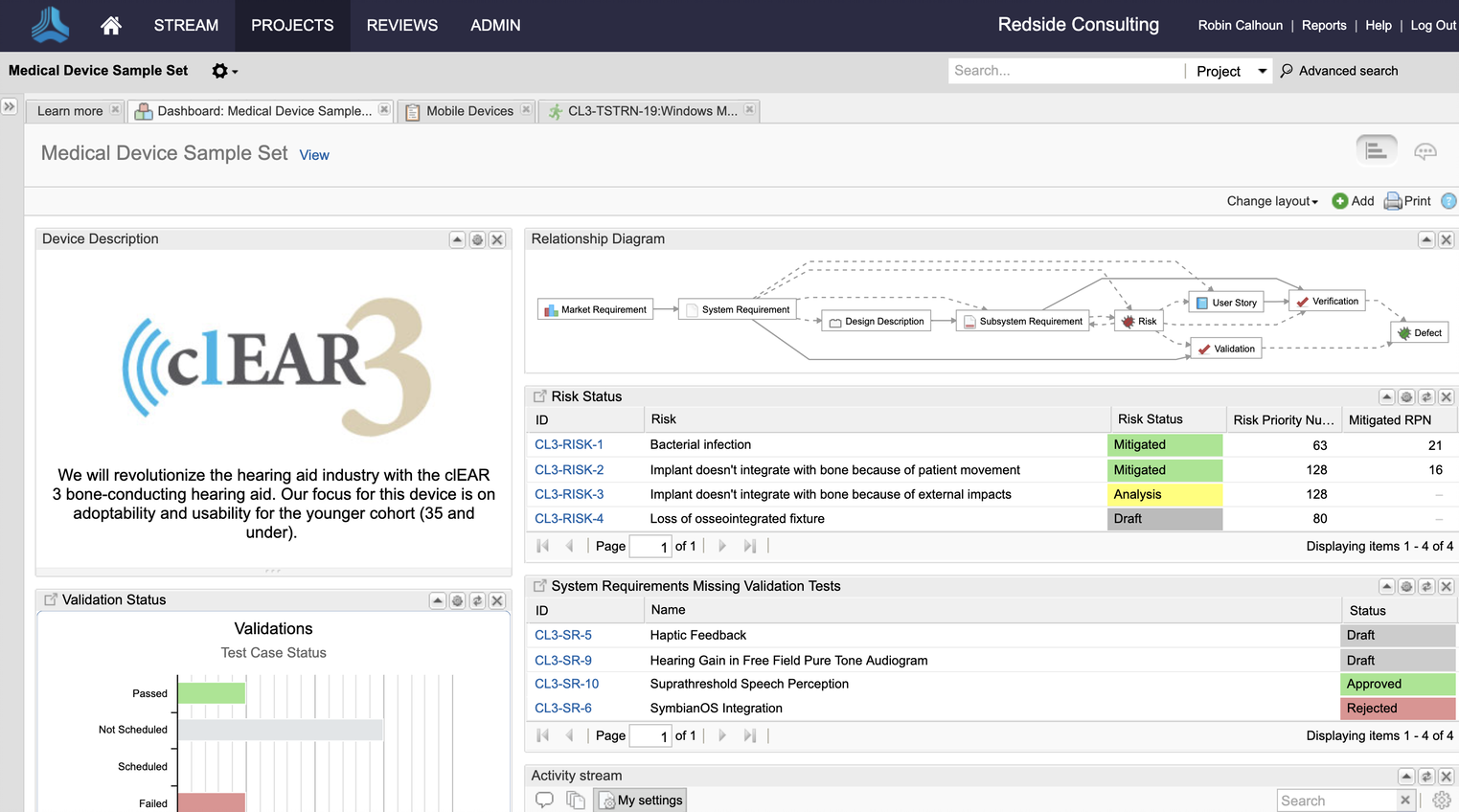
Jama Connect® is a Requirements Management software and Requirements Traceability solution. Jama Software enables teams to manage product requirements and enable Live Traceability™ across the development process, in order to reduce cycle times and improve product quality.
N/A
Rally Software
Score 6.8 out of 10
N/A
Rally Software headquartered in Boulder, Colorado developed the Rally agile software development / ALM platform which was acquired by CA Technologies and rebranded as CA Agile Central. After CA's acquisition by Broadcom the software was once again rebranded as Rally.
Jama connect has the best UI compared to DOORS, Codebeamer, and PTC Integrity. It’s the clearest to use with the best usability. For example make traces between all requirements is as straightforward as clicking a button. The trace matrix view is highly configurable to get you to show anything you need. It has extensive filtering where every index in your requirement is indexed. Same with their export features, you can use default templates or create custom templates to export to PDF for all your regulatory needs like submitting documentation to FDA. This has helped us a ton without requiring much edits and letting us create up to date reviewed documents.
Speaking of review system, it’s well organized and you can set required approved and optional reviewers. Track your redlines in the tool and also view and resolve comments.
The one issue I’ve experienced is that with a large system the web app can take some time to load everything.
If your organisation is planning to adopt Scaled Agile Framework Methodology (SAFe) without being worried about cost, CA Agile Central is one of the best tools. Here, you can look at various release trains and how that then flows up to the overall program budget. You can look holistically across all the release trains with minimal effort and have it flow up to the program office’s budget. It also helps by easily maintaining backlogs and integrating more seamlessly into software developers releases, iterations, and features. It has no conformance issue as it supports almost all the browsers like IE from version 8.0, Firefox from 3.6 and the newest versions of Chrome (from 6.0) and Safari (from 4.0).
Focus in the content without loosing the track of the evolution of the items by maintaining the exchange of information between the users inside the Tool.
The possibilities to integrate this tool within our IT-landcape and with our other engineering tools is for us a leverage to success.
structuring teams separately in a clean way. You can add as much teams as you want, and guarantee each team's work would stay separate in browsing, graphs and analytics.
detailed menus and drop-downs listing of features - technically it covers all there is of agile aspects and some more
ability to set your email notifications on/off
ability to split user stories into the next iteration if work isn't done in the previous one - no need to duplicate your user story manually
The 'filtering' capabilities in Jama are not as good as they could be. In particular, the ability to "nest" filters is quite limited. I have certain seen much better capabilities in other tools. ('Cradle' is an example of a tool with excellent "nested filters" capabilities.)
From an administrative point of view, the 'License' admin view is pretty disappointing. The particular thing that I'd like to be able to find out from it is the peak number of 'Float Creator' licenses in concurrent use on each day. If there's a way to get to that information, I haven't found it yet.
Jama is really easy to use and operate compared to other tools. This allows a process owner to get easier buy-in from the organization to see value early. My experience with this tool was very positive and we were able to see value early in its introduction
Assuming we were paying - right now my group gets it for free as the broader engineering organization pays for it. There would be switching costs. There would be pretty minimal data migration, but the biggest cost is getting people to learn a new tool and starting off on the right footing. Evaluation and identification of the right product is a big part of switching too
The requirements and baseline parts are easy to use. The review centre is very useable and understandable, once you understand/set up the moderation. (This last part could use some refinement.) Integration/connectability (the Connect part of Jama) is quite possible, but the useability could use some love as well.
Great UI, recent refresh was terrific. Great graphs and metrics, inline editing for updates, and a multitude of views on sprint progress make for a great team collaboration experience. There is also an active community and forums so that if you do need help, it is readily available
It has always been available, except for preventative maintenance which is announced beforehand. Nonetheless, we experienced one day shortage over a miscommunication about payment.
With performance compared to JIRA, I do recommend Jama in this case. Jama provides very good performance, it loads immediately for any of the items and searches any item immediately. Performance is really good in all of the operations including creating stories, epics, item types or other support operations or report generation.
The screens render relatively quickly but many actions that you would expect to require a single click require multiple clicks and pop-up windows. The extra windows and clicks make the product feel ponderous.
They typically answer within minutes of posting a ticket, and then you have a clear expectation of what the issue is, how to diagnose it, how long will it take to get resolved, and in which version a given problem is resolved, or if there is a patch for hosted services. They have a number of support people, and all of them are top-notch.
I've had to use support only one time and my issue was eventually resolved but not because of my ticket--because others complained about the functionality taken away so they brought it back. My ticket was never answered or addressed. So I can't really say much for the support factor for Rally.
Helpful and exhaustive and tailorable for our needs. Instructor was well versed and engaged. Material was a good reference and was up to date with tool. Overall, in person training was valuable for tool introduction. Trainer was an active user of the tool and worked closely with other clients. So, very knowledgeable.
Easy to reference and understand. Updated routinely to include new topics. Online training evolves to include more advanced topics and how to guides. Online training includes videos and reference guides that make it easy to perform more complex tasks. Online training is free and can be accessed from any computer.
It more or less confirmed that we are using it the way they had in mind. We were hoping for a epiphany in terms of how we could use it better.
They also want to be a go to source for agile processes and have an online resource center. It’s not that great but had a couple of nuggets. It hasn’t really helped us too much and we are not too far off from the classical interpretation of agile.
I would recommend training, in particular for organizations that multiple on-going projects. The product seems optimized for larger, more complex teams and getting proper training on how to configure, administer and use the system would be beneficial
Jama 2015.5 implementation is very smooth and no need for much manual work. Jama 8 has many challenges and we can not install it as smoothly as Jama 2015.5. Initially, Jama didn't provide the Jama 8's installer files or zip files and they were just providing docker files to everyone (which was really strange). It is the worst that they don't provide all the files at a time. Why should they tell us where we should deploy, and why only a dockerfile? I am not very satisfied with Jama implementation.
Implementation of RALLY services and program satisfaction among various group,... 1) Dev Outcomes: How were our resiliencies, development, learning & practitioners “make them do the work,” but that they ask you to do it “in a way like before. 2) The Ops group: Just wish to make sure any change won't break current production envirements All the stake holders has to be on the same page
JCA is an extraordinary tool that is very simple to use and brings efficiency to the creation of requirements. It is particularly good at highlighting improvements to requirements which, when done properly and done up front in the engineering development process, will save significant time and prevent confusion downstream in the development process. It's difficult to quantify how much of a positive impact JCA would have on any individual project, but I would say it could easily save an organization more than its cost in terms of improving efficiencies and the traceability integrity throughout the entire portfolio of projects when applied correctly. This additional product from Jama is highly recommended.
Rally and Asana have comparable features and are both valuable project management tools, but Asana's user interface is well-organized and highly intuitive. It's easy to add tasks and collaborators, edit due dates, indicate progress on tasks, close out projects, etc. However, Rally's interface is somewhat cluttered and difficult to navigate. My team ended up choosing Asana over Rally due to these concerns.
There is no horizontal scalability available in Jama, we have only one choice to scale it vertically. But vertical scalable applications always have limitations to grow. In this case, Jama doesn't support horizontal scalability functions like multi-node architectures with a shared drive for the home directory.
One experience that converted an engineer to using Jama Connect was an electronics engineer that was writing test plans. I showed them about how to write "unit" or very discrete tests and then showed them an automatic export to get the document. Thus the authoring of the document effort was taken away, they could focus on defining the test
Unfortunately I have very much struggled to embed systems engineering, requirements management and Jama Connect as part of the 'ways of working' outside the systems and electronics teams.