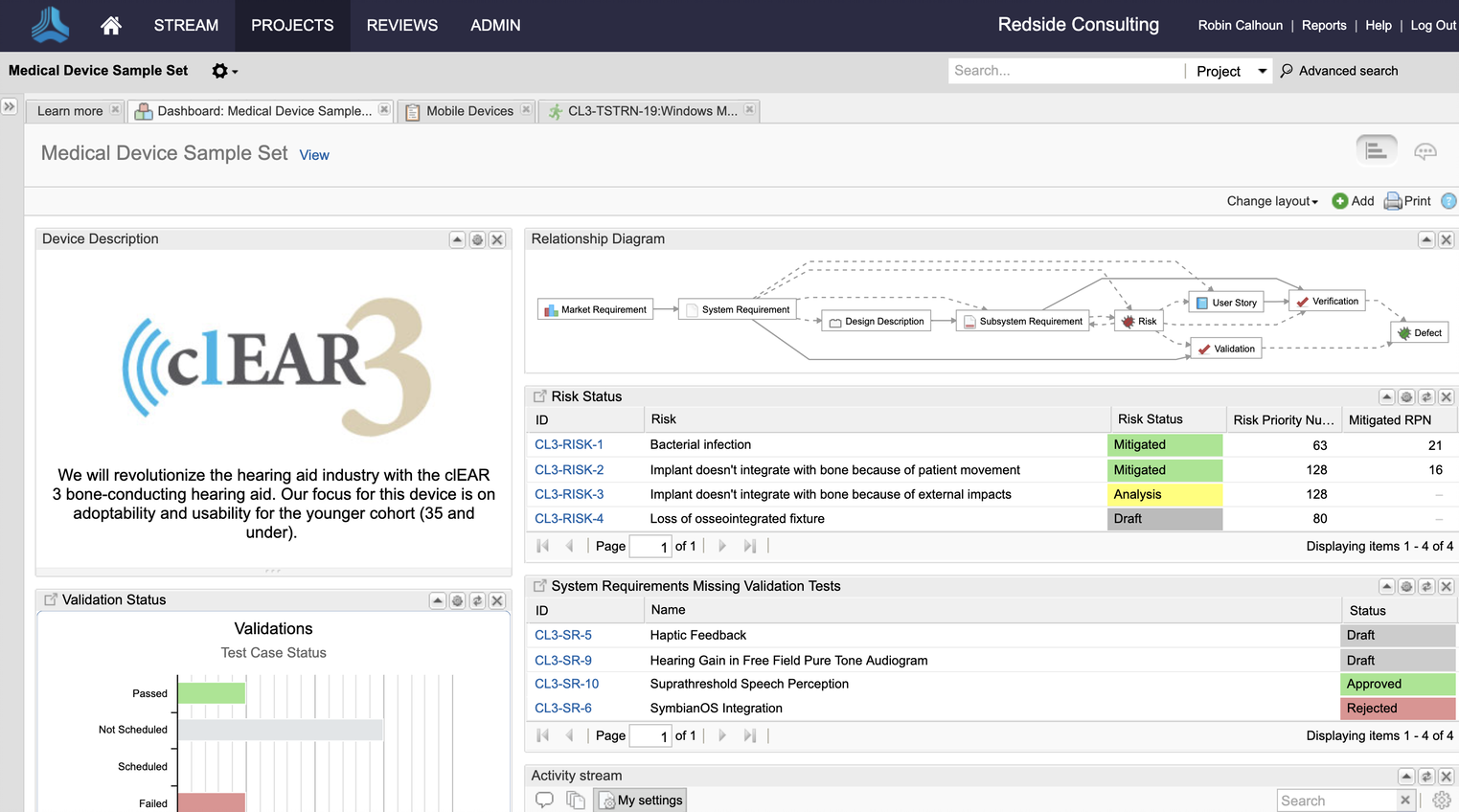
Jama Connect® is a Requirements Management software and Requirements Traceability solution. Jama Software enables teams to manage product requirements and enable Live Traceability™ across the development process, in order to reduce cycle times and improve product quality.
N/A
OpenText ALM/Quality Center
Score8 out of 10
N/A
OpenText™ ALM/Quality Center, formerly from Micro Focus, serves as the single pane of glass for software quality management. It helps users to govern application lifecycle management activities and implement rigorous, auditable lifecycle processes.
N/A
Pricing
Jama Connect
OpenText ALM/Quality Center
Editions & Modules
No answers on this topic
No answers on this topic
Offerings
Pricing Offerings
Jama Connect
OpenText ALM/Quality Center
Free Trial
Yes
No
Free/Freemium Version
No
No
Premium Consulting/Integration Services
Yes
No
Entry-level Setup Fee
No setup fee
No setup fee
Additional Details
—
—
More Pricing Information
Community Pulse
Jama Connect
OpenText ALM/Quality Center
Considered Both Products
Jama Software
Verified User
Chose Jama Connect
None of this software provides the traceability matrix view (coverage explorer) like Jama. This was the main reason.
A de minimis incentive was given to thank the reviewer for their time. The incentive was not used to bias or drive a particular response, nor was the incentive contingent on a positive endorsement. More Info
Sr. Quality Assurance Software Lead in Research & Development at Advanced Bionics (Medical Devices, 1001-5000 employees)
Chose Jama Connect
Jama has a lot going for it. Although it may not seamlessly plug in from the get-go into ALM tools or be an ALM tool itself, I believe it has a very bright future. In comparison to Rational Doors, we believe for our needs, it is much more of an bang-for-the-buck and feature …
A de minimis incentive was given to thank the reviewer for their time. The incentive was not used to bias or drive a particular response, nor was the incentive contingent on a positive endorsement. More Info
A de minimis incentive was given to thank the reviewer for their time. The incentive was not used to bias or drive a particular response, nor was the incentive contingent on a positive endorsement. More Info
For the past year, I had taken on the Jama Administrator role for my client and was able to quick learn how to configure the system to meet requirements and expectations of ASPICE, Functional Safety, and Automotive Cybersecurity as well as ISO 9001 and IATF 16949 standards focused on quality. Jama Connect is one of the most powerful engineering tools I've ever had a chance to use. It not only does exactly what's advertised and the customer service and technical support are Best-in-Class. For those who are searching for a Requirements Management Tool, I highly recommend you give Jama a try. They've got everything down to a science from the moment you start interacting with a Jama representative, to the training and the on-boarding. The learning curve was very quick for me, in large part due to the amazing technical support that I was able to receive from Jama's subject matter experts. Every person whom I spoke with about the tool and its capabilities was absolutely top-notch. If you really want to level-up your game, try Jama Connect Advisor. Get yourself a free demo. You won't find any better tool for Requirements Management!
For an organisation that has completely adopted SAFe structure including naming terminology, it is less appropriate and apart from that. It can suit any organisation out there, and it can solve all your problems one way or another by customising it. It is a robust and highly scalable solution to support all the business needs. It improves a lot of productivity and visibility.
A de minimis incentive was given to thank the reviewer for their time. The incentive was not used to bias or drive a particular response, nor was the incentive contingent on a positive endorsement. More Info
Focus in the content without loosing the track of the evolution of the items by maintaining the exchange of information between the users inside the Tool.
The possibilities to integrate this tool within our IT-landcape and with our other engineering tools is for us a leverage to success.
A de minimis incentive was given to thank the reviewer for their time. The incentive was not used to bias or drive a particular response, nor was the incentive contingent on a positive endorsement. More Info
If you have a mix of automation & manual test suites, HPALM is the best tool to manage that. It definitely integrates very well with HP automation tools like HP Unified Functional Testing and HP LoadRunner. Automated Suites can be executed, reports can be maintained automatically. It also classifies which test suites are manual & which are automated & managers can see the progress happening in moving from manual to automated suites. In HPA ALM all the functional test suites, performance test suites, security suites can be defined, managed & tracked in one place.
It is a wonderful tool for test management. Whether you want to create test cases, or import it, from execution to snapshot capturing, it supports all activities very well. The linking of defects to test runs is excellent. Any changes in mandatory fields or status of the defect triggers an e-mail and sent automatically to the user that the defect is assigned to.
It also supports devops implementation by interacting with development tool sets such as Jenkins & GIT. It also bring in team collaboration by supporting collaboration tools like Slack and Hubot.
This tool can integrate to any environment, any source control management tool bringing in changes and creates that trace-ability and links between source control changes to requirements to tests across the sdlc life-cycle.
A de minimis incentive was given to thank the reviewer for their time. The incentive was not used to bias or drive a particular response, nor was the incentive contingent on a positive endorsement. More Info
The 'filtering' capabilities in Jama are not as good as they could be. In particular, the ability to "nest" filters is quite limited. I have certain seen much better capabilities in other tools. ('Cradle' is an example of a tool with excellent "nested filters" capabilities.)
From an administrative point of view, the 'License' admin view is pretty disappointing. The particular thing that I'd like to be able to find out from it is the peak number of 'Float Creator' licenses in concurrent use on each day. If there's a way to get to that information, I haven't found it yet.
A de minimis incentive was given to thank the reviewer for their time. The incentive was not used to bias or drive a particular response, nor was the incentive contingent on a positive endorsement. More Info
The requirements module is not as user friendly as other applications, such as Blue Bird. Managing requirements is usually done in another tool. However, having the requirements in ALM is important to ensure traceability to tests and defects.
Reporting across multiple ALM repositories is not supported within the tool. Only graphs are included within ALM functionality. Due to size considerations, one or two projects is not a good solution. Alternatively, we have started leveraging the template functionality within ALM and are integrating with a third party reporting tool to work around this issue.
NET (not Octane) requires a package for deployment to machines without administrative rights. Every time there is a change, a new package must be created, which increases the time to deploy. It also forces us to wait until multiple patches have been provided before updating production.
A de minimis incentive was given to thank the reviewer for their time. The incentive was not used to bias or drive a particular response, nor was the incentive contingent on a positive endorsement. More Info
Jama is really easy to use and operate compared to other tools. This allows a process owner to get easier buy-in from the organization to see value early. My experience with this tool was very positive and we were able to see value early in its introduction
A de minimis incentive was given to thank the reviewer for their time. The incentive was not used to bias or drive a particular response, nor was the incentive contingent on a positive endorsement. More Info
A de minimis incentive was given to thank the reviewer for their time. The incentive was not used to bias or drive a particular response, nor was the incentive contingent on a positive endorsement. More Info
The requirements and baseline parts are easy to use. The review centre is very useable and understandable, once you understand/set up the moderation. (This last part could use some refinement.) Integration/connectability (the Connect part of Jama) is quite possible, but the useability could use some love as well.
A de minimis incentive was given to thank the reviewer for their time. The incentive was not used to bias or drive a particular response, nor was the incentive contingent on a positive endorsement. More Info
Because it lets me track the test cases with detailed scenarios and is clearly separated in folders. Also the defect filter helps me filter only the ones that have been assigned to a particular area of interest. The availability of reports lets me see the essentials fields which I might be missing the data on and helps me to work on these instead of having to go through everything.
A de minimis incentive was given to thank the reviewer for their time. The incentive was not used to bias or drive a particular response, nor was the incentive contingent on a positive endorsement. More Info
It has always been available, except for preventative maintenance which is announced beforehand. Nonetheless, we experienced one day shortage over a miscommunication about payment.
A de minimis incentive was given to thank the reviewer for their time. The incentive was not used to bias or drive a particular response, nor was the incentive contingent on a positive endorsement. More Info
With performance compared to JIRA, I do recommend Jama in this case. Jama provides very good performance, it loads immediately for any of the items and searches any item immediately. Performance is really good in all of the operations including creating stories, epics, item types or other support operations or report generation.
A de minimis incentive was given to thank the reviewer for their time. The incentive was not used to bias or drive a particular response, nor was the incentive contingent on a positive endorsement. More Info
They typically answer within minutes of posting a ticket, and then you have a clear expectation of what the issue is, how to diagnose it, how long will it take to get resolved, and in which version a given problem is resolved, or if there is a patch for hosted services. They have a number of support people, and all of them are top-notch.
A de minimis incentive was given to thank the reviewer for their time. The incentive was not used to bias or drive a particular response, nor was the incentive contingent on a positive endorsement. More Info
It is a great tool, however, it got this rating because there is a lot of learning that takes a lot longer than other tools. There are no mobile versions of ALM even with just a project summary view. I believe ALM is well capable of integration with other analytics tools that can help business solutions prediction based on current and past project data. This is Data held in ALM but with no other use apart from human reading and project progress. ALM looks like a steady platform that I believe can handle more dynamic functionality. You could add an internal communication platform that is not a third party. Limit that communication tool to specific project members.
A de minimis incentive was given to thank the reviewer for their time. The incentive was not used to bias or drive a particular response, nor was the incentive contingent on a positive endorsement. More Info
Helpful and exhaustive and tailorable for our needs. Instructor was well versed and engaged. Material was a good reference and was up to date with tool. Overall, in person training was valuable for tool introduction. Trainer was an active user of the tool and worked closely with other clients. So, very knowledgeable.
A de minimis incentive was given to thank the reviewer for their time. The incentive was not used to bias or drive a particular response, nor was the incentive contingent on a positive endorsement. More Info
Easy to reference and understand. Updated routinely to include new topics. Online training evolves to include more advanced topics and how to guides. Online training includes videos and reference guides that make it easy to perform more complex tasks. Online training is free and can be accessed from any computer.
A de minimis incentive was given to thank the reviewer for their time. The incentive was not used to bias or drive a particular response, nor was the incentive contingent on a positive endorsement. More Info
Jama 2015.5 implementation is very smooth and no need for much manual work. Jama 8 has many challenges and we can not install it as smoothly as Jama 2015.5. Initially, Jama didn't provide the Jama 8's installer files or zip files and they were just providing docker files to everyone (which was really strange). It is the worst that they don't provide all the files at a time. Why should they tell us where we should deploy, and why only a dockerfile? I am not very satisfied with Jama implementation.
A de minimis incentive was given to thank the reviewer for their time. The incentive was not used to bias or drive a particular response, nor was the incentive contingent on a positive endorsement. More Info
It’s easier to use, easier to trace requirements and verification and has a better UI These other tools feel more like glorified excel sheets whereas Jama actually feels intentional with being an ALM tool.
As stated before tracing is much faster, creating the tracing matrix/workflow is easy like using a Miro workflow.
A de minimis incentive was given to thank the reviewer for their time. The incentive was not used to bias or drive a particular response, nor was the incentive contingent on a positive endorsement. TR verified that a representative sample of customers was invited. More Info
We have other tools in our organization like Atlassian JIRA and Microsoft Team Foundation Server, which are very capable tools but very narrow in their approach and feature set and does not come even close to the some of the core capabilities of HP ALM. HP ALM is the "System of Record" in our organization. It gives visibility for an artifact throughout the delivery chain, which cut downs unnecessary bottlenecks and noise during releases.
A de minimis incentive was given to thank the reviewer for their time. The incentive was not used to bias or drive a particular response, nor was the incentive contingent on a positive endorsement. More Info
There is no horizontal scalability available in Jama, we have only one choice to scale it vertically. But vertical scalable applications always have limitations to grow. In this case, Jama doesn't support horizontal scalability functions like multi-node architectures with a shared drive for the home directory.
A de minimis incentive was given to thank the reviewer for their time. The incentive was not used to bias or drive a particular response, nor was the incentive contingent on a positive endorsement. More Info
One experience that converted an engineer to using Jama Connect was an electronics engineer that was writing test plans. I showed them about how to write "unit" or very discrete tests and then showed them an automatic export to get the document. Thus the authoring of the document effort was taken away, they could focus on defining the test
Unfortunately I have very much struggled to embed systems engineering, requirements management and Jama Connect as part of the 'ways of working' outside the systems and electronics teams.
A de minimis incentive was given to thank the reviewer for their time. The incentive was not used to bias or drive a particular response, nor was the incentive contingent on a positive endorsement. TR verified that a representative sample of customers was invited. More Info
A de minimis incentive was given to thank the reviewer for their time. The incentive was not used to bias or drive a particular response, nor was the incentive contingent on a positive endorsement. More Info