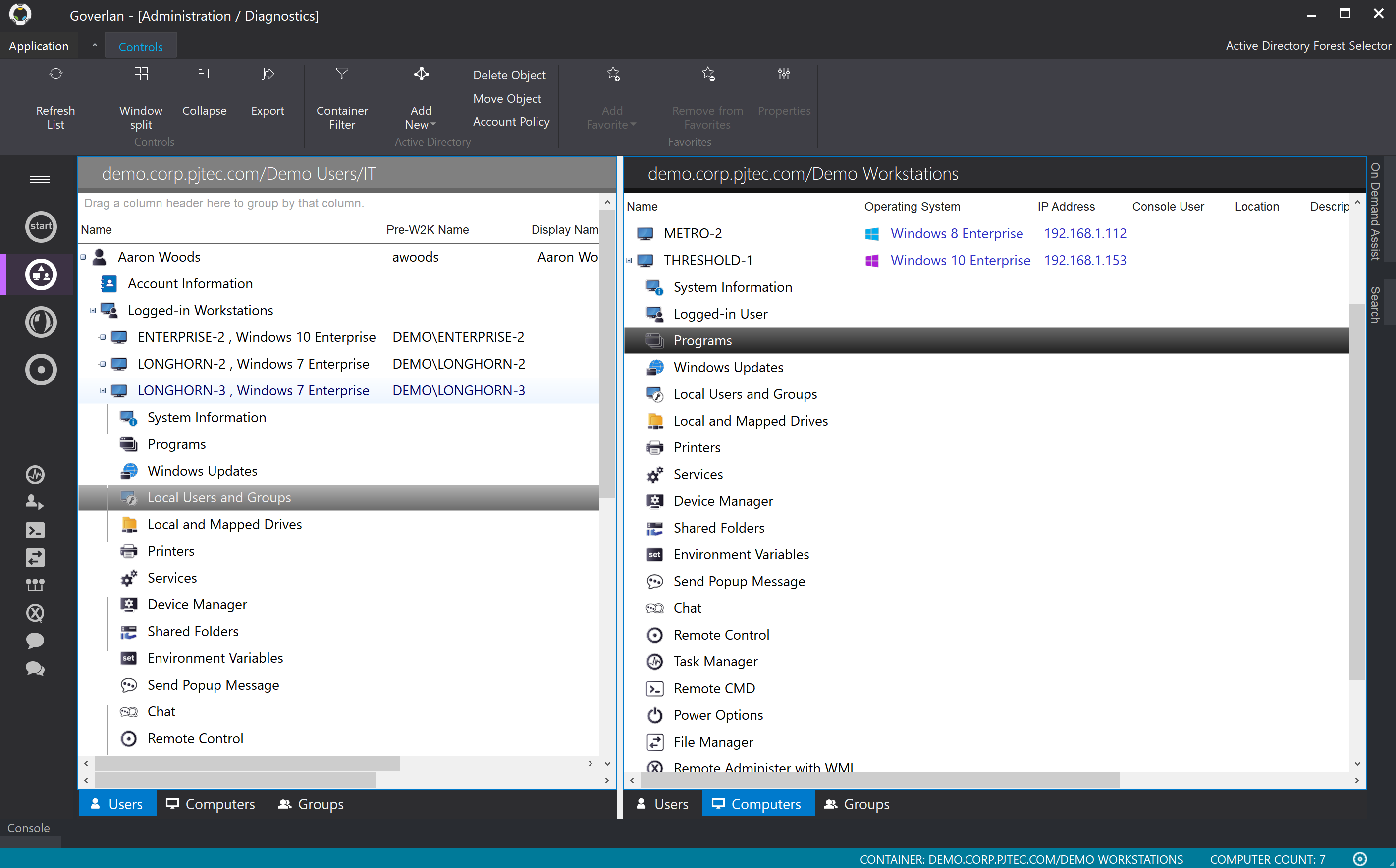
The Goverlan Remote Administration Suite from Goverlan is remote administration software for IT management.
$648
per year
ManageEngine Endpoint Central
Score9.3 out of 10
N/A
Desktop Central from ManageEngine is a client desktop management with patching, remote control, and configuration.
$795
per year per user
Pricing
Goverlan Reach
ManageEngine Endpoint Central
Editions & Modules
Standard
$648
per year
Professional
$1,428
per year
Enterprise
$2,772
per year
No answers on this topic
Offerings
Pricing Offerings
Goverlan Reach
ManageEngine Endpoint Central
Free Trial
Yes
Yes
Free/Freemium Version
No
No
Premium Consulting/Integration Services
No
No
Entry-level Setup Fee
No setup fee
No setup fee
Additional Details
* Each operator license allows the remote management and support of an unlimited number of INTERNAL endpoints
* Each license includes between 10 to 20 manageable EXTERNAL endpoints (based on edition). Additional external endpoint licence is $5 per node per year (volume discount available)
* Operator licenses can be purchased on a perpetual or subscription basis
This product is a must for any help desk that is supporting an active directory based network. Scope action capabilities also make it valuable to systems administrators etc.
A de minimis incentive was given to thank the reviewer for their time. The incentive was not used to bias or drive a particular response, nor was the incentive contingent on a positive endorsement. More Info
Compared to other endpoint management tools that I have experience with, the patch management and the system health statistics functions work much better and are easier to navigate. The endpoint control functions are nowhere near as good as what I've used with Kaseya's VSA application - with that you could remote control a machine via a remote desktop type interface, or you could connect to the command line or PowerShell and it functioned as if you were directly connected to the machine - command history, tab completion, etc.. "just worked" and if the endpoint disconnected, you didn't lose anything that was going in the window when it reconnected (Exception being if the machine rebooted), grouping systems by department or building was also easier, as was moving systems between groups
A de minimis incentive was given to thank the reviewer for their time. The incentive was not used to bias or drive a particular response, nor was the incentive contingent on a positive endorsement. More Info
A de minimis incentive was given to thank the reviewer for their time. The incentive was not used to bias or drive a particular response, nor was the incentive contingent on a positive endorsement. More Info
We set alerts when a devices gets low on disk space. That is automatic and creates a ticket in ME SDP. We are then able to Add space to a VM Desktop, and then go thru ManageEngine Endpoint Central to extend the drives so the entire process can be done without interruption to the end user.
Using the patch scans we can easily see what patches have been installed for all manufacturers not just Microsoft, without having to physically go to the device. It also allows us to choose which patches we want to push out and automate the process so we can be hands off, freeing up out time for other things.
Remote access to devices. This allows us to remotely make changes, not just via remote control but also make registry changes and clean up space without going to the device and without interruption to the end user.
Alerts. We have set up to get email alerts when new hardware is plugged into any computers. This lets us know if someone is bringing in un-authorized equipment (thumb drives, hubs, etc) to better manage what is/is not on our network.
A de minimis incentive was given to thank the reviewer for their time. The incentive was not used to bias or drive a particular response, nor was the incentive contingent on a positive endorsement. TR verified that a representative sample of customers was invited. More Info
Machines must be online for actions to be performed, scopes allow you to rerun them against failed objects only but really a much better option would be for client agent to check in at power on for open jobs.
Newest version of Reach is glitchy on Windows 10 requiring the occasional restart of the application.
A de minimis incentive was given to thank the reviewer for their time. The incentive was not used to bias or drive a particular response, nor was the incentive contingent on a positive endorsement. More Info
When I first started using ManageEngine Endpoint Central, the UI felt very complicated and cluttered up, which means as a new user, it took a lot of time to get used to using it and knowing where certain features are. This was also because specific features aren't obvious to the user, it can take time to find them through multiple routes.
When pushing out specifc software to a large number of endpoint devices such as 1500 in my organisation, the deployment fails a lot more meaning some devices dont receive the software and this has to be done manually for them. This can take a lot of time.
When an issue is reported about ManageEngine Endpoint Central, for example it constantly crashing when being heavily used. The support was delayed and it took a lot of time for first line support to address the issue and escalate it.
ManageEngine is considered an excellent product due to its comprehensive suite of solutions for IT management, with ManageEngine Endpoint Central specifically excelling in endpoint management. The platform stands out for its user-friendly interface, robust features, and versatility in addressing diverse IT needs. It offers organizations a centralized solution for endpoint security, patch management, software deployment, and asset management
The application itself is great. However, I have little insight to what the patches are doing. Being able to see patch download progress, not just the status, would be great. The user interface could also use an overhaul. The countless menus, sometimes containing similar if not duplicate tabs can be frustrating to navigate.
A de minimis incentive was given to thank the reviewer for their time. The incentive was not used to bias or drive a particular response, nor was the incentive contingent on a positive endorsement. More Info
The immediate chat support is great and very helpful. However, if you need escalated support or have a deeper need that the chat tool can't help with, you will experience significant wait times and slow responses. The time zone difference becomes painful to the point of often just giving up.
A de minimis incentive was given to thank the reviewer for their time. The incentive was not used to bias or drive a particular response, nor was the incentive contingent on a positive endorsement. More Info
I tend to use a combination of solutions to keep the estate running efficiently. ManageEngine Endpoint Central has more control over the timing of patching for users. Juggling users being able to work and keeping systems up to date with user satisfaction in mind is a monthly goal. Pushing updates with giving users some control seems to be working.
A de minimis incentive was given to thank the reviewer for their time. The incentive was not used to bias or drive a particular response, nor was the incentive contingent on a positive endorsement. More Info
With a product like this it is entirely possible that you will see large increase in Help Desk efficiency for those who are willing to take the time to fully explore its possibilities.
Much more robust that any other remote support product I have used while still extremely cheap compared to competing products. This can bring enterprise level support options to those that may normally not be able to afford it.
Reporting features are invaluable to anyone wanting to truly know what is happening on their network.
A de minimis incentive was given to thank the reviewer for their time. The incentive was not used to bias or drive a particular response, nor was the incentive contingent on a positive endorsement. More Info
It has greatly helped us with our compliances through the compliance scans, such as taking our CIS compliance from 36% up to around 90%.
It has massively reduced the number of application/patch vulnerabilities through automated patching & dynamic configurations with custom scripts. From 60 criticals and 300 highs down to just 5 criticals and 25 highs, very quickly.
It has helped us identify issues with our Bitlocker not syncing to Azure AD properly, because the recovery keys in ManageEngine were always correct but werent always correct in Azure AD.
A de minimis incentive was given to thank the reviewer for their time. The incentive was not used to bias or drive a particular response, nor was the incentive contingent on a positive endorsement. More Info