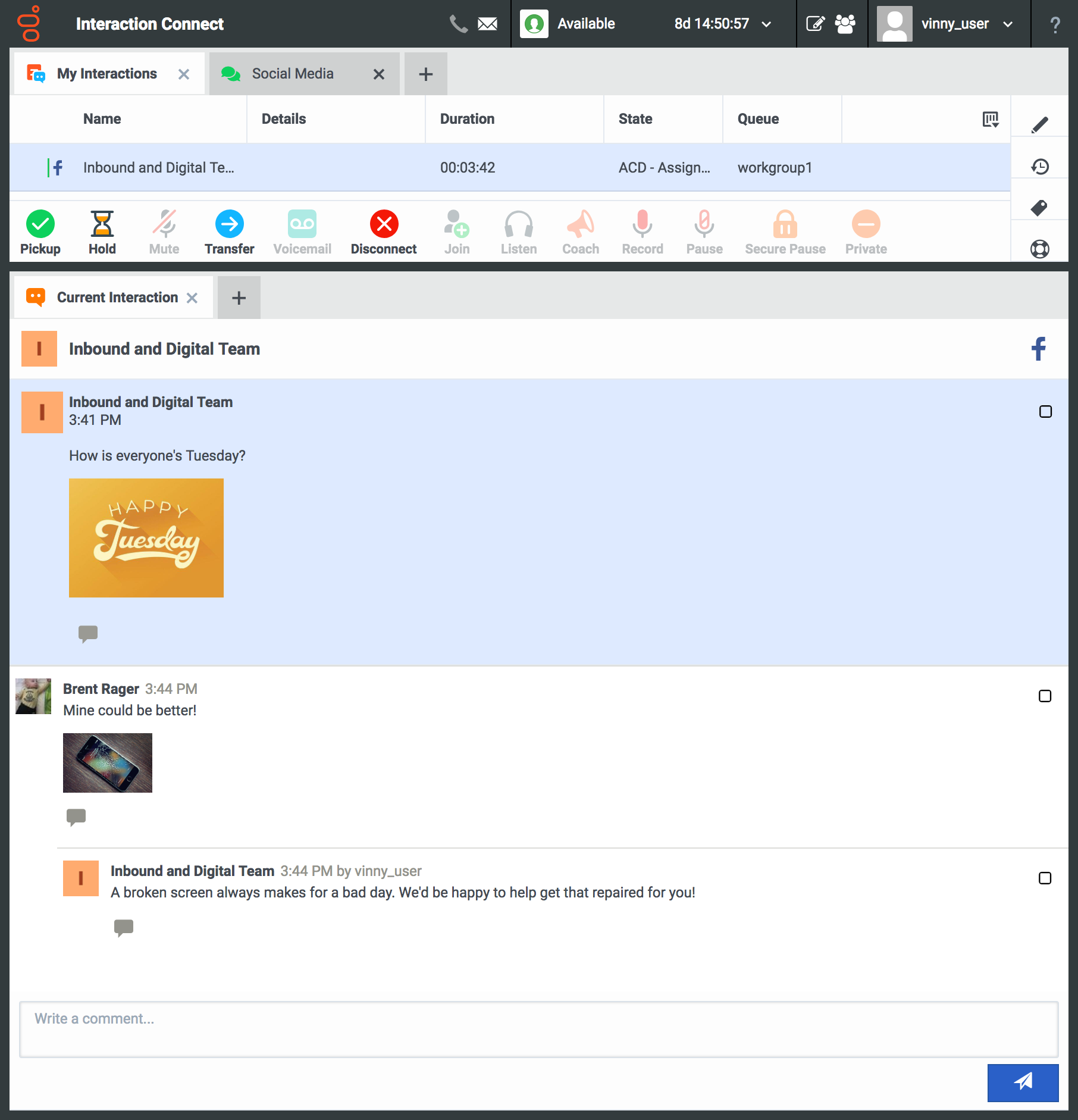
Genesys PureConnect was an omnichannel contact center platform that offered cloud-based or on-premise deployments. It featured a SIP-based architecture with VoIP capabilities, allowing companies to connect legacy voice systems and use existing phones. A legacy product, new users are encouraged to investigate Genesys Cloud.
N/A
Salesforce Service Cloud
Score 8.4 out of 10
N/A
Service Cloud is a customer service platform that helps businesses manage and resolve customer inquiries and issues. It provides tools for case management, knowledge base, omni-channel support, automation, and analytics, enabling companies to deliver exceptional customer service experiences.
$25
per month
Pricing
Genesys PureConnect (discontinued)
Salesforce Service Cloud
Editions & Modules
No answers on this topic
Starter Suite
$25
per month
Pro Suite
$100
per month per user
Enterprise
$165
per month per user
Unlimited
$330
per month per user
Agentforce 1
$550
per month per user
Offerings
Pricing Offerings
Genesys PureConnect (discontinued)
Salesforce Service Cloud
Free Trial
No
Yes
Free/Freemium Version
No
Yes
Premium Consulting/Integration Services
No
No
Entry-level Setup Fee
No setup fee
No setup fee
Additional Details
—
—
More Pricing Information
Community Pulse
Genesys PureConnect (discontinued)
Salesforce Service Cloud
Features
Genesys PureConnect (discontinued)
Salesforce Service Cloud
Contact Center Software
Comparison of Contact Center Software features of Product A and Product B
Genesys PureConnect (discontinued)
7.9
64 Ratings
5% below category average
Salesforce Service Cloud
-
Ratings
Agent dashboard
6.755 Ratings
00 Ratings
Validate callers
7.548 Ratings
00 Ratings
Outbound response
8.541 Ratings
00 Ratings
Call forwarding
7.756 Ratings
00 Ratings
Click-to-call (CTC)
8.043 Ratings
00 Ratings
Warm transfer
8.357 Ratings
00 Ratings
Predictive dialing
8.036 Ratings
00 Ratings
Interactive voice response
8.045 Ratings
00 Ratings
REST APIs
7.037 Ratings
00 Ratings
Call scripts
8.539 Ratings
00 Ratings
Call tracking
7.755 Ratings
00 Ratings
Multichannel integration
9.044 Ratings
00 Ratings
CRM software integration
8.038 Ratings
00 Ratings
Workforce Optimization (WFO)
Comparison of Workforce Optimization (WFO) features of Product A and Product B
Genesys PureConnect (discontinued)
5.5
54 Ratings
40% below category average
Salesforce Service Cloud
-
Ratings
Inbound call routing
6.551 Ratings
00 Ratings
Omnichannel inbound routing
6.539 Ratings
00 Ratings
Recording
4.552 Ratings
00 Ratings
Quality management
4.546 Ratings
00 Ratings
Call analytics
3.043 Ratings
00 Ratings
Historical reporting
5.052 Ratings
00 Ratings
Live reporting
6.548 Ratings
00 Ratings
Customer surveys
8.035 Ratings
00 Ratings
Customer interaction analytics
5.030 Ratings
00 Ratings
Incident and problem management
Comparison of Incident and problem management features of Product A and Product B
Genesys PureConnect (discontinued)
-
Ratings
Salesforce Service Cloud
8.8
77 Ratings
9% above category average
Organize and prioritize service tickets
00 Ratings
9.475 Ratings
Expert directory
00 Ratings
8.553 Ratings
Subscription-based notifications
00 Ratings
8.663 Ratings
ITSM collaboration and documentation
00 Ratings
8.260 Ratings
Ticket creation and submission
00 Ratings
9.375 Ratings
Ticket response
00 Ratings
9.174 Ratings
Self Help Community
Comparison of Self Help Community features of Product A and Product B
Genesys PureConnect (discontinued)
-
Ratings
Salesforce Service Cloud
8.7
72 Ratings
10% above category average
External knowledge base
00 Ratings
8.463 Ratings
Internal knowledge base
00 Ratings
8.970 Ratings
Multi-Channel Help
Comparison of Multi-Channel Help features of Product A and Product B
CIC is best suited for business models that rely on heavily leverage Data Integration especially one like ours that require real-time and high-speed data access for billing and customer integration. CIC is not well suited for small organizations < 50 where they are only answering phones in the course of doing business VS. the business is the phone.
It is a helpful tool, but it can be a bit cumbersome to manage. It is also a bit expensive, but we already use CRM for Salesforce and it is convenient to be able to immediately tag contacts and accounts when the tickets come into the system and tie them directly to the account. I do know an integration with Jira is possible (we use Jira internally for our engineering team to escalate issues) but it is not configured right now so managing the connection between support tickets and Jira tickets is manual and hard to keep up with
We are so embedded on Pure Connect that we like to progress with it. For instance, we are looking into ways to provide different solutions to our customers, help our business to succeed, and work in a better CX.
One of the biggest advantages is that all is in one platform.
Professional edition works best for a small company with lower call volumes and is very useful but as you grow exponetially I think it has limited ability to do all the things we want to - SLA management, defect, release management to name a few. Reports and dashboards being available in real time.
The interface is only semi user-friendly on almost every front. Agent experience is lacking and we have found many limitations within the system. Workforce forecasting is not as robust as expected. Quality continues to be a struggle. Interaction searches are not robust.
I had Salesforce experience prior to using Service Cloud which made it a little easier to learn and navigate, but overall my team (some who had no Salesforce experience) caught on very quickly and found Service Cloud to be easy to use.
The application itself uses a hub and spoke model that can help isolate errors in one section of the application from the rest, creating a much more stable overall program. Of all of the outages that we've had with our contact center platform, I can count on one hand how often it was truly a Genesys issue rather than a network issue, server issue or issue with a platform relied upon for an integration (web services, db calls).
Salesforce's Trust Center clearly communicates occasional issues to anyone who subscribes, down to an organization's cloud instance. Bundled sandboxes ease updates, and seasonal upgrades are seamless, scheduled well in advance with plenty of information about what's coming. Support agents have noticed intermittent Omni-Channel disconnects due to internet connections, and these are clearly notified.
Some of the client applications take a bit of time on initial load, but with the move towards web based applications that issue is alleviated. You can tell that effort really isn't putting into the desktop apps any longer and that the client development effort is being put into bringing Interaction Connect closer to feature parity with the desktop (and bringing wholly new features to Connect). As far as IVR operations, web service calls, database operations: they all operate reasonably.
The Salesforce Service Cloud generally has very good performance, however the overall new Lightning user experience can bring that down. For example, if you have too many tabs open, then it can take a while for the Lightning UI to load. This UI is probably not well equipped to handle loading of all of that information at once, but Users tend to leave their tabs open all day long. It can also be fickle depending on which browser you use, what extensions you have installed, and whether you've cleared your cache. This can be the downfall with any software as a service though, not just Salesforce
Some cases are resolved quickly others are taking longer and the reseller sometimes has to chase support several times and explain the issue seen several times. While being a direct customer before, I recognise this and it seems that when a case moves to another engineer they don’t read the previous case notes or don’t understand what has been done. This, from a customers perspective, slows down resolution times.
Salesforce offers support, although it generally gets routed to overseas support teams first, and once they are unable to help, it gets escalated up the chain to higher tiers. Frequently, the answer back from support is that there is no native solution, and we either have to turn to the AppExchange for some solution provided by another developer, or custom build our own solution.
I liked the setup of the whole class. The instructor knew the topic well enough to answer questions from entry level to a more advanced one.
Instructor encouraged participation of the whole class and was able to engage every one. Also provided "real live" examples so everyone can relate to it.
Our in-person training was provided by our implementation partner and it was quite good. This was in part because we were already working with them and so it naturally leant itself to a good training relationship. And because they were building our customizations and configuring things, they could then provide training on those things naturally.
The online training itself is good. You are provided resources and can self study to a certain point, but the pacing always felt off. Either snails pace or like trying to drink from a fire hose. I think this easily could have had to do with course material and my personal preparations, though. I would say my main gripe is that since the acquisition the team responsible for actually booking training is very unresponsive and often not knowledgeable about the courses they offer. Booking my last training was a real chore.
Trailheads are great but it was often unclear what actually applied to our organization. This made it difficult to get a whole lot out of it. Part of it is that because the basic Salesforce features didn't quite work for us, we had to add customizations, which then nullified a lot of the training.
Don't try to go the perfect solution as a first target. Work on answer the more needs with a simple solution. Then analyse and try again to answer the most needs with adding a bit if complexity only if require. No needs to customise straight from the beginning or deployment takes too long.
I would go through an implementation very differently knowing what I know now. It was difficult coming from systems we liked in post-sales service and having to adapt to the clunky and underwhelming feature set in Salesforce. I would trim back our expectations
Call Manager, you had to buy all the components that are out of the box for PureConnect. The licensing model is more expensive on the Cisco side vs the Genesys PureConnect side. Lastly was on the Cisco side since you have to connect/integrate all the components on the cisco side you have to have so many vendors to install those parts. This drives the cost up even more so it was not worth going that route for our organization.
Salesforce service cloud is more configurable than Zendesk and Freshdesk. It has its own inbuilt AI chatbot also which further improves service agent efficiency. Salesforce is more integration agnostic and has pre-built connectors with multiple 3rd party systems. However, in terms of pricing it is priced at a premium compared to the other solutions
Genesys PureConnect's core and adjunct model allows for fairly easy growth in satellite locations via off site session managers, remote located media servers, remote content servers, etc to allow you to spread the infrastructure out while not pushing as much network traffic to your core data centers.
We're improving our CX by optimizing our call centers, using additional attributes and keys to identify the best rep for the job.
We are also streamlining the journey of each individual customer by using PureConnect as the central interface for omnichannel interactions, allowing us to pick up the conversation where we left off.
Using additional attributes that start with the contact center interaction, we're able to track a student journey and proactively step in - increasing our individualized support to focus on the student outcome.
Because this is a cloud service, the security, implementation framework and feature list is very mature and you don't have to develop these during implementation.
The larger the implementation programme the better the licensing arrangements
Free developer toolkit for proof of concepts or showcasing features