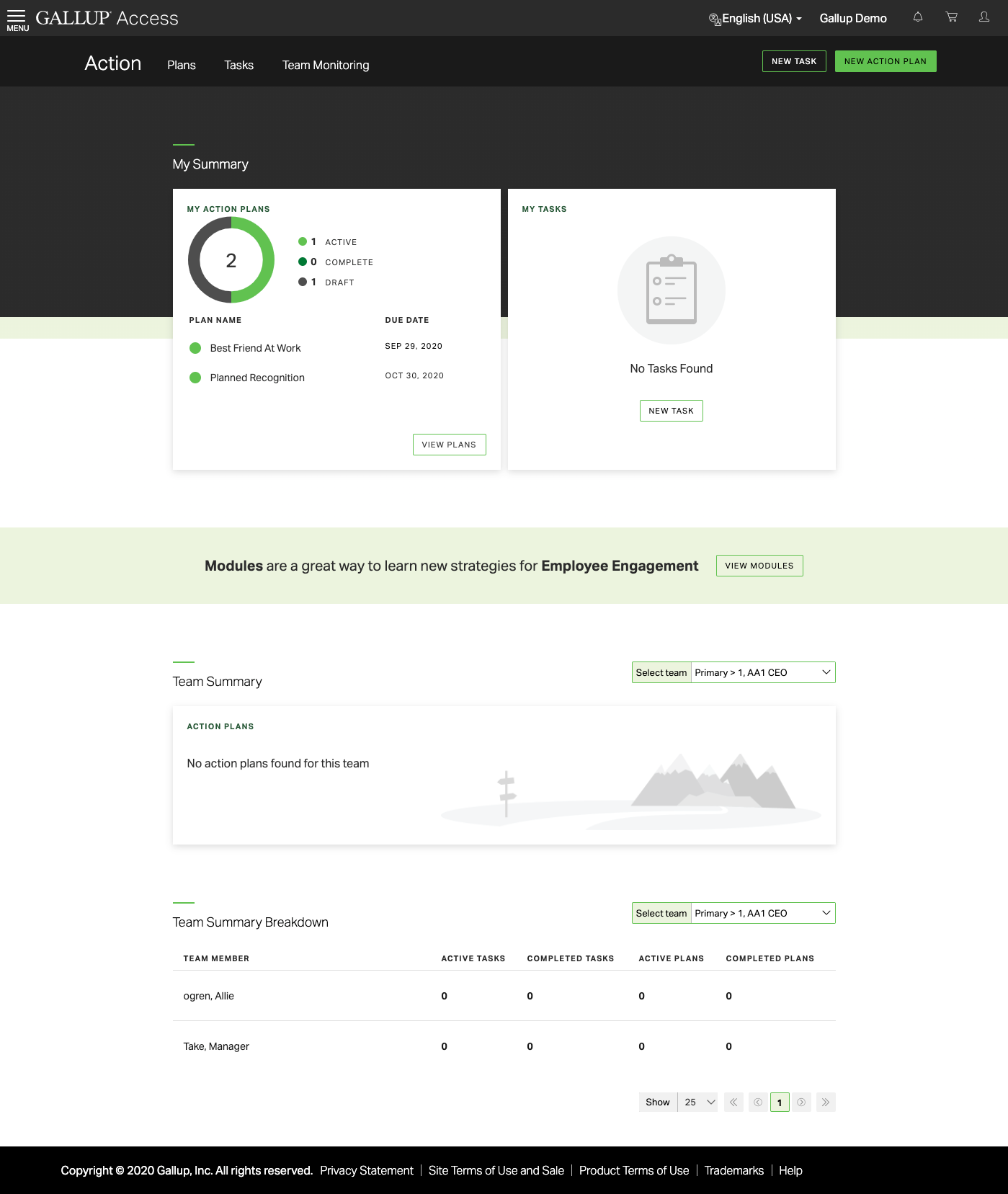
Gallup Access provides tailored advice and actionable next steps for managers and leaders. Leadership and HR teams can explore the data using reporting tools such as organization-wide visualizations and heat map comparisons. Slice and dice data in real time and generate ad hoc reports after employees complete a survey. Find patterns in the data using text analytics to group employees’ written feedback into sentiment and topic categories. Go…
N/A
Workplace from Meta
Score 8.0 out of 10
N/A
Facebook at Work allows users to interact with co-workers through the Facebook interface.
I used Gallup Access for the CliftonStrengths assessment and I do believe it was a great platform for that to be on. However, it took me a second to figure out if I was on the correct website. I'm not sure how, but being able to easily see that taking the assessment on this website would be super helpful. I think I struggled with it because CliftonStrengths book was red and white and the website is black and green. Colors are important when people are looking for certain products.
Well suited: - leadership communication. When our CEO posts a video to all company - it always gets the highest engagement - recognition/achievements posts - live streams for education, knowledge sharing - we are a company of 12000 associates and there is no other corporate channel for us to gather more than 500 people in one place. Less appropriate: - sharing some very targetted messages - it's impossible to do at Workplace without creating a group. So we use email channel for such targetted communications - instant communication like in a chat (probably it's less appropriate in our specific case because we use MS Teams for such quick communication instead of WP chats)
Bring groups of people together to share info, stories, updates, etc.
The chat app is pretty decent.
Workplace Live is a good large-group meeting broadcast platform.
It's pretty intuitive to use for anyone who's used Facebook.
It provides different levels of "security" for groups, allowing you to have open, closed, and "secret" groups.
It's easy to paste images into your posts and comments, without having to necessarily go through the process of saving an image as a file, etc.
It has search capabilities for finding old information.
It's available for both desktop/laptop and mobile devices.
It's secured to allow only those within the company to see company-related info (but it also has a few inter-company groups, which can be useful, too).
Workplace Chat has the ability to set it to Do Not Disturb.
You can set notifications, including email notifications, if you want to be alerted to new activity in your groups, etc.
It would be helpful if a review confirmation checkbox was able to be placed by files that needed to be read or reviewed. Along the same line, approve, review again, etc. would be helpful checkboxes to add by files, proposals.
The layout is clean but suffers a bit from the center column width with two sidebars and a lot of empty space. It almost looks like a going out of business sale retail store where you notice the empty shelves. Workplace feels a bit bare at times. I think some good design modifications can help. Now on mobile, it is a great layout. I am addressing specifically the desktop browser login.
An admin control dashboard would be really effective and even more so with more users on the platform.
Having to download multiple apps just to use the tool is very cumbersome. Facebook would have make this better by wrapping it in as a main feature within their app, but having to use multiple apps to see discussions and walls is so frustrating.
Workplace by Facebook is an excellent fit in respect of support and documentation. It has excellent tutorials and documentation, as well. The UI and UX are already great as it is developed and maintained by Facebook, so most of the times, there is no need for any support or documentation.
GA is a very professional tool, in my past experience, other platforms had felt very lacking, they cover what is needed but GA has really lived up to the expectations, I was surprised by what it does and then some more, there are still some aspects that need more polishing but you get over them with time.
Workplace by Facebook is so much more than just a project management tool like Basecamp or Slack. The ability to disseminate information to employees is easier and better with Workplace by Facebook. It can also be used for informal messaging and sharing of information. It combines the best features of both with the same look and feel as Facebook.
I can't give numbers yet but we have been able to split our most recent project up based on our strengths outlined by cliftonstrengths
Another positive impact is that we were able to bond as a team, we just got jumbled up and put on a new team so the ability to connect with our manager was really awesome
We can meet the project times, that with the communication in real time.
We provide solutions to our suppliers in a reliable and efficient manner.
When a business can save time and at the same time respond to the demands of customers, this translates into greater market capture of action for the company.