draw.io is an online diagramming tool with integrations with Jira, Google, and Confluence available free online or at cost depending on integration chosen.
$5
per month
MindMeister
Score 3.5 out of 10
N/A
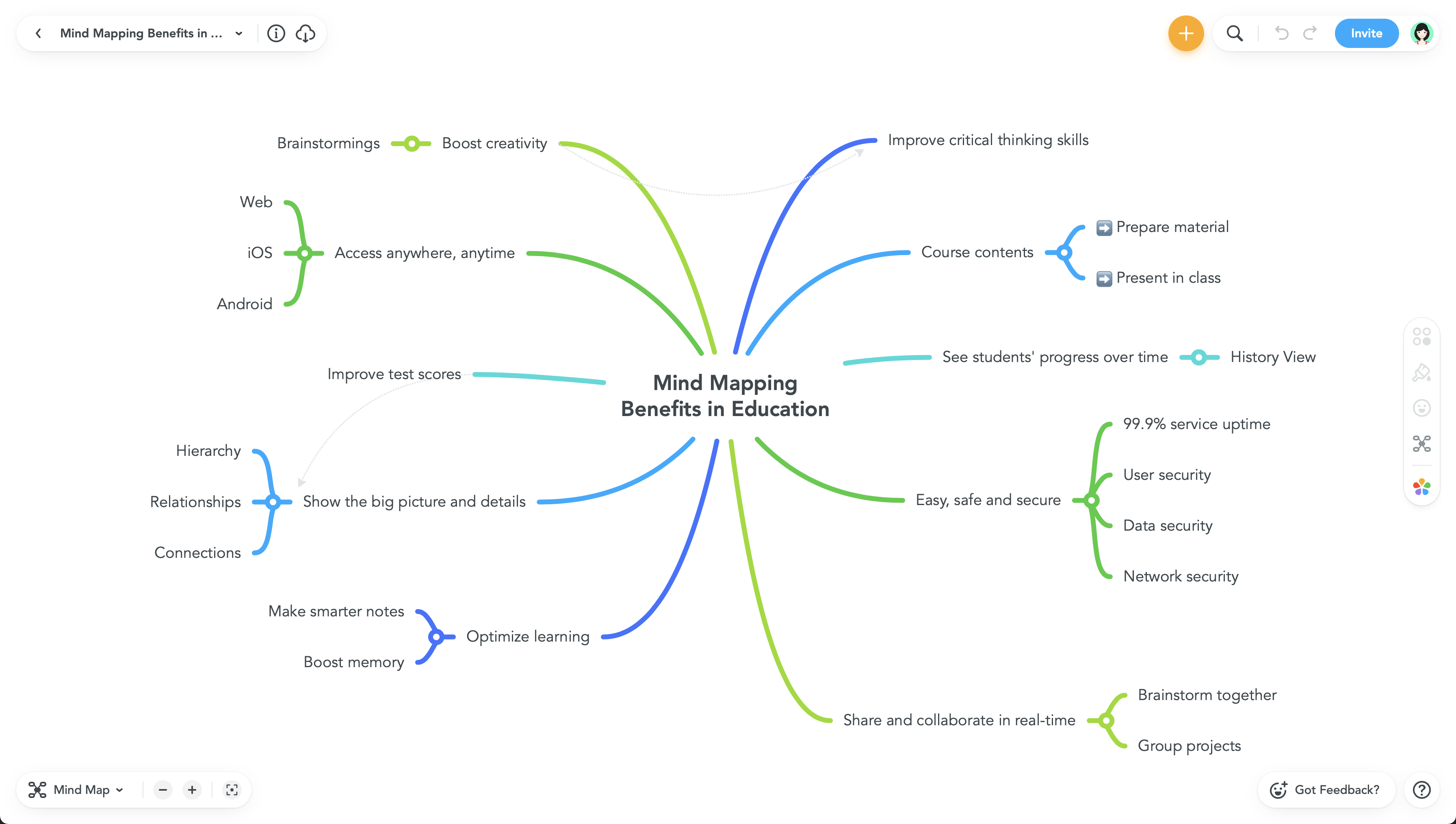
MindMeister is an online mind mapping tool that lets users share maps with an unlimited number of users and collaborate with them in real-time. MindMeister is used to brainstorm ideas, plan projects, take meeting minutes, develop business strategies, and create presentations. MindMeister runs in any standard web-browser as well as on iOS and Android devices, so users can access, edit and present their mind maps anytime, wherever they are. With MindMeister, users…
$45
per 6 months per user
Pricing
draw.io
MindMeister
Editions & Modules
Up to 10 Users
$5
per month
Up to 20 Users
$11
per month
Up to 50 Users
$27.50
per month
Up to 75 Users
$41.25
per month
Up to 100 Users
$55
per month
Up to 200 Users
$95
per month
Up to 500 Users
$152.50
per month
Up to 750 Users
$190
per month
Up to 1,000 Users
$227.50
per month
Up to 2,000 Users
$377.50
per month
Up to 5,000 Users
$827.50
per month
Up to 10,000
1,577.50
per month
Personal
$45
per 6 months per user
Pro
$75
per 6 months per user
Business
$114
per 6 months per user
Offerings
Pricing Offerings
draw.io
MindMeister
Free Trial
No
No
Free/Freemium Version
No
Yes
Premium Consulting/Integration Services
No
No
Entry-level Setup Fee
No setup fee
No setup fee
Additional Details
—
MindMeister offers 6-monthly and yearly subscriptions. Discounts for educational users and non-profit organizations are also available. Up to 22% discount for yearly pricing.
If you need to create a diagram in the cloud, I haven't found a better tool yet. If you need further customizability or export options not offered, then a larger tool might make more sense, but wherever Draw.io can fit in, I think it's the ideal solution.
This product is well suited for making mind maps and outlining projects and ideas from the start. It can be tough if you are trying to convert something you began in Docs. It allows for a lot of intuitive creation, making your work flow easily. It can get to be a bit clunky though if you make your map too large.
The UI is well laid out and easy to use. The workflow makes perfect sense and makes creating tasks a breeze.
The collaboration features make brainstorming not only easy but fun! Everyone enjoys using the tool, which was not the case with other collaboration software we used.
I love being able to get all of my thoughts and ideas on the screen to see them and then be able to connect them in a logical way.
One element that was hard to use was converting pre-existing drawings and workflows from Gliffy to Draw.io once our company made the change. While we were able to complete the migration, when going back we noticed, oftentimes, some formatting and dependencies did not make it or were not compatible.
While the template repository is vast, it has a heavy focus on network style maps. It would be ideal for added diversity in the templates with a focus on workflows just as much.
While the integrations are strong, the cloud collaborative environment could still use some work. While you can save and edit in the cloud. Group editing and live dynamic sharing/editing similar to Microsoft office are still missing.
Draw.io could add some version control functionality for ease of rollback, auditing, & comparison.
I wish collaborators could add comments without having to be given editor privileges. A "Reviewer" role would be helpful.
I would like to be able to toggle note visibility on and off. If there is a way to do it now, I haven't found it. As it is, I have to hover or use the sidebar to see notes.
Two or three times I have seen my nodes spontaneously reverse order in a big map (over their recommended limit). Even so, they are working on tracking the issue down.
The support for draw.io is pretty decent, considering it is a free website. I had a question one time when I was trying to do something, so I sent an email to their support email and got a response fairly quickly with an answer to my question. They also have some excellent support tools on their support website for helping you get more familiar with their program, and I found that very helpful.
Never had an issue with customer support, though we never really needed anything major as far as technical help. I do not believe they offer 24 hour customer support but we don't need it as MindMeister is not the type of tool we need need 24 hour a day support for. Overall, very happy with the level of support.
Draw.io is a free online diagram drawing application for workflow, BPM, org charts, UML, ER, network diagrams. No login or registration are required and features include the ability to save locally (including svg), a range of stencils, .vsdx, Lucidchart and Gliffy import and real time diagram sharing. When I compare draw.io to Lucidchart, it's natural that the first point of comparison will be templates. Lucidchart provides many more templates for both beginners and professionals than draw.io but draw.io has all the essential tools and templates for both business professionals and students (engineering drawing, floor plans, etc). Lucidchart lets you import all the three Microsoft Visio formats — .vdx, .vsd, and .vsdx as well as diagrams from Gliffy, Draw.io, and Omnigraffle. Draw.io lets you import Google Drive, Dropbox, Trello, Gliffy and GitHub. Overall, if you plan to make simple drawings, Draw.io is perhaps the best tool for you. All you need is a Google account to upload and save documents. If you can live with the three documents and sixty objects rule of Lucidchart, you may want to give it a try instead.
Mindmeister has a good free plan compared with Lucidchart, and better Google Drive integration in my opinion. draw.io has a better free plan than MindMeister, but I prefer MindMeister for mindmap creation still, while I prefer draw.io for other types of diagrams. Xmind is powerful, but bloated, and requires installation on every machine that needs to open the file. The fact that MindMeister is in the cloud is a huge bonus.
Our meetings became more productive (time saving /better outcome).
Project management activities became more efficient (time-saving/increased quality/better collaboration).
It became easier to create online repositories to share relevant and well-organized information to our teams (before it was dispersed, incomplete, and difficult to find/manage).