Data Center Real-User Monitoring (DCRUM), discontinued vs. ManageEngine Site24x7

Overview
ProductRatingMost Used ByProduct SummaryStarting Price
Data Center Real-User Monitoring (DCRUM), discontinued
Score 7.2 out of 10
N/A
Data Center Real-User Monitoring (DCRUM), also known as Dynatrace Network Application Monitoring (NAM), was an application monitoring solution focusing on user experience, with an emphasis on how the network – especially the WAN – influences user experience. It is a legacy product from Dynatrace, and is no longer sold or supported.N/A
ManageEngine Site24x7
Score 9.8 out of 10
N/A
Site24x7 from ManageEngine is a full-stack application, website, server, cloud and network monitoring tool. Site24x7 offers code-level diagnostics and customizable error thresholds, end-to-end monitoring with topology visualization tools, and mobile accessibility.
$9
10 monitors
Pricing
Data Center Real-User Monitoring (DCRUM), discontinuedManageEngine Site24x7
Editions & Modules
No answers on this topic
Starter
$9.00
10 monitors
Pro
$35.00
40 Monitors
Classic
$89.00
100 Monitors
Elite
$225.00
250 Monitors
Enterprise
$449.00
500 Monitors
Enterprise Plus Web
$899.00
2500 Monitors
Offerings
Pricing Offerings
Data Center Real-User Monitoring (DCRUM), discontinuedManageEngine Site24x7
Free Trial
NoYes
Free/Freemium Version
NoYes
Premium Consulting/Integration Services
NoNo
Entry-level Setup FeeNo setup fee$1 monitors
Additional DetailsEach Pack will also support additional benefits such as Network interfaces, Applogs, Alert credits etc. You can also, purchase add-ons to create custom pricing options. Please visit the vendor's pricing page, for more information.
More Pricing Information
Community Pulse
Data Center Real-User Monitoring (DCRUM), discontinuedManageEngine Site24x7
Features
Data Center Real-User Monitoring (DCRUM), discontinuedManageEngine Site24x7
Application Performance Management
Comparison of Application Performance Management features of Product A and Product B
Data Center Real-User Monitoring (DCRUM), discontinued
7.2
Ratings
6% below category average
ManageEngine Site24x7
-
Ratings
Application monitoring7.00 Ratings00 Ratings
Database monitoring6.00 Ratings00 Ratings
Threshold alerts7.00 Ratings00 Ratings
Predictive capabilities8.00 Ratings00 Ratings
Application performance management console8.00 Ratings00 Ratings
Collaboration tools8.00 Ratings00 Ratings
Out-of-the box templates to monitor applications7.00 Ratings00 Ratings
Application dependency mapping and thresholding8.00 Ratings00 Ratings
Virtualization monitoring6.00 Ratings00 Ratings
Server availability and performance monitoring7.00 Ratings00 Ratings
Server usage monitoring and capacity forecasting7.00 Ratings00 Ratings
IT Asset Discovery7.00 Ratings00 Ratings
Monitoring Tasks
Comparison of Monitoring Tasks features of Product A and Product B
Data Center Real-User Monitoring (DCRUM), discontinued
-
Ratings
ManageEngine Site24x7
8.4
Ratings
8% above category average
Remote monitoring00 Ratings9.10 Ratings
Network device monitoring00 Ratings7.50 Ratings
Multiple Server Monitoring00 Ratings8.60 Ratings
Multi-device monitoring00 Ratings8.00 Ratings
Automated alerts and notifications00 Ratings9.00 Ratings
Management Tasks
Comparison of Management Tasks features of Product A and Product B
Data Center Real-User Monitoring (DCRUM), discontinued
-
Ratings
ManageEngine Site24x7
7.4
Ratings
0% above category average
Policy-based automation00 Ratings7.40 Ratings
Reporting
Comparison of Reporting features of Product A and Product B
Data Center Real-User Monitoring (DCRUM), discontinued
-
Ratings
ManageEngine Site24x7
8.5
Ratings
11% above category average
Performance data reports00 Ratings8.10 Ratings
Customizable reporting00 Ratings8.40 Ratings
Data visualization00 Ratings8.80 Ratings
Risk analysis00 Ratings8.60 Ratings
Security
Comparison of Security features of Product A and Product B
Data Center Real-User Monitoring (DCRUM), discontinued
-
Ratings
ManageEngine Site24x7
6.6
Ratings
5% above category average
Antivirus and malware management00 Ratings6.60 Ratings
Best Alternatives
Data Center Real-User Monitoring (DCRUM), discontinuedManageEngine Site24x7
Small Businesses
GitLab
GitLab
Score 8.7 out of 10
Panda Systems Management
Score 9.8 out of 10
Medium-sized Companies
ManageEngine Site24x7
Score 9.8 out of 10
ManageEngine ADAudit Plus
Score 9.2 out of 10
Enterprises
ManageEngine Site24x7
Score 9.8 out of 10
ManageEngine ADAudit Plus
Score 9.2 out of 10
All AlternativesView all alternativesView all alternatives
User Ratings
Data Center Real-User Monitoring (DCRUM), discontinuedManageEngine Site24x7
Likelihood to Recommend
7.0
(0 ratings)
8.6
(0 ratings)
Usability
10.0
(0 ratings)
-
(0 ratings)
Support Rating
9.0
(0 ratings)
8.0
(0 ratings)
User Testimonials
Data Center Real-User Monitoring (DCRUM), discontinuedManageEngine Site24x7
Likelihood to Recommend
Dynatrace Network Application Monitoring (NAM), formerly DCRUM, has improved greatly compared to when it was DCRUM; however, it still needs a lot of improvement in end-to-end flow capture with regards to network monitoring. Its alerting and integration capabilities are very good and easy to use. But it still needs a lot of tweaking in usability.
Read full review
I have tried other tools (PRTG etc) in the past, and switched from US monitor to [Site24x7 All-in-One Monitoring], for all the built-in features and ability to implement by using with or without the agents deployed (ip discovery LAN). This is one tool that encompasses the entire organization and allows that single pane of glass feel (NOC screen view) for an accurate virtual snapshot of your entire organization, either cloud and/or LAN.
Read full review
Pros
  • Dynatrace Network Application Monitoring (NAM), formerly DCRUM, is very useful to find the network packet flow across applications
  • It shows the application behavior in terms of end-user performance
  • It integrates very well with other Dynatrace components
Read full review
  • Alerts: Site24x7 can be configured to send alerts in all sorts of ways, from email, to text messages, to even direct automated phone calls.
  • Internal monitoring: An agent installed on one or more machines can monitor internal connectivity to other network devices. This means if connectivity to a server goes down, we often know about it before users alert us.
  • External monitoring: Site24x7 also watched our websites and sends alerts if they're unreachable. It uses multiple locations to do so, which means if there's a partial network outage in some part of the country, we know who is affected.
Read full review
Cons
  • Its configuration requires a lot of technical and business knowledge to drive monitoring expectations to dashboards.
  • DCRUM needs a robust monitoring architecture to store, analyze and visualize all collected data.
  • DCRUM can't monitor the latest Microsoft Exchange versions.
Read full review
  • I wish the advanced monitors were not so expensive.
  • It is a cloud solution, so it is necessary to open up outbound ports in all security zones.
  • If you lose outbound internet service, all your internal servers will throw alarms and life gets extremely noisy.
Read full review
Usability
Best of breed.
Read full review
No answers on this topic
Support Rating
The only thing missing for a 10, would be if they texted or called you back.
Read full review
I have only had to use support once, so I can't go into much detail about their support team. The one time I did use it the response was fast but the resolution took some time.
Read full review
Alternatives Considered
Nagios can't trace real user transactions from a front-end tier through a backend-tier,;with Nagios you only can monitor server availability and hardware issues. Riverbed is commonly used to determine networking issues without considering real user transactions impact on an application stack.
Read full review
Site24x7 [All-in-One Monitoring] has some similarities to ThousandEyes. Especially in the troubleshooting aspect where both offer Web performance waterfall charts to analyze the issue better. Both have cloud-based servers globally that allow to determine performance on the Internet. Site24x7 has more features available so we selected it instead.
Read full review
Return on Investment
  • It has reduced the number of war rooms as well as the number of people involved to address issues.
  • It helps in utilization trending for network capacity.
  • It has prevented poor solutions from hitting production.
  • When the various business units launch own initiatives such as third party tools or new platforms, it's become extremly easy to detect.
  • The reports help in the field of continuous improvement as any changes are immediately discovered and can be compared to history. Deviations from what you have decided as a tolerance corridor can be used to trigger alarms, both positive and negative.
Read full review
  • Positivity wise, we're spending a third of what we were on our website monitoring, this has allowed us to focus funding elsewhere (namely SolarWinds).
  • We have enhanced our core monitoring by now also being able to provide better coverage, whereas we were handicapped with our previous supplier due to the scaling costs of multi-step transactions.
  • The general feeling from our IT staff is that the platform is not great, which obviously reduces confidence in the ability for the platform to provide accurate monitoring data for our websites.
Read full review
ScreenShots

ManageEngine Site24x7 Screenshots

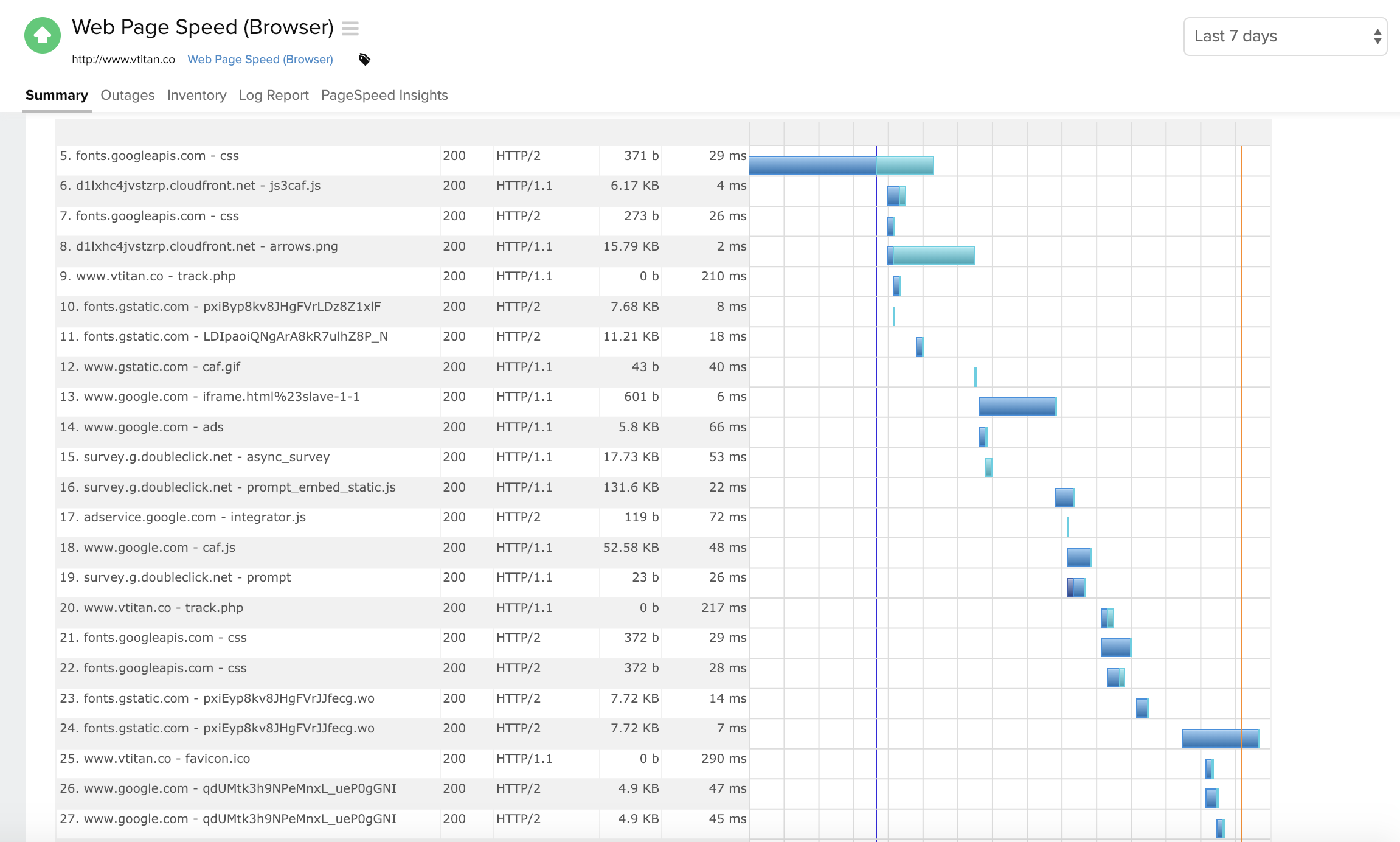
Screenshot of Component wise metric breakdown in a Webpage Speed (Browser) monitorScreenshot of Summary page for a windows server monitorScreenshot of Response time and outages summary for a DNS server monitorScreenshot of Summary page for traces run on a Java applicationScreenshot of Desktop and mobile view of a Website monitorScreenshot of Homepage view