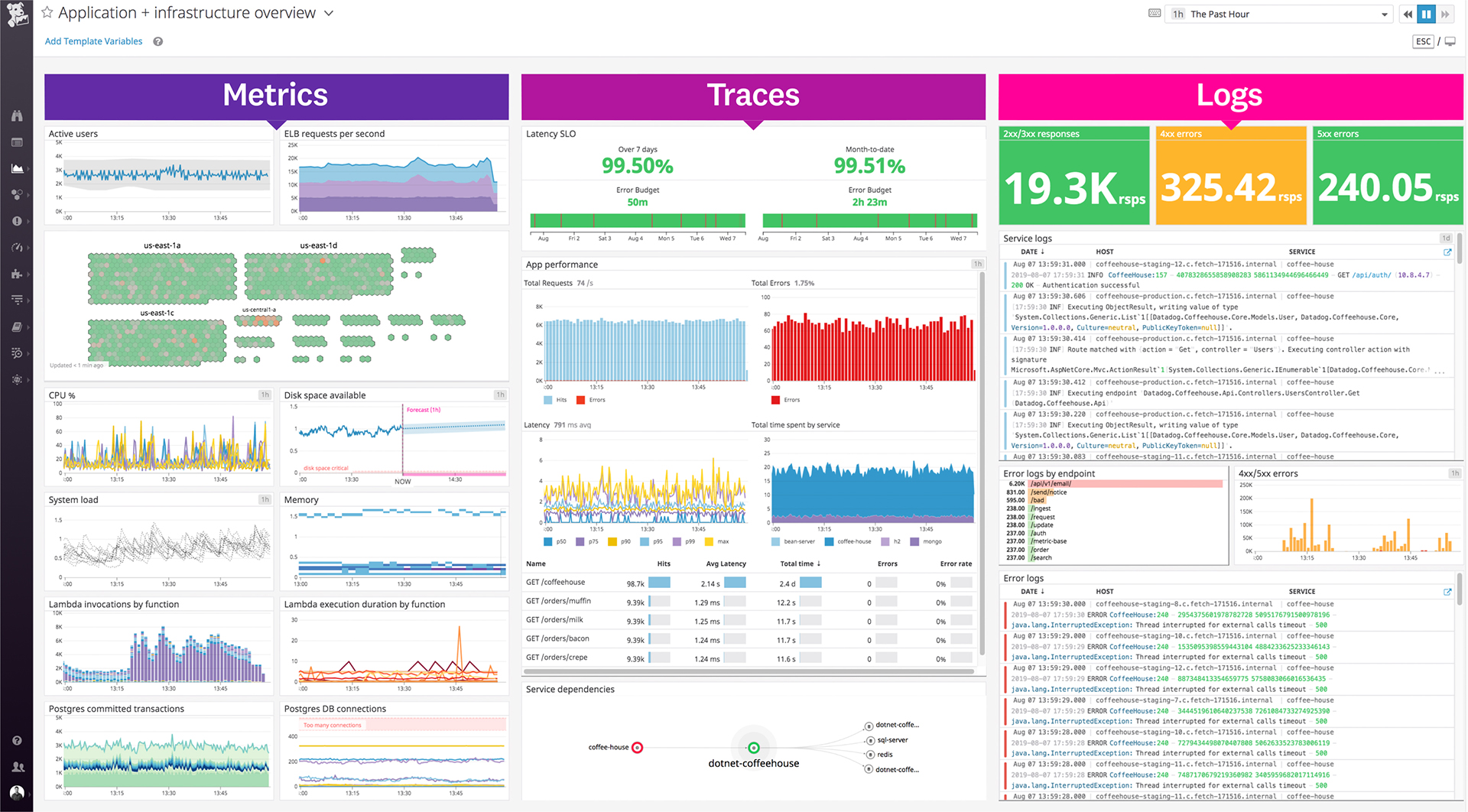
Datadog is a monitoring service for IT, Dev and Ops teams who write and run applications at scale, and want to turn the massive amounts of data produced by their apps, tools and services into actionable insight.
$18
per month per host
Palo Alto Networks WildFire
Score9.8 out of 10
N/A
Palo Alto Network’s WildFire is a malware prevention service. It specializes in addressing zero-day threats through dynamic and static analysis, machine learning, and advanced sandbox testing environments.
N/A
Pricing
Datadog
Palo Alto Networks WildFire
Editions & Modules
Log Management
$1.27
per month (billed annually) per host
Infrastructure
$15.00
per month (billed annually) per host
Standard
$18
per month per host
Enterprise
$27
per month per host
DevSecOps Pro
$27
per month per host
APM
$31.00
per month (billed annually) per host
DevSecOps Enterprise
$41
per month per host
No answers on this topic
Offerings
Pricing Offerings
Datadog
Palo Alto Networks WildFire
Free Trial
Yes
No
Free/Freemium Version
Yes
No
Premium Consulting/Integration Services
No
No
Entry-level Setup Fee
Optional
No setup fee
Additional Details
Discount available for annual pricing. Multi-Year/Volume discounts available (500+ hosts/mo).
Datadog works really well with complex microservices architecture like any E-commerce platform which will be having multiple services but they all are interdependent to others so in this scenario Datadog will be best to monitor these as it will show the transactions also between those microservices. If you are using multiple services in your architecture whether it will be cloud services or on prem services Datadog will be the best choice to monitor all those service with in Datadog so that you can see everything in a single place. But if you are having small architecture and few services in that then in that scenario you can use Datadog but it will be little costly as compared to other but obviously the features are very well.
A de minimis incentive was given to thank the reviewer for their time. The incentive was not used to bias or drive a particular response, nor was the incentive contingent on a positive endorsement. TR verified that a representative sample of customers was invited. More Info
Palo Alto Networks WildFire is highly effective in enterprise environments where detecting zero-day threats and unknown malware is critical. Small businesses may find the cost of advanced subscriptions prohibitive, especially if they only need basic protection. Much of our infrastructure is OT and Palo Alto Networks WildFire is cloud dependent so cannot be used where we have air-gapped systems.
A de minimis incentive was given to thank the reviewer for their time. The incentive was not used to bias or drive a particular response, nor was the incentive contingent on a positive endorsement. More Info
A de minimis incentive was given to thank the reviewer for their time. The incentive was not used to bias or drive a particular response, nor was the incentive contingent on a positive endorsement. More Info
This is could base and easily manageable for our collocation. While working within the could can review in live time potential treats that it has reported from other devices.
Worked very well with existing Palo Alto devices.
Another huge plus is the simplicity of managing and ease of scalability.
Its cost is competitive with similar/like products available.
A de minimis incentive was given to thank the reviewer for their time. The incentive was not used to bias or drive a particular response, nor was the incentive contingent on a positive endorsement. More Info
Alert windows cause lag in notifications (e.g. if the alert window is X errors in 1 hour, we won't get alerted until the end of the 1 hour range)
I would appreciate more supportive examples for how to filter and view metrics in the explorer
I would like a more clear interface for metrics that are missing in a time frame, rather than only showing tags/etc. for metrics that were collected within the currently viewed time frame
A de minimis incentive was given to thank the reviewer for their time. The incentive was not used to bias or drive a particular response, nor was the incentive contingent on a positive endorsement. More Info
A de minimis incentive was given to thank the reviewer for their time. The incentive was not used to bias or drive a particular response, nor was the incentive contingent on a positive endorsement. More Info
It works very well and takes care of protecting us from threats new and well-known. It's been a game changer in terms of threat detection & prevention.
A de minimis incentive was given to thank the reviewer for their time. The incentive was not used to bias or drive a particular response, nor was the incentive contingent on a positive endorsement. More Info
There is some room for improvement, but the Datadog team sends out updates frequently, and the UI is user-friendly for engineers, with no significant loading issues or region-specific problems. That was one of the key reasons we preferred Datadog; our company has employees worldwide, and it wasn't difficult to transition to the tool.
A de minimis incentive was given to thank the reviewer for their time. The incentive was not used to bias or drive a particular response, nor was the incentive contingent on a positive endorsement. More Info
It is a great product that has definitely improved our security posture, however it does require quite a bit of training and time spent customizing for the environment. We had several difficulties in deployment but Palo Alto support was able to help us work through the problems that we were not able to figure out on our own.
A de minimis incentive was given to thank the reviewer for their time. The incentive was not used to bias or drive a particular response, nor was the incentive contingent on a positive endorsement. More Info
The support team usually gets it right. We did have a rather complicate issue setting up monitoring on a domain controller. However, they are usually responsive and helpful over chat. The downside would be I don’t think they have any phone support. If that is important to you this might not be a good fit.
A de minimis incentive was given to thank the reviewer for their time. The incentive was not used to bias or drive a particular response, nor was the incentive contingent on a positive endorsement. More Info
PAN support is very good. You can get the reasonable and timely support on any conditions. When the product is already integrated with the PAN firewalls, you can choose the severity levels based on the effect. The customer service/TAC is very helpful, they even have additional recommendations of advises for product usability. Local partners are also assisting the cases and give their expertise.
A de minimis incentive was given to thank the reviewer for their time. The incentive was not used to bias or drive a particular response, nor was the incentive contingent on a positive endorsement. More Info
We are still trying other products, but people still like Datadog. After setting up a dashboard, it's great for monitoring instances on Datadog. Also, the DevOps team had a good time setting up Datadog. It means Datadog was way easier to set up compared to those others.
A de minimis incentive was given to thank the reviewer for their time. The incentive was not used to bias or drive a particular response, nor was the incentive contingent on a positive endorsement. More Info
WildFire from Palo Alto Networks provides security with very little overhead. With AutoFocus, they’ve got threat intelligence built right in. That way, it can prepare us to react swiftly when a significant danger is identified and dealt with as soon as possible. They introduced firewalls that are aware of applications and can make use of Wildfire. It sped our ability to respond to emerging threats up because of this game-changing development.
A de minimis incentive was given to thank the reviewer for their time. The incentive was not used to bias or drive a particular response, nor was the incentive contingent on a positive endorsement. More Info
A de minimis incentive was given to thank the reviewer for their time. The incentive was not used to bias or drive a particular response, nor was the incentive contingent on a positive endorsement. More Info
We've had one or two malware files that were blocked by Wildfire. We use it occasionally to check unusual or unexpected files. Hard to monetize ROI, because we don't know what the impact would have been if the file made it through.
We pay significantly for the Wildfire licenses, but given the potential impact to our business, we feel it is worthwhile. Figure costs are somewhere around $1,500 per year per firewall for a mid-range model. Can be higher or lower for different sized firewalls. Onsite appliance was somewhere between $50-100K, which was too much for us, so we use the cloud model.
A de minimis incentive was given to thank the reviewer for their time. The incentive was not used to bias or drive a particular response, nor was the incentive contingent on a positive endorsement. More Info