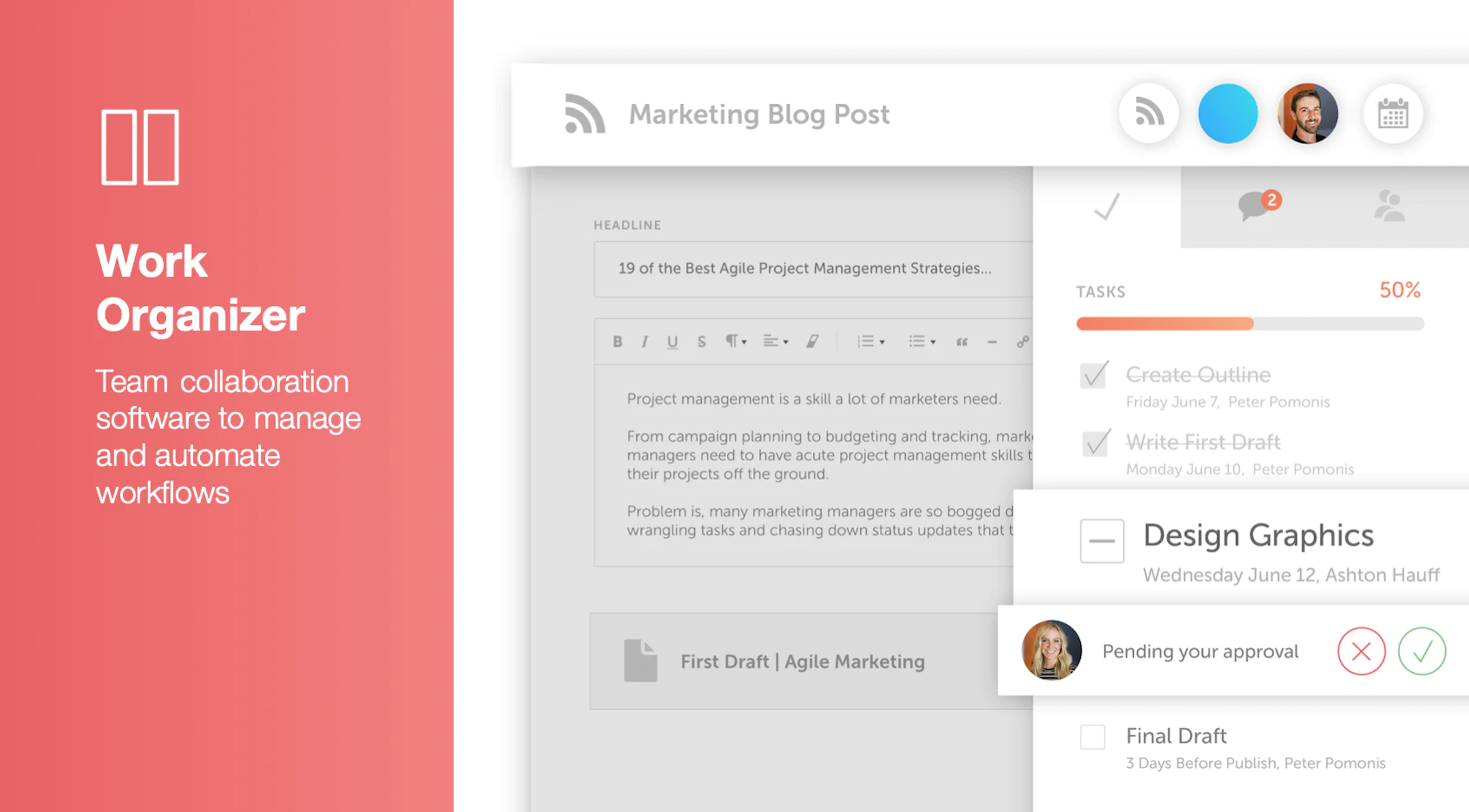
CoSchedule provides a content calendar, content optimization, and contentmarketing products, with users among 50,000 marketers worldwide, helping them organize their work, deliver projects on time, and prove marketing team value.
N/A
Piano Amplifier
Score5.6 out of 10
N/A
A solution to amplify content with AI-powered social publishing. Used to grow and engage an audience through real-time data and machine-learning optimization, guiding users to content, and to just the right place in the social conversation.
Socialflow was acquired by Piano in 2022, and is now a Piano solution.
N/A
Pricing
CoSchedule Marketing Suite
Piano Amplifier
Editions & Modules
No answers on this topic
No answers on this topic
Offerings
Pricing Offerings
CoSchedule Marketing Suite
Piano Amplifier
Free Trial
No
No
Free/Freemium Version
Yes
No
Premium Consulting/Integration Services
No
No
Entry-level Setup Fee
No setup fee
No setup fee
Additional Details
—
—
More Pricing Information
Features
CoSchedule Marketing Suite
Piano Amplifier
Content Creation
Comparison of Content Creation features of CoSchedule Marketing Suite and Piano Amplifier
Feature
CoSchedule Marketing Suite
7.3
1 Ratings
10% below category average
Piano Amplifier
-
Ratings
Ideation
5.01 Ratings
00 Ratings
Content collaboration
7.01 Ratings
00 Ratings
Content calendar
10.01 Ratings
00 Ratings
Content Publishing
Comparison of Content Publishing features of CoSchedule Marketing Suite and Piano Amplifier
Feature
CoSchedule Marketing Suite
10.0
1 Ratings
21% above category average
Piano Amplifier
-
Ratings
Content distribution
10.01 Ratings
00 Ratings
Content promotion
10.01 Ratings
00 Ratings
Content automation
10.01 Ratings
00 Ratings
Content Reporting & Analytics
Comparison of Content Reporting & Analytics features of CoSchedule Marketing Suite and Piano Amplifier
Feature
CoSchedule Marketing Suite
10.0
1 Ratings
24% above category average
Piano Amplifier
-
Ratings
Closed-loop tracking and reporting
10.01 Ratings
00 Ratings
Content performance analytics
10.01 Ratings
00 Ratings
Listening/monitoring
Comparison of Listening/monitoring features of CoSchedule Marketing Suite and Piano Amplifier
Feature
CoSchedule Marketing Suite
-
Ratings
Piano Amplifier
5.0
2 Ratings
43% below category average
Boolean keyword searches
00 Ratings
5.12 Ratings
Filtering out noise/spam
00 Ratings
4.62 Ratings
Sentiment analysis
00 Ratings
5.12 Ratings
Broad channel coverage
00 Ratings
5.12 Ratings
Publishing
Comparison of Publishing features of CoSchedule Marketing Suite and Piano Amplifier
Feature
CoSchedule Marketing Suite
-
Ratings
Piano Amplifier
5.1
3 Ratings
45% below category average
Content planning and scheduling
00 Ratings
5.13 Ratings
Audience targeting
00 Ratings
5.13 Ratings
Content optimization
00 Ratings
5.13 Ratings
Workflow management
00 Ratings
5.13 Ratings
Engagement
Comparison of Engagement features of CoSchedule Marketing Suite and Piano Amplifier
Feature
CoSchedule Marketing Suite
-
Ratings
Piano Amplifier
5.0
3 Ratings
45% below category average
Automated routing and prioritization
00 Ratings
5.12 Ratings
Customer interaction histories
00 Ratings
4.62 Ratings
Bulk actions
00 Ratings
5.13 Ratings
Marketing
Comparison of Marketing features of CoSchedule Marketing Suite and Piano Amplifier
Feature
CoSchedule Marketing Suite
-
Ratings
Piano Amplifier
5.1
3 Ratings
41% below category average
Lead generation
00 Ratings
5.13 Ratings
Content marketing
00 Ratings
5.13 Ratings
Paid media management
00 Ratings
5.13 Ratings
Campaigns and promotions
00 Ratings
5.13 Ratings
Channel coverage/integration
Comparison of Channel coverage/integration features of CoSchedule Marketing Suite and Piano Amplifier
Feature
CoSchedule Marketing Suite
-
Ratings
Piano Amplifier
5.7
3 Ratings
39% below category average
Twitter
00 Ratings
5.13 Ratings
Facebook
00 Ratings
5.13 Ratings
LinkedIn
00 Ratings
5.13 Ratings
Google+
00 Ratings
9.01 Ratings
Instagram
00 Ratings
5.13 Ratings
Pinterest
00 Ratings
5.12 Ratings
YouTube
00 Ratings
5.12 Ratings
Reporting/analytics
Comparison of Reporting/analytics features of CoSchedule Marketing Suite and Piano Amplifier
Feature
CoSchedule Marketing Suite
-
Ratings
Piano Amplifier
5.1
3 Ratings
43% below category average
Campaign success analytics
00 Ratings
5.13 Ratings
Real-time tracking
00 Ratings
5.13 Ratings
Competitor analysis
00 Ratings
5.12 Ratings
Account management
Comparison of Account management features of CoSchedule Marketing Suite and Piano Amplifier
Feature
CoSchedule Marketing Suite
-
Ratings
Piano Amplifier
7.1
3 Ratings
12% below category average
Role-based user permissions & privileges
00 Ratings
7.13 Ratings
Mobile access
00 Ratings
7.13 Ratings
Best Alternatives
CoSchedule Marketing Suite
Piano Amplifier
Small Businesses
Contently
Score9.9 out of 10
Sendible
Score7.6 out of 10
Medium-sized Companies
Optimizely Content Marketing Platform
Score7.1 out of 10
Vista Social
Score9.5 out of 10
Enterprises
Contently
Score9.9 out of 10
Salesforce Marketing Cloud Social Studio (discontinued)
CoSchedule is great for businesses or agencies who need an overview of all their marketing efforts, and who want to establish collaboration between multiple departments. The calendar view is one of the best we've worked with and makes it easy to see exactly what's happening. There is some slight clunkiness when it comes to admin-related tasks, and a few things aren't easy to find, but there's great support.
A de minimis incentive was given to thank the reviewer for their time. The incentive was not used to bias or drive a particular response, nor was the incentive contingent on a positive endorsement. More Info
SocialFlow is well suited for Platform & keyword research : 1. In-depth research to identify requisite platforms & channels and the pertaining keywords, followed by query building to create search profiles & topic tags Social mediaplatforms Professional review forums Industry-focused discussion sites E-commerce websites Content streaming platforms data extraction 2. Setting up processes and tools for data extraction such as –-Social intelligence tools-Web scraping-Custom crawlers-Manual minimum (if applicable)
A de minimis incentive was given to thank the reviewer for their time. The incentive was not used to bias or drive a particular response, nor was the incentive contingent on a positive endorsement. More Info
A de minimis incentive was given to thank the reviewer for their time. The incentive was not used to bias or drive a particular response, nor was the incentive contingent on a positive endorsement. More Info
The platform seems sluggish as of late, likely as a result of the robust amount of data we are entering and the number of filters we're creating.
Social media scheduling exists, but we do run into publishing errors more often then we'd like.
Task templates when updated are not retroactive, so when you create projects for an entire year and then change a template, you need to go back and change them manually.
A de minimis incentive was given to thank the reviewer for their time. The incentive was not used to bias or drive a particular response, nor was the incentive contingent on a positive endorsement. More Info
A de minimis incentive was given to thank the reviewer for their time. The incentive was not used to bias or drive a particular response, nor was the incentive contingent on a positive endorsement. More Info
A de minimis incentive was given to thank the reviewer for their time. The incentive was not used to bias or drive a particular response, nor was the incentive contingent on a positive endorsement. More Info
The interface is very intuitive, from setting up social profiles, to posting, to tags, to optimizing for best day/time to post. It's super easy to scan the aggregate analytics. The calendar is very easy to grok at a glance, and the more advanced functionality is intuitive to set up.
A de minimis incentive was given to thank the reviewer for their time. The incentive was not used to bias or drive a particular response, nor was the incentive contingent on a positive endorsement. More Info
I give this rating as an outcome to understand competitor social strategy to improve strategic positioning. Drive improvement by benchmarking and serving to compete on content Identify trends, topics/themes, potential threats, etc. Improve campaigns by measuring and comparing audience reach, Interaction, etc. Measure engagement rate to analyze audience association. What themes/topics are generating higher engagement Insights to assist marketing teams in planning future campaigns
I didn't have to use their official support, but I can say that they put out a lot of content online to help users. Their YouTube page has quite an array of tutorial videos explaining how things work and how to get the most out of their tools. If you're struggling, before picking up a phone or blasting off an email, try searching for your problem on YouTube or their forums.
A de minimis incentive was given to thank the reviewer for their time. The incentive was not used to bias or drive a particular response, nor was the incentive contingent on a positive endorsement. More Info
A de minimis incentive was given to thank the reviewer for their time. The incentive was not used to bias or drive a particular response, nor was the incentive contingent on a positive endorsement. More Info
CoSchedule provides collaborative planning of projects. The calendar view is very well designed. Meetings and tasks can be scheduled and tracked easily. Whatever is being done, no matter how big the task/project is, it gives a bird-eye view of everything. Additionally, it also integrated very well with WordPress. Their customer service team is also very helpful.
A de minimis incentive was given to thank the reviewer for their time. The incentive was not used to bias or drive a particular response, nor was the incentive contingent on a positive endorsement. More Info
We've also evaluated HootSuite and Sprout Social, and we used both in the past. SocialFlow is superior in its content system for creating, editing, and publishing posts. It's ideal for a team of our size. The cost is fair. It was overall the best option in all of the categories we were looking for.
A de minimis incentive was given to thank the reviewer for their time. The incentive was not used to bias or drive a particular response, nor was the incentive contingent on a positive endorsement. More Info
It has saved me about 1 hour per day to keep things organized from Asana to WordPress.
By not having a functioning Google Doc import feature, it costs me about 30 minutes for each blog post to copy paste all the content, images, etc.
By bundling too many features into their plans, many of which we don't use (e.g. social media scheduling), we lose a little ROI because we are not using the full feature set. We use and prefer Buffer for social media, so when CoSchedule raised their price $40+ per month on features we would not be using, that hurt.
A de minimis incentive was given to thank the reviewer for their time. The incentive was not used to bias or drive a particular response, nor was the incentive contingent on a positive endorsement. More Info
A de minimis incentive was given to thank the reviewer for their time. The incentive was not used to bias or drive a particular response, nor was the incentive contingent on a positive endorsement. More Info