AWS Elastic Beanstalk is the platform-as-a-service offering provided by Amazon and designed to leverage AWS services such as Amazon Elastic Cloud Compute (Amazon EC2), Amazon Simple Storage Service (Amazon S3).
$0
Users pay for AWS resources (e.g. EC2, S3 buckets, etc.) used to store and run the application.
CS-Cart Multi-Vendor
Score 8.6 out of 10
Mid-Size Companies (51-1,000 employees)
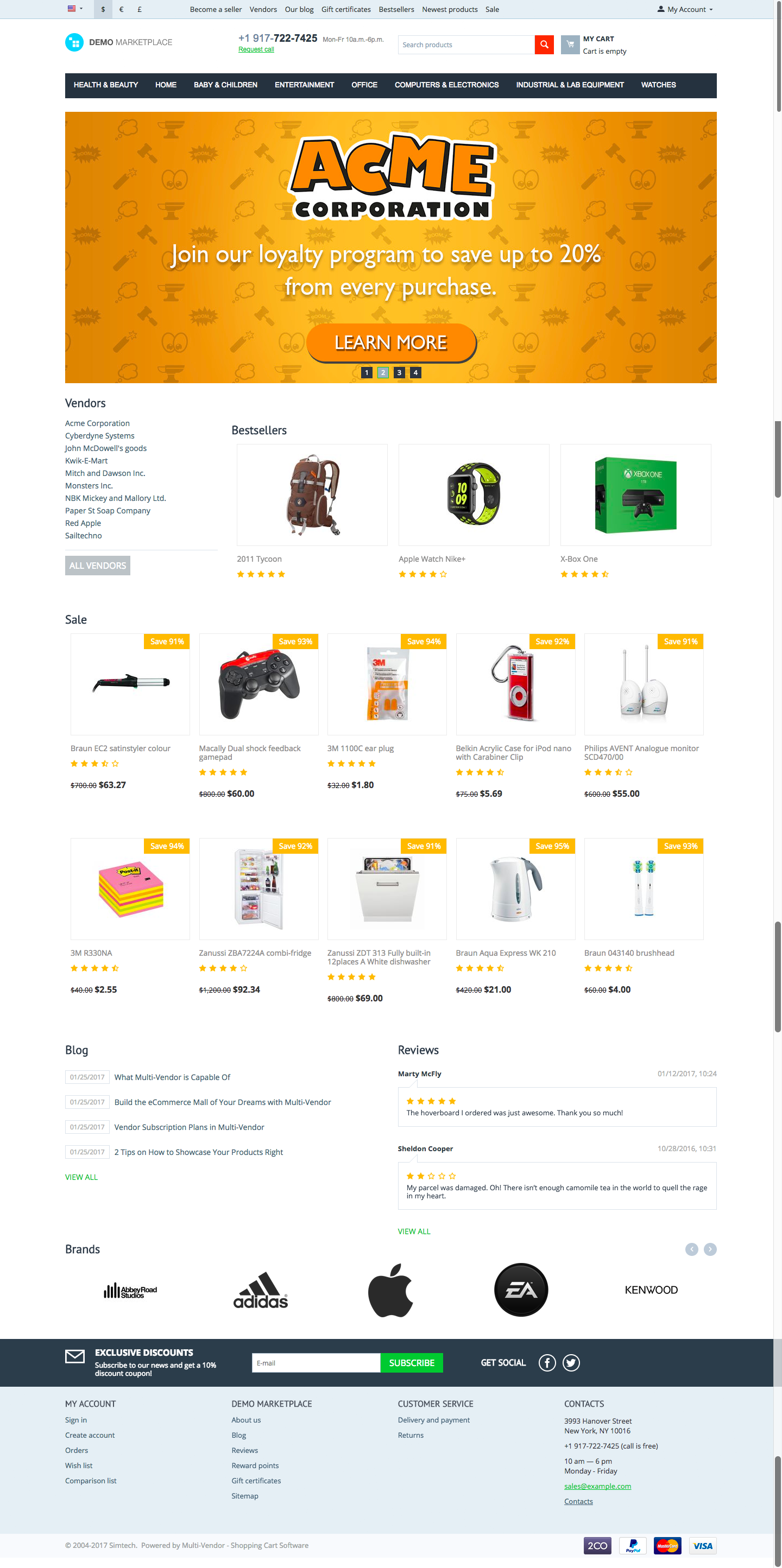
CS-Cart Multi-Vendor is an eCommerce marketplace software for SMBs available in cloud (No-Code) and self-hosted (On-Premises) versions. It allows users to open an online marketplace, where the user is the admin, and all the others—invited sellers. Each seller has his or her own micro-store with a customizable storefront, categories, filters, and search. Just like in Amazon. In the CS-Cart Multi-Vendor marketplace platform, managing vendors is designed to be simple:…
$660
per year
Pricing
AWS Elastic Beanstalk
CS-Cart Multi-Vendor
Editions & Modules
No Charge
$0
Users pay for AWS resources (e.g. EC2, S3 buckets, etc.) used to store and run the application.
Standard
$660
per year
Plus
$1,320
per year
Ultimate
$3,300
per year
Unlimited
Contact Sales
one-time fee
Offerings
Pricing Offerings
AWS Elastic Beanstalk
CS-Cart Multi-Vendor
Free Trial
No
Yes
Free/Freemium Version
Yes
No
Premium Consulting/Integration Services
No
No
Entry-level Setup Fee
No setup fee
Optional
Additional Details
—
—
More Pricing Information
Community Pulse
AWS Elastic Beanstalk
CS-Cart Multi-Vendor
Features
AWS Elastic Beanstalk
CS-Cart Multi-Vendor
Platform-as-a-Service
Comparison of Platform-as-a-Service features of Product A and Product B
AWS Elastic Beanstalk
8.0
Ratings
0% above category average
CS-Cart Multi-Vendor
-
Ratings
Ease of building user interfaces
8.10 Ratings
00 Ratings
Scalability
7.20 Ratings
00 Ratings
Platform management overhead
8.10 Ratings
00 Ratings
Workflow engine capability
7.20 Ratings
00 Ratings
Platform access control
8.10 Ratings
00 Ratings
Services-enabled integration
8.10 Ratings
00 Ratings
Development environment creation
7.20 Ratings
00 Ratings
Development environment replication
8.10 Ratings
00 Ratings
Issue monitoring and notification
8.10 Ratings
00 Ratings
Issue recovery
9.10 Ratings
00 Ratings
Upgrades and platform fixes
8.10 Ratings
00 Ratings
Online Storefront
Comparison of Online Storefront features of Product A and Product B
AWS Elastic Beanstalk
-
Ratings
CS-Cart Multi-Vendor
8.6
Ratings
9% above category average
Product catalog & listings
00 Ratings
8.80 Ratings
Product management
00 Ratings
8.90 Ratings
Bulk product upload
00 Ratings
8.30 Ratings
Branding
00 Ratings
8.70 Ratings
Mobile storefront
00 Ratings
8.00 Ratings
Product variations
00 Ratings
8.50 Ratings
Website integration
00 Ratings
8.60 Ratings
Visual customization
00 Ratings
8.70 Ratings
CMS
00 Ratings
8.80 Ratings
Online Shopping Cart
Comparison of Online Shopping Cart features of Product A and Product B
AWS Elastic Beanstalk
-
Ratings
CS-Cart Multi-Vendor
8.4
Ratings
9% above category average
Abandoned cart recovery
00 Ratings
8.20 Ratings
Checkout user experience
00 Ratings
8.50 Ratings
Online Payment System
Comparison of Online Payment System features of Product A and Product B
AWS Elastic Beanstalk
-
Ratings
CS-Cart Multi-Vendor
8.9
Ratings
7% above category average
eCommerce security
00 Ratings
8.90 Ratings
eCommerce Marketing
Comparison of eCommerce Marketing features of Product A and Product B
AWS Elastic Beanstalk
-
Ratings
CS-Cart Multi-Vendor
8.4
Ratings
9% above category average
Promotions & discounts
00 Ratings
8.80 Ratings
Personalized recommendations
00 Ratings
8.00 Ratings
SEO
00 Ratings
8.40 Ratings
eCommerce Business Management
Comparison of eCommerce Business Management features of Product A and Product B
AWS Elastic Beanstalk is well suited for [the] rapid development of applications that use standard compute platforms based on popular programming languages. So getting a Go, Python, Ruby, or Node.js app going in AWS Elastic Beanstalk will be easy. For non-standard applications, containers provide another option for using AWS Elastic Beanstalk. In either case, AWS Elastic Beanstalk is well suited for applications that are [self-contained]. AWS Elastic Beanstalk is also good for development or test environments that need a built-in deployment method. AWS Elastic Beanstalk is less appropriate for complex applications that rely on multiple AWS services. While deploying and running the base code might be easy to get going, it may be difficult to apply permissions and integrations with the other services.
Great for a quick and easy setup of a multi-vendor solution, supporting multiple stores / languages / payment options. Will probably need some tuning if you have 1 million products or so. Great if you have a PHP dev or team, probably not the best option if you don't know the language and need to customise backend logic.
How to more easily integrate with other other AWS services. There are plenty out there, but it's not quite as seamless as I feel like it should be to mix and match products.
Make backing up easier when scaling the server. It took quite a bit of time to make sure we had everything set up in case something went wrong.
When you are first starting to use AWS, the dashboard can be very intimidating. There are countless products all with names that aren't very indicative of what they actually do.
As our technology grows, it makes more sense to individually provision each server rather than have it done via beanstalk. There are several reasons to do so, which I cannot explain without further diving into the architecture itself, but I can tell you this. With automation, you also loose the flexibility to morph the system for your specific needs. So if you expect that in future you need more customization to your deployment process, then there is a good chance that you might try to do things individually rather than use an automation like beanstalk.
The overall usability is good enough, as far as the scaling, interactive UI and logging system is concerned, could do a lot better when it comes to the efficiency, in case of complicated node logics and complicated node architectures. It can have better software compatibility and can try to support collaboration with more softwares
The software consists of most of all e-commerce related features. Also, there are plenty of third party addons are available in the market which can improve our business. There are a lot of powerful themes available in the cs cart market which improve the look and feel on the front store. If CS-cart adjusted the price on their software license cost, controlling the third party addon cost and provide more freelancers with cheaper hourly rate for the customization on the cs-cart multi vendor software, the cs-cart company can be a master among other e-commerce software companies in the world.
As I described earlier it has been really cost effective and really easy for fellow developers who don't want to waste weeks and weeks into learning and manually deploying stuff which basically takes month to create and go live with the Minimal viable product (MVP). With AWS Beanstalk within a week a developer can go live with the Minimal viable product easily.
- Do as many experiments as you can before you commit on using beanstalk or other AWS features. - Keep future state in mind. Think through what comes next, and if that is technically possible to do so. - Always factor in cost in terms of scaling. - We learned a valuable lesson when we wanted to go multi-region, because then we realized many things needs to change in code. So if you plan on using this a lot, factor multiple regions.
There are many services like AWS Elastic beanstalk, but there are none with the maturity in the platform or the cost-effectiveness of AWS Elastic Beanstalk. Also, AWS Elastic Beanstalk is the oldest among them, so there are more people with AWS experience than the other platforms. The only thing is their documentation and UX are a bit old, which doesn't stop it from performing greatly, but yes, if you are looking for better UX, then you can check out other options.
For big vision in doing something in online marketplace, I think CS-Cart can help to scale up and run business smoothly. CS-Cart started their business in 2005 and since [then has been] running successfully worldwide. It means they have a large scale of experience in implementing online marketplace based software and we can rely on them.
Elastic Beanstalk removes countless hours from development team responsibility, freeing up those resources to instead focus on building the products that our customers want to use.
As a business that is already embedded into using EC2 instances, it's essentially free to leverage the work that AWS performs on configuring the Elastic Beanstalk stacks.
With Elastic Beanstalk, while there is still a responsibility to ensure that applications can work with updated underlying dependencies, it's much easier when AWS handled the heavy lifting of updating the stacks.
From an investment point of view, it is naturally much more profitable to purchase CS-Cart Multi-Vendor than to assemble a team of developers and try to create such a platform from scratch.
Creating a marketplace is a rather risky business. If you don't know a lot about marketplace building technologies, consider investing in a different business. But if you have already decided on the idea, and all you have to do is find a suitable platform, then CS-Cart Multi-Vendor will probably be a profitable investment. And if your sales go at least half a year after purchasing this platform, then you will quickly enough recoup these several thousand dollars.