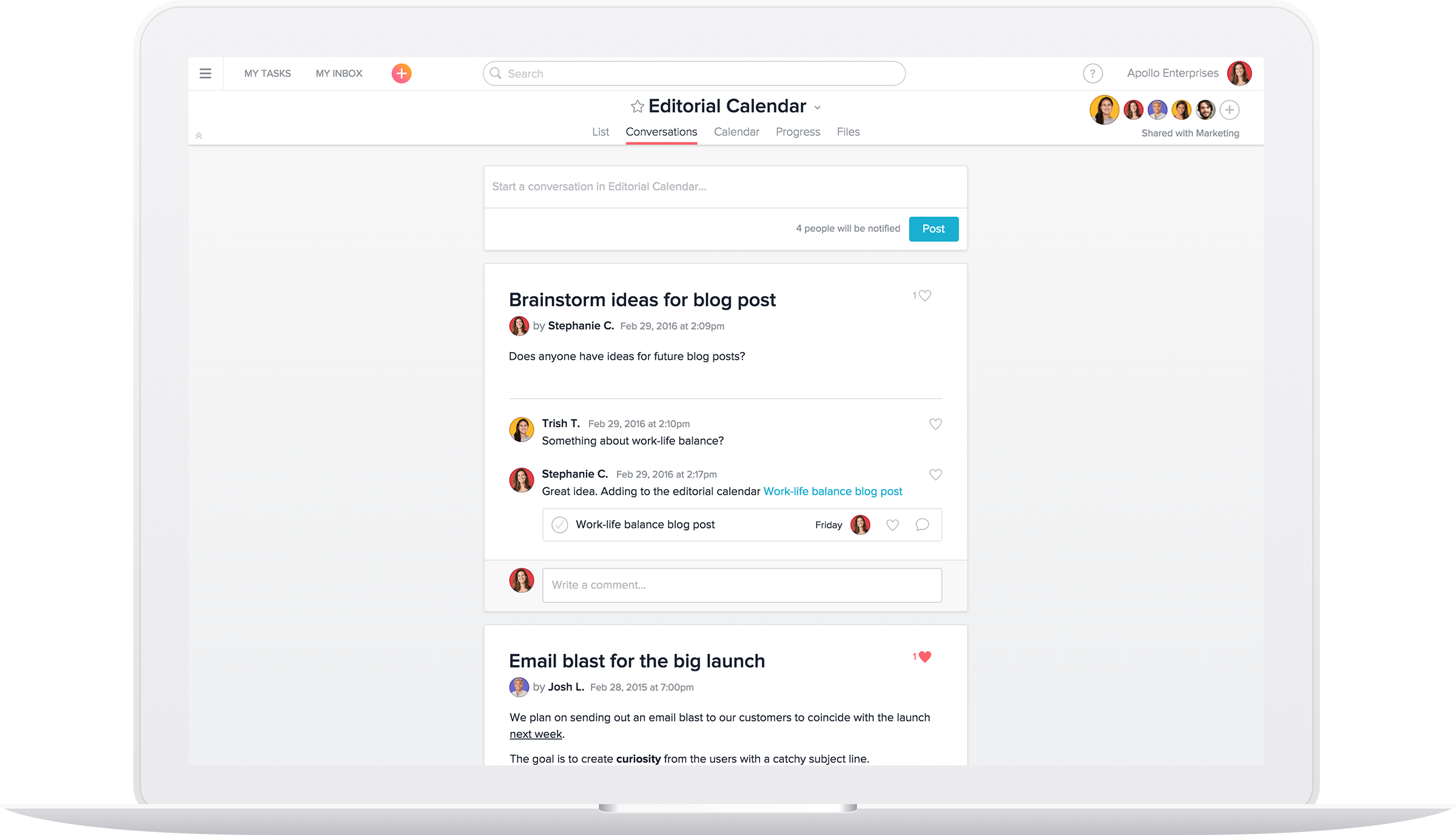
Asana is a web and mobile project management app. With tasks, projects, conversations, and dashboards, Asana lets an entire team know who's doing what by when, enabling workload balancing. Users can also add integrations for GANTT charts, time tracking and more.
$13.49
per month per user
BugHerd
Score 9.9 out of 10
N/A
BugHerd is a bug tracking solution designed for users of all technical backgrounds. By making it easy for anyone to report a bug, BugHerd aims to make resolution by technical teams easier and faster.
$39
per month
Pricing
Asana
BugHerd
Editions & Modules
Starter
$13.49
per month per user
Advanced
$30.49
per month per user
Enterprise
Contact Sales
Personal
Free
Standard
$39.00
per month
Premium
$129
per month
Deluxe
$229
per month
Offerings
Pricing Offerings
Asana
BugHerd
Free Trial
Yes
Yes
Free/Freemium Version
Yes
No
Premium Consulting/Integration Services
No
No
Entry-level Setup Fee
Optional
No setup fee
Additional Details
A discount is offered for annual billing.
BugHerd gives a discount equivalent to the cost of two months for annual subscriptions.
BugHerd offers a 14-day free-trial of all plans.
Custom pricing is available for large enterprises.
More Pricing Information
Community Pulse
Asana
BugHerd
Features
Asana
BugHerd
Project Management
Comparison of Project Management features of Product A and Product B
Asana
8.2
Ratings
7% above category average
BugHerd
-
Ratings
Task Management
9.20 Ratings
00 Ratings
Resource Management
8.10 Ratings
00 Ratings
Gantt Charts
8.90 Ratings
00 Ratings
Scheduling
8.50 Ratings
00 Ratings
Workflow Automation
8.80 Ratings
00 Ratings
Team Collaboration
9.10 Ratings
00 Ratings
Support for Agile Methodology
8.50 Ratings
00 Ratings
Support for Waterfall Methodology
8.50 Ratings
00 Ratings
Document Management
7.50 Ratings
00 Ratings
Email integration
7.50 Ratings
00 Ratings
Mobile Access
8.70 Ratings
00 Ratings
Timesheet Tracking
6.10 Ratings
00 Ratings
Change request and Case Management
8.40 Ratings
00 Ratings
Budget and Expense Management
7.20 Ratings
00 Ratings
Professional Services Automation
Comparison of Professional Services Automation features of Product A and Product B
The usability of Asana is broad since it's available in a variety of platforms that are widely used nowadays. I think that it would be great for people who are constantly on the move and switching devices, since it has allowed me to work from my phone, too. I also think that Asana has proven itself to handle a large quantity of work
Bugherd is well suited to our needs because it's an intuitive tool that doesn't require a ton of training, and we are working with a development agency to improve our backend and communicate issues to developers. From what I've seen, it does require you to use Chrome, which might not be perfect for other companies but it great for us. The tool has great functionality for tracking and allows you to move bugs into stages like "doing", "done" or "backlog". The screenshot tool has been super easy to use, and when we do have a bug that requires multiple screenshots, it's easy to open up a newly submitted ticket to attach a custom screenshot. It isn't easy to track down a specific bug you've logged if there are hundreds, so be prepared to dig quite a bit if you're using it for extensive testing and find yourself trying to go back
I just can't see us getting it off of Asana any time soon, despite the many headaches it has caused us. We have too much data in there, too much time & training invested into it, too much at stake to move. If we were just starting out today, fresh, I don't know for certain that I would absolutely go the same direction, but I *think* I still would. I just haven't seen anything better yet. Maybe if Podio's support staff hadn't treated me like a worthless nuisance to them, I might feel differently, but the fact is that their task management is simply inferior to Asana's. That can't be denied, and in fact Podio said it themselves: "Tasks are a simple function. They cannot be customized. Tasks in Podio can be used for quick to-do's for you and your team members." In our operation, however, prompt task completion is a big deal; one task can't be completed until another one is done first, and closing the gaps between those tasks is critical in meeting deadlines and servicing our customers. Asana gets us there, the others don't.
It is very user-friendly. Takes a new employee an hour to start figuring out how the system works. That's an important factor. You don't want to encounter the issue where employees need a week to understand how the system works. For example, JIRA, I tried using it for a week and I still don't understand the complicated layout. Asana has a simple interface. Once you see it, you get it type of program.
BugHerd is an easy-to-use, highly intuitive tool that fits seamlessly into our web development process. It is easy for all users to use, web developers, project managers, testers and clients. Clients are able to easily pin bugs and provide explanatory feedback that allows our team to fix what is broken and incorporate client feedback.
I haven't had to use their support so I can't rate it. The fact that I haven't needed them reflects the ease of use of the product. I would recommend that any new users schedule a complete demo of the product to ensure that they are using it to it's fullest (there's a lot of useful features).
Truthfully, we have had very little need for BugHerd support, as the tool is intuitive and does not have many bugs of its own. They have a pretty solid help/FAQ section and their support people have been reasonably responsive the few times we have needed to contact customer support. We have had our issues resolved and questions answered.
Asana is a top-tier project management software that helps us organize and track projects from start to finish. It allows us to apply tasks/to-dos to multiple projects without duplication, divide complex projects into smaller tasks, and track project progress. It also helps us organize work on Kanban boards or linear lists. It stands out from the crowd in a big way compared to the competition.
BugHerd is more focused on web-based tools, which we needed, as opposed to app-based tools like Instabug. Jira has a much higher level of complexity and barrier to entry and didn't suit our use case.