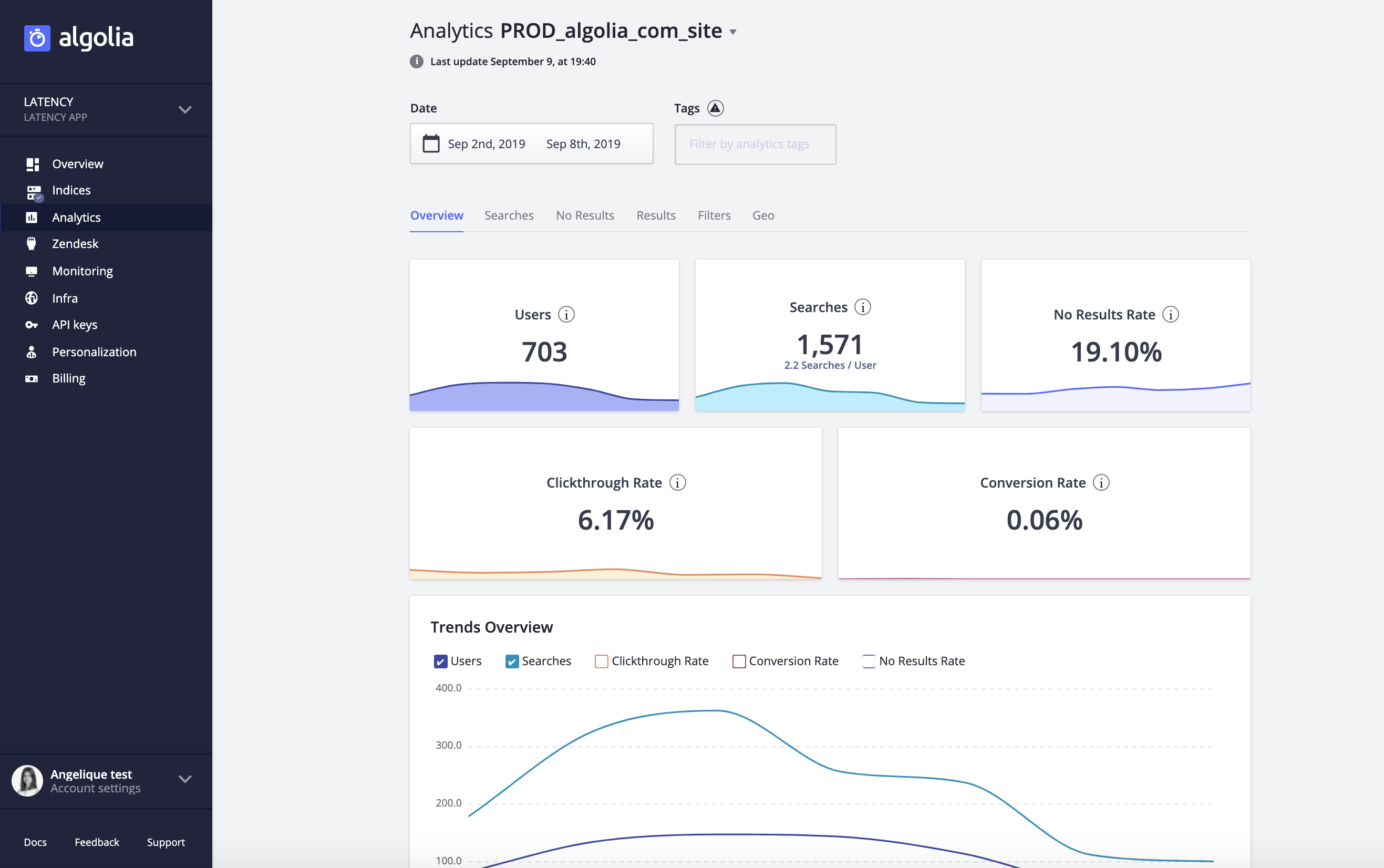
Algolia offers AI-powered solutions to improve online search and discovery experiences, with tools for business teams and APIs for developers that help to improve user engagement and conversions across websites, apps, and e-commerce platforms.
$0
per month Up to 10,000 search requests + 1 Million records
Coveo Qubit
Score 7.4 out of 10
Enterprise companies (1,001+ employees)
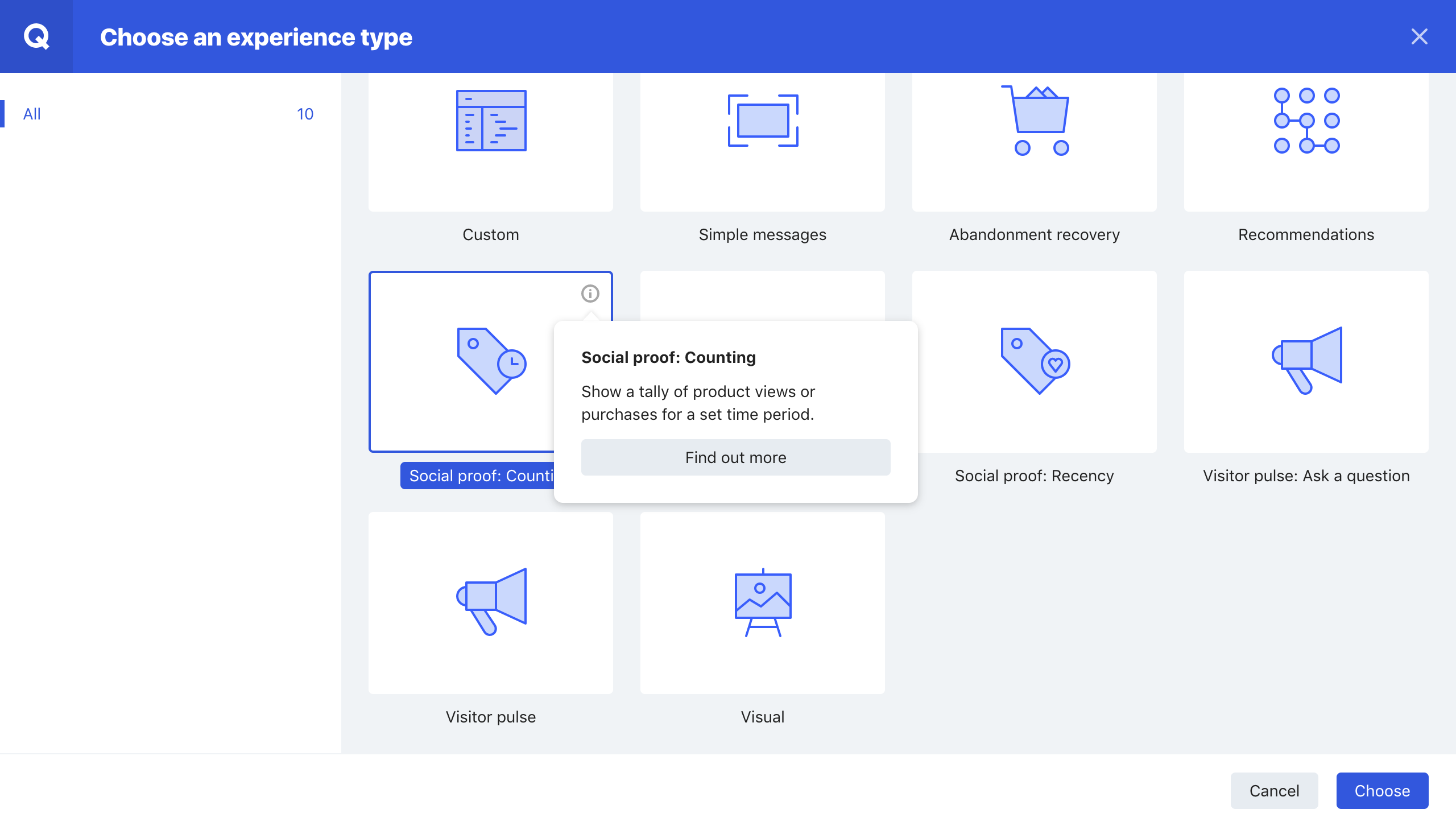
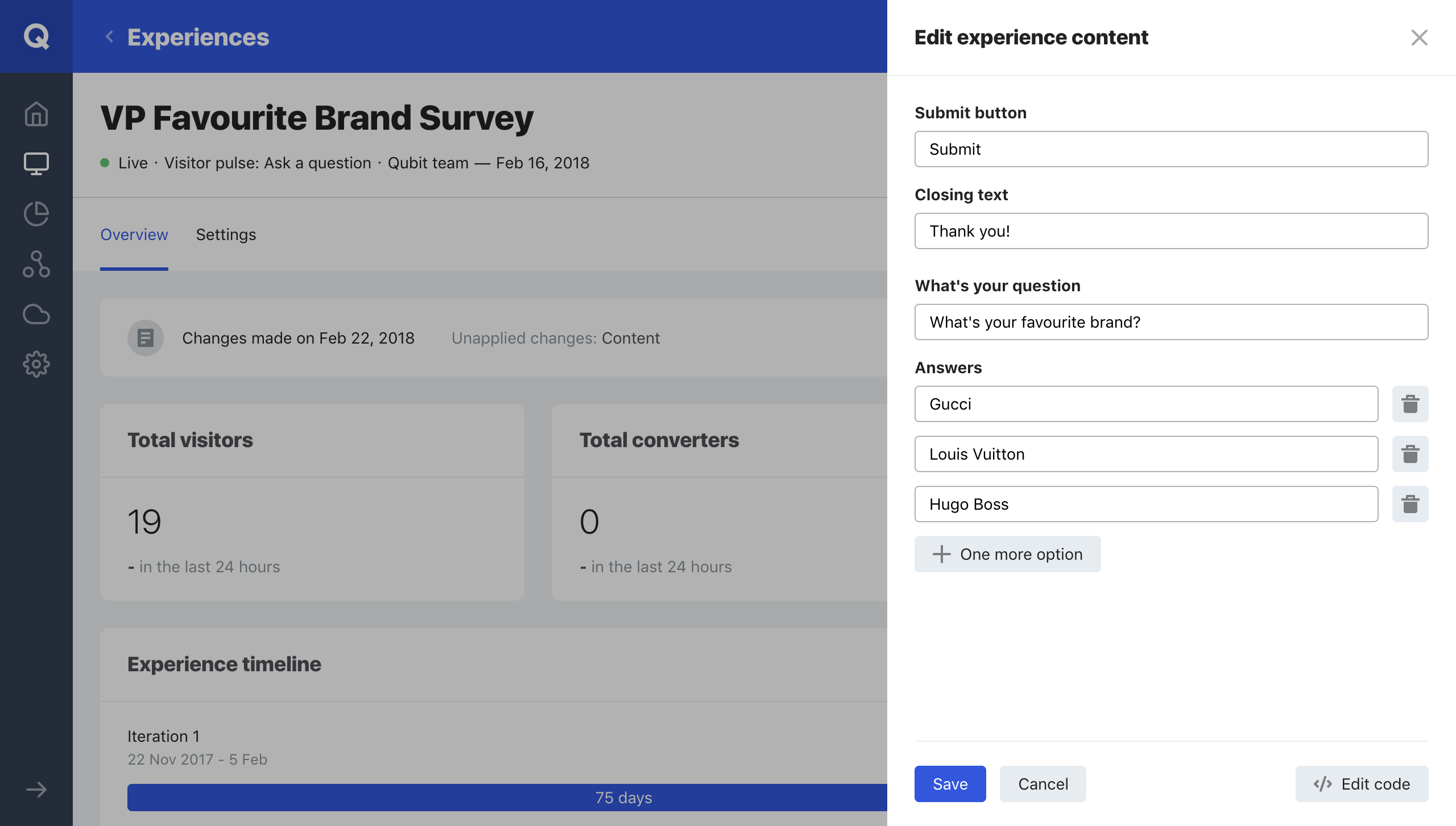
Qubit, now from Coveo (acquired October 2021) uses visitor history data to understand different user segments and serve personalized messages to segments using JavaScript. It is available as either a managed or self-service model. Data is collected using Qubit's own Universal Variable data model, or by integrating the user's existing model via our API. It combines quantitative data with qualitative visitor feedback to give Qubit users the ability to detect areas for optimization.
Using…
N/A
Pricing
Algolia
Coveo Qubit
Editions & Modules
Build
$0
per month Up to 10,000 search requests + 1 Million records
Grow
$0.50
per month per 1,000 search requests
Algolia Recommend
$0.60
per month per 1,000 Recommend requests
Premium
Custom
per month Customized pricing
Elevate
custom
per year
No answers on this topic
Offerings
Pricing Offerings
Algolia
Coveo Qubit
Free Trial
Yes
No
Free/Freemium Version
Yes
No
Premium Consulting/Integration Services
No
No
Entry-level Setup Fee
Optional
No setup fee
Additional Details
Pay as you go, scale instantly, or upgrade anytime for advanced features and capabilities.
—
More Pricing Information
Community Pulse
Algolia
Coveo Qubit
Best Alternatives
Algolia
Coveo Qubit
Small Businesses
Yext
Score 8.9 out of 10
Bloomreach - The Agentic Platform for Personalization
Well-suited Scenarios: - Fast Car Browsing with Filters: Algolia shines when a user is browsing thousands of cars using filters like price, mileage, year, brand, and location. It returns instant, ranked results even with complex combinations. - Mobile Search with Typos: When users type “Camary” or “Toyta” on mobile, Algolia still returns accurate matches thanks to its typo tolerance and synonyms—improving UX and reducing zero-result queries. - Featured Car Prioritization: We can use custom ranking to boost certain listings (e.g., newly added, better margins, location-specific promos) without affecting the user’s search experience.
Less Appropriate Scenarios: - Complex Rule-Based Inventory Logic: If we want to show different results based on time of day, inventory pressure, or dynamic business rules, Algolia falls short. This logic needs to be applied before indexing. - Global Search Across Entities: Searching across cars, articles, FAQs, and service centers in one go requires heavy frontend orchestration due to lack of native multi-index blending. - Real-Time Updates at Scale: For highly dynamic data (e.g., car availability or pricing updates every few minutes), frequent indexing can be costly and requires batching, making it less real-time than needed
Coveo Qubit is a very helpful platform mainly for organizations that need to provide a solid business model before carrying out any implementation or new functionality. In addition, it is a very good tool to generate changes and show different content to different types of clients, with their personalization and segmentation criteria.It is ideal for simultaneous testing and customization, only one of these activities individually is not recommended.
Algolia is brain-dead simple to set up. I've implemented search with Algolia in a dozen different ways now, and it never took me longer than a few minutes to get the functionality I want. With Algolia, the only challenge is designing your search UI -- if you don't want to use their baked in UI solutions.
Results come back incredibly fast. I'm not sure how Algolia does it, but every keystroke I make in a search field returns new results instantly. It's hard to believe that I'm searching large datasets on a remote server when it works so fast.
Very little customization is needed for 99% of use-cases. Algolia's out of the box setup works great, and it takes no prior knowledge to set up.
The testing platform itself is continually evolving. This means that we are always able to try new ideas as well as quickly and efficiently put others into practice.
The beta programme and the additional functionality products are both exciting to see as well as ensuring we can cherry pick the functionality we need. This means that we don't end up paying for functionality we don't need
Algolia can be a bit complex -- for smaller companies or companies without many tech resources, it may be difficult to implement and use without the help of a third party
Manually manipulating search results (for specific queries having listings show up first) is a bit difficult to do without custom developing that functionality
Some of the reporting within Qubit has been overly simplified in the past, a point they are continually addressing.
At times the syntax of experience (test) creation can be specific to Qubit and so there is a slight learning curve for developers.
Unless developers have much time to allocate to creating tests in Qubit, marketers may potentially find simple tests limited. I would recommend having someone in-house as we do.
Algolia is a great tool, we didn't have to build a custom search platform (using Elasticsearch for example) for a while. It has great flexibility and the set of libraries and SDKs make using it really easy. However, there are two major blockers for our future: - Their pricing it's still a bit hard to predict (when you are used to other kind of metrics for usage) so I really recommend to take a look at it first. - Integrating it within a CI/CD pipeline is difficult to replicate staging/development environments based on Production.
Qubit helps out immensely and lays out in plain English the profitability of each of our A-B tests. Say Qubit has provided us overall with a 5% profit increase this year (that is a completely arbitrary figure for illustration only), then if we didn't renew it could be seen as us taking a 5% loss as Qubit wouldn't be there. The results of our tests are showing no slowing down and as Qubit and Toast grow to understand each other better we can only see our performance getting better as the years go on.
Algolia has a good interface and they have done some improvements. However, some non technical users have a challenging time in the use for the first days of learning. But once the main aspects are learned is a straight forward operation
Overall navigation on Qubit is very user friendly and requires a minimal training to be up and running. Be it reviewing existing experiences or setting up new experiences, the process is pretty simple for business user. Add some basic development skills to your kitty, you can do magic with Qubit and make your website do wonders!
I would say that the Qubit account managers are always available for any request. We have a lot of different promotions that could always do with last minute optimizing or changes and Qubit can be relied on to get this changes up and running in an impressive amount of time, so that we don't need to patch live or wait for the next IT sprint. Invaluable to our business.
Performance is always a major concern when integrating services with our client's websites. Our tests and real-world experience show that Algolia is highly performant. We have more extremely satisfied with the speed of both the search service APIs and the backend administrative and analytic interface.
Technology is good for A/B testing and personalisation - allowing any team with a dedicated developer to create test relatively easily and to report/analyse them in a fair amount of details. Some advanced features, especially on the set up of test cells, are dearly missing. Unfortunately, new features are often not free of bugs... Also, support is sub-par, which means new features are realised without proper documentation, example or training (but of our Qubit counterparts and internally).
It’s non existent. No tech support and no customer service… my application was blocked and is currently inactive causing huge business disruption, and I’m still waiting days later for a response to an issue which could be resolved very very quickly if only they would respond. Very poor from a company of that size
Qubit are supportive and flexible in providing support. They are happy working out of usual hours, even on weekends and if I have any doubts about the set up of an experience they’re quick to respond and willing to check my work. On particularly big revenue days they monitor our account and they’re quick to identify and problem solve any issues.
The training was great, but would be great to have a script or PDF with some explanations of the qubit JS layer. Without the script you can just try to learn on your own, so the training is not as powerfull as it could be. On the other hand - would be great to have training related to reading statistics or personalisation.
Implementation couldn't be easier. All we needed to do was insert the tag. (easy) and set up the data layer. (dev required) This was pretty smooth in comparison to some of the other tools we use on our site, and was done in less than a day. Note : Data needs to be collected for a set period of time before you can accurately rely on the data that you are receiving. This is normal though with everyone else that we have used
There are many open source search products available. Prior to Algolia, we used an in-house search system adopted from an open-source system. While this was nice in that we could modify it in any way we wanted, it also required dedicated engineering and setting up many analytics tools and monitoring systems to ensure it stayed performant/could adapt to our ever evolving needs. Algolia takes a load off our plate and frees our engineers to work on bigger problems vs minute search changes or monitoring. It also empowers our product teams to directly use the AI to make basic changes and see analytics in one easy place. We chose Algolia to increase development velocity and reduce the hidden costs of maintaining and operating open-source code/search tools.
We're using Qubit as a fully managed testing platform, and their account management and level of service we've received from any other contact (technical, support, sales etc) was above any of their competitors. Integration and on-boarding was well done and we feel confident that the campaigns are developed and tested thoroughly.
Overall is a scalable tool as the environment and the backend functions are the same and many things are done directly on the tool so without the need of further specific developments. However some things could be improved such as documentation for integration that could help in doing whitelabel solutions
Our requirements change throughout the year like most E Commerce retailers. At Christmas and Peak we're dealing with around ten times the usual traffic on the site. Qubit had no problems with this at all, tests continued to fire, and stats were still reported accurately. I don't think that it is the most server intensive .js anyway, but we have seen no issues at all.
Users who had abandoned our product (attributing slow search speeds as the reason) returned to us thanks to Algolia
We used Algolia as our product's backbone to relaunch it, making it the center of all search on our platform which paid off massively.
Considering we relaunched our product, with Aloglia functioning as its engine, we got a lot of press coverage for our highly improved search speeds.
One negative would be how important it is to read the fine print when it comes to the technical documentation. As pricing is done on the basis of records and indexes, it is not made apparent that there is a size limit for your records or how quickly these numbers can increase for any particular use case. Be very wary of these as they can quite easily exceed your allotted budget for the product.