airfocus offers a modular product management platform. It provides a solution for product teams to manage and communicate their strategy, prioritize their work, build roadmaps, and connect feedback to solve the right problems. Designed with flexibility in mind, airfocus allows users to customize the platform to fit the user's needs without disrupting the way teams works.
airfocus offers a 14-day trial now.
$15
user/month
Dovetail
Score 8.3 out of 10
Mid-Size Companies (51-1,000 employees)
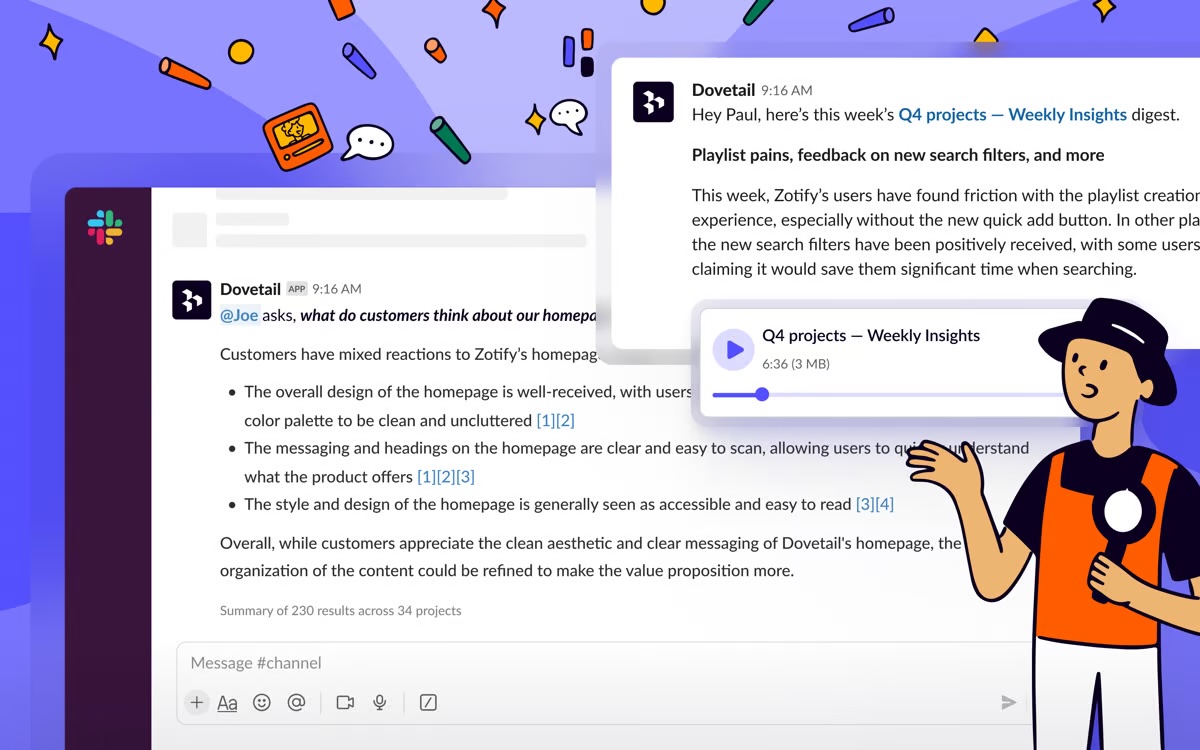
Dovetail, headquartered in Sydney, aims to enable the world to create better products and services through deep customer understanding. Dovetail states they empower 45,000+ people, from agencies to universities to Fortune 100 companies, to make sense of their customer research in one collaborative research platform.
Airfocus is as well suited for large product teams that have several members working on the same product line as it is for a product team of one. For large teams, the collaboration tools that come in the out-of-the-box solution act as a huge timesaver. Frankly speaking, it will help eliminate a lot of resource-intensive face-to-face meetings. For individual managers, the visualization tools can really help organize disparate ideas into a cohesive product roadmap.
One flaw of airfocus is that it fails to live up to its ultimate utility because–like many SaaS products–it is dependent on the entire team, to include all stakeholders, to buy into the solution if it is to be a true one-stop solution for product roadmapping. However, there is no denying it greatly helps in getting teams a little bit closer to the goal of effective collaboration.
See 1st question answer for my use case, I went into depth there for the specific use cases we have. For less appropriate (touched on this earlier) the final report is not great in dovetail. The formatting options are not great and does not look professional because of the lack of customization and layouts. For my customer we wouldn't be able to present that data as it's constructed. So we have to copy and paste all the quotes and insights to a word doc. That's ok but then it means if we want to use Dovetail as a repository of data we have to then re-import a pdf of the report into the project page.
The tagging, linking, and repository features make it simple to maintain a living library of knowledge, ensuring past work is never lost.
Dovetail enables our researchers and non-research partners to engage more directly with findings, fostering a stronger culture of evidence-based decision-making.
Dovetail makes it simple to track engagement metrics with research insights proving overall ROI.
Sharing of finished products (e.g., road maps) via downloading or PDF docs could be a bit less high touch than they currently are. The product works best when all stakeholders have a seat but not all stakeholders (i.e. non-product team members) like to work that way, exporting options for them could be better.
Customization (look & feel) options are pretty limited.
JIRA integration only works for JIRA in the cloud customers.
Because we are really happy with the tool and it’s capabilities at the moment. The price increase is the main issue we can have but the features are getting better and better. It really saves a lot of time for our team and allow us to collaborate more efficiently with certain stakeholders that often did not réalise how much research we conduct. Now they can just have a look to it by themself!
One of Dovetail’s key strengths is that it’s very easy to get started with — even for people without a research background. Uploading a transcript, tagging highlights, and generating a quick summary is intuitive and low-effort, which helped drive organic adoption at Dext. However, mastering the more advanced features — like taxonomy management, insight reporting, or strategic tagging structures — does require more time and guidance. The learning curve becomes steeper as you try to scale insight operations or enforce consistency across teams.
Regarding performance, I would say it’s satisfactory. Adding data and transcriptions is really fast and efficient, and can be done in the background, so I’m never hindered by these aspects. However, all the new AI-generated features are still somewhat slow to run. It’s nothing major, but it should improve in the future.
My customer success manager is very responsive and has always been able to answer my questions and resolve issues quickly. The collaboration is smooth, so I have no complaints in that regard.
The training went very well, and we co-built it to really address our needs. I also think it was beneficial to have feedback coming from someone other than myself (since I manage the tool), as it helped reinforce the points I wanted to highlight. The team’s feedback on the training was very positive.
It's easy to use, it's customizable. It is ideal for managing multiple product lists, it is transparent and helps keep any work team centralized. It has an intuitive interface, special to track the time to our established goals.
Dovetail is 10X better. So much easier and truly meant for having one centralized workspace. Everything from the highlights and tags and videos and column customization when editing makes it easy to call them the winner in this field. I wouldn't want to go back to my other tools I've used in the past due to the amount of time it takes and would choose Dovetail over Google Workspace, UserTesting, and Basecamp hands down
Management is quite straightforward; it’s easy to change access if certain stakeholders need to use it. The repository features are accessible to all teams, making it a good entry point into the tool. The more people use it, the more powerful the tool becomes, so it seems truly scalable to me. The limits are more financial, in terms of accessing additional features.
We know exactly what the impact/effort is of our projects, so we don't waste time on projects or features that won't drive meaningful revenue or increased brand affinity.
Researchers and designers now spend less time digging through scattered notes or redoing similar studies. Centralizing everything in Dovetail has significantly reduced the time needed to prepare synthesis reports, align stakeholders, or onboard new teammates into past research.
With Dovetail, user insights are no longer abstract or anecdotal—they're traceable, searchable, and backed by real quotes. Product teams feel more confident making roadmap decisions based on what users actually need, not assumptions.
Dovetail has encouraged more non-designers to engage with user feedback directly. This democratization of insights helps align everyone around real user problems, which ultimately leads to better product-market fit and faster iteration loops.