Adobe Test and Target is an A/B, multi-variate testing platform which Adobe acquired as part of the Omniture platform in 2009. It is now part of the Adobe Marketing Cloud. It offers tight integration with Adobe analytics and content management products.
N/A
ConfigCat
Score 9.1 out of 10
N/A
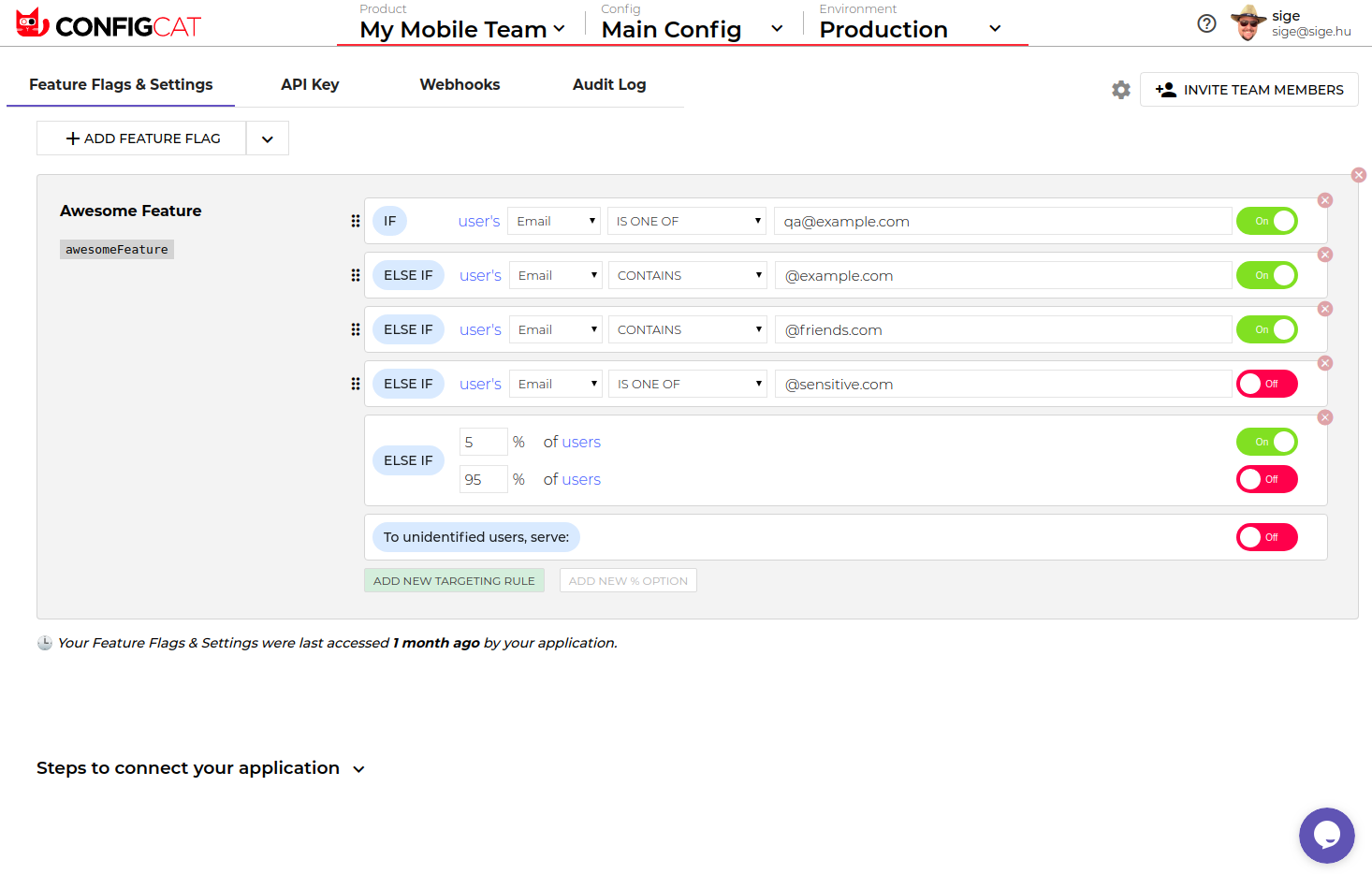
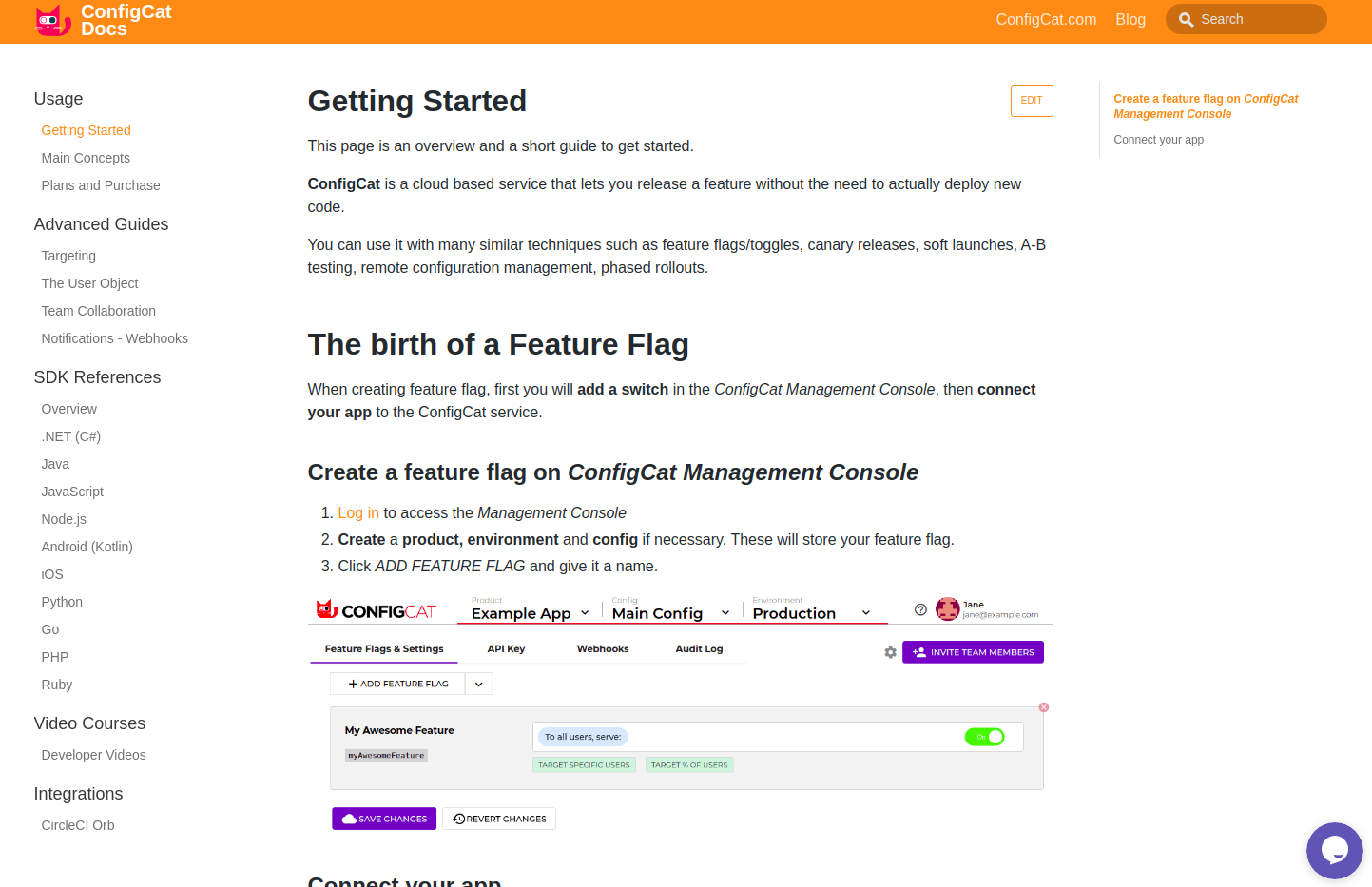
ConfigCat allows the user to launch new features and change software configuration without (re)deploying code. ConfigCat SDKs enable easy integration with any web, mobile or backend applications. The ConfigCat website enables non-developers too to switch ON/OFF application features or change software configuration. This way the user can decouple feature launches and configuration from code deployment.
$0
per month
Pricing
Adobe Target
ConfigCat
Editions & Modules
No answers on this topic
Free
$0.00
per month
Professional
$49.00
per month
Unlimited
$199.00
per month
Dedicated on-premise infra
$1499.00
per month
Dedicated hosted infra
$1499.00
per month
Offerings
Pricing Offerings
Adobe Target
ConfigCat
Free Trial
No
Yes
Free/Freemium Version
No
Yes
Premium Consulting/Integration Services
No
No
Entry-level Setup Fee
No setup fee
No setup fee
Additional Details
—
Fair pricing policy: All features available in all plans, even in Free. Simple and predictable prices. No hidden fees. We don't charge for team size. We don't charge for MAUs (monthly active users). Our plans only differ in limitations.
More Pricing Information
Community Pulse
Adobe Target
ConfigCat
Features
Adobe Target
ConfigCat
Testing and Experimentation
Comparison of Testing and Experimentation features of Product A and Product B
Adobe Target
8.6
Ratings
5% above category average
ConfigCat
-
Ratings
a/b experiment testing
10.00 Ratings
00 Ratings
Split URL testing
8.50 Ratings
00 Ratings
Multivariate testing
9.50 Ratings
00 Ratings
Multi-page/funnel testing
8.00 Ratings
00 Ratings
Cross-browser testing
8.60 Ratings
00 Ratings
Mobile app testing
8.60 Ratings
00 Ratings
Test significance
7.40 Ratings
00 Ratings
Visual / WYSIWYG editor
8.50 Ratings
00 Ratings
Advanced code editor
8.00 Ratings
00 Ratings
Page surveys
9.00 Ratings
00 Ratings
Visitor recordings
8.50 Ratings
00 Ratings
Preview mode
9.50 Ratings
00 Ratings
Test duration calculator
9.50 Ratings
00 Ratings
Experiment scheduler
9.00 Ratings
00 Ratings
Experiment workflow and approval
7.90 Ratings
00 Ratings
Dynamic experiment activation
8.00 Ratings
00 Ratings
Client-side tests
9.50 Ratings
00 Ratings
Server-side tests
8.00 Ratings
00 Ratings
Mutually exclusive tests
7.50 Ratings
00 Ratings
Audience Segmentation & Targeting
Comparison of Audience Segmentation & Targeting features of Product A and Product B
Adobe Target
8.5
Ratings
0% below category average
ConfigCat
-
Ratings
Standard visitor segmentation
8.50 Ratings
00 Ratings
Behavioral visitor segmentation
8.00 Ratings
00 Ratings
Traffic allocation control
8.50 Ratings
00 Ratings
Website personalization
9.00 Ratings
00 Ratings
Results and Analysis
Comparison of Results and Analysis features of Product A and Product B
We recommend this application because it allows us to segment and track the traffic of our domain under an analysis of their behavior, ranging from counting the number of clicks they make on a single element to the most complete action within our page in real time.
If you are looking for an experimentation/feature flag style tool that is quick to adopt and provides enough functionality for light/medium use cases, then this is the tool for you. Additionally, they are growing and expanding their functionality and feature set so they can grow alongside you and your needs. The publicly accessible roadmap is also a great benefit to see where time is being spent on which feature next.
There should be some more clarity around what makes a test significant. While this can be decided by the client themselves, some direction from the tool would be helpful.
Also, if there was an easier way to organize campaigns and search for them it would be helpful. Right now there is just a long list of campaigns and you have to rely on search to find a specific campaign. What if you don't know the name of the test?
Once you get started with your testing program, you realize that it is necessary to continue. You must keep optimizing in order to remain a vital competitor in today's marketing world. Even if you're not using Test & Target or any other user experience testing software, you ought to be performing comparison tests on your own, simply by routing your audience to different experiences and quantifying the aggregate of the results.
The recent UI update is a complete mess. It is difficult to navigate and find features that previously existed. The reactiveness of the page depending on window size is also ridiculous and it is absurd that depending on how large your window is, entire columns of functions will disappear with no indication that they are missing. The usability of the tool has fallen off a cliff.
Just everything from the website to locating what i need (docs) specific to my platforms is super easy. Not to mention the support articles answering previous questions
On several occasions, we have had the need to ask for help from the Adobe Target support team, and I must say that they have provided us with an excellent experience, as they take care of solving the problems quickly and with high precision
They have a community Slack channel that is open to anyone. They always seem to have people in there, even over the weekends and are always happy to answer any questions you have,
The instructor that came to train us was awesome and this training was very useful. I would recommend it for anyone who is going to be using this software. I only mark it lower because it is an added expense to an already expensive product, and a lot of the training covered the "Target" portion of the software (which again, we didn't use)
The training was very easy to understand, however it would have been more useful to my development team than me. It was also primarily over-the-phone, which is never as easy to follow as in-person. We ended up scheduling and paying for an in-person training session to supplement the online/phone training because it wasn't helpful enough.
Implement using a global mBox on the page so you can change any and everything over the traditional method. Traditional method is good if you do not have technical web dev resources, do not know Javascript/jQuery, or you have money to blow on mBox calls. Global deployment reduces mBox calls and allows you to touch many parts of the page easily. A lot more customizable
For us, the decision was very straightforward. We chose to invest in the Adobe stack and utilize tools that are developed to integrate together and complement each other. Ex: Adobe Target 'A4T' integration within Adobe Analytics. Optimizely appears to be a great tool, but for us aligning with the Adobe suite, ensuring that future product enhancements and tools would work well together was a very important key factor in our decision
At iBinder we searched for and vetted several suppliers of a feature toggle service to handle feature toggling in our production environment. In addition to our functional requirements, it was crucial for us to find a partner that could deliver an EU-compliant service. We finally decided to sign a service agreement with ConfigCat. This has been a real success story for us – in addition to being compliant, ConfigCat delivers an amazing, flexible, and reliable service. They continue to impress by also being very transparent and having a fantastic support and they are very solution oriented and accommodating when it comes to our feature requests etc. We have now used ConfigCat for approximately 2 years and we give our warmest recommendations to anyone who needs a stable, reliable and EU-compliant feature toggle service.
This is something we've been working to improve on, as far as how we're calculating and tracking this, but Target has had a substantial ROI on our business.
I will say specific to our efforts, we could have probably done similar work if not the same work using a different testing tool (Optimizely for example), but Target has been good for us.
Allowed us to migrate seamlessly from a major customer communication system to another, reducing end-user friction and production bugs by being able to turn features off if they didn't work as intended.
We went from zero experimentation to running 10-20 experiments concurrently across systems. Engineering teams are thinking in an experimentation mindset.