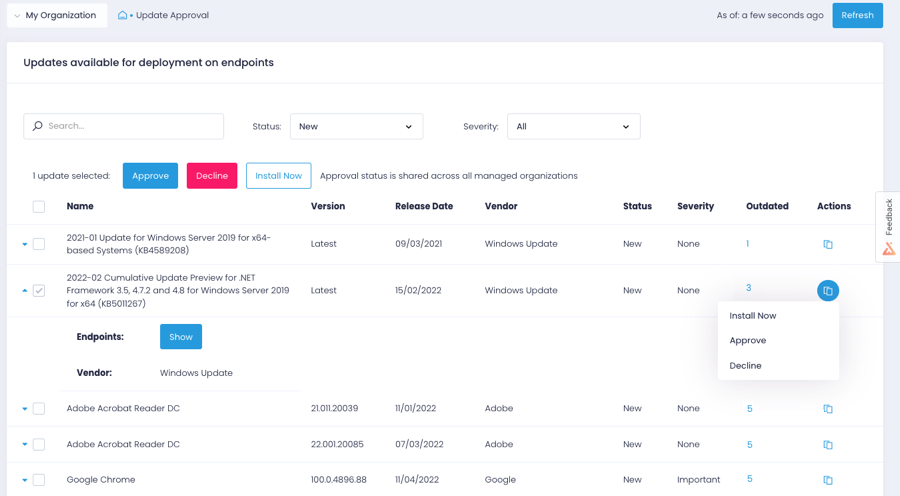
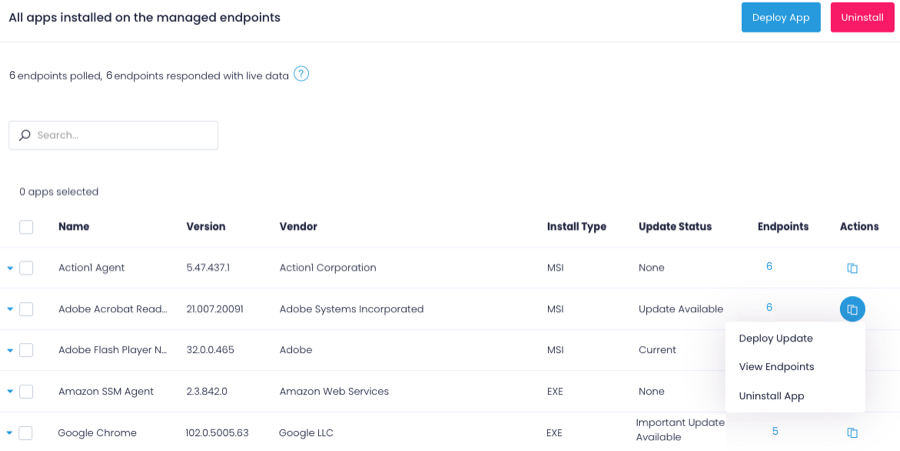
Action1 is an autonomous endpoint management platform that is cloud-native, scalable, and configurable in 5 minutes. It is free for the first 200 endpoints, with no functional limits. By pioneering autonomous OS and third-party patching - AEM’s foundational use case - through peer-to-peer patch distribution and real-time vulnerability assessment without needing a VPN, it eliminates costly, time-consuming routine labor, preempts ransomware and security risks, and protects the digital…
N/A
Microsoft Intune
Score 8.4 out of 10
N/A
Microsoft Intune (formerly Microsoft Endpoint Manager), combining the capabilities of the former Microsoft System Center Configuration Manager, SCCM or ConfigMgr, is presented as a unified endpoint management option. Microsoft Intune is an endpoint management solution for mobile devices, an MDM solution that allows the user to securely manage iOS, Android, Windows, and macOS devices with a single endpoint management solution. The component Endpoint Configuration Manager (the…
For small teams having to deal with significant ammount of devices, I can't express how useful Action1 is. With very small effort, you can easily keep track of your devices, keep them up to date, deploy new software to your users, create recurring reports/alerts and so on. Initially, the 100 endpoints for free was also a nice touch. Now, even better since they increased to 200. For the forseeable future, I have not to worry about costs and still can't believe it's a full solution for free, not those freeware stuff where what you really desire is behind a cost.
Windows Autopilot makes provisioning user Windows PC laptops a breeze. A user only needs to turn on the laptop, join it to their local WiFi, login with their O365 account then sit back and let Windows Autopilot handle the app installations required for work, configure the laptop settings to meet my organization requirements. I have seen this all completed in less than 30 minutes depending on how fast the internet connection is. Where Microsoft Intune needs to improve I think is the part where it can push out software updates to 3rd party apps. Right now I have to use Automox to fill in this gap.
[Microsoft Endpoint Manager (Microsoft Intune + SCCM)] helps to speed up the deployment of patches/software throughout our environment. I can easily build a package and then deploy across all endpoints.
The ability to supercede software is also quite handy. This automates the removal of old versions and replacing them with newer versions.
The Intune Autopilot option is very useful if you want to deploy software to devices straight out of the box. You can configure them to download software when a user opens a new PC and turns it on for the first time.
Lots of times Action1 will identify a program that needs to be patched, but then not really have a path laid out to get that done...so they just remain as they are, but are tagged as such.
Really wants to replace the windows update mechanism. Resists (or did at least) you if you try to keep updates as they are and update occasionally from Action1
Could develop the scripts section a bit more, looked pretty sparse last time I checked it out.
Installation is very laborious and complicated. The number of things to manually configure during the installation is incredible.
OS deployment is hard to configure and troubleshoot. The Microsoft article on deploying Windows 10 via System Center Configuration Manager in a test environment takes 44 minutes to read (Microsoft's estimate, not mine -- check here: https://docs.microsoft.com/en-us/windows/deployment/windows-10-poc-sc-config-mgr). If something goes wrong, there are multiple log locations to check on both the server and client, making troubleshooting difficult.
The management console looks old, and its performance isn't great. It is often hard to find settings in the console, and it refreshes slowly. The old name for System Center Configuration Manager, SMS, comes to mind often. "Slowly Moving Software."
Mascom Wireless is a Microsoft shop and SCCM has proved to be helpful in keeping our Microsoft products up to date every month without fail. We also have a Microsoft Enterprise Agreement which we renewed for three years ending 2022. The remote access utility works wonders for the organisation and have saved travel bills including subsistance allowance. We have been able to fulfill security audits both internal and external. We have been able to keep a robust inventory of our computer assets and nothing falls of the cracks
Agent deployment is simple (and silent) - once that is done, you're good to go. Everything is simple, centralized and very easy to work with. There isn't one aspect of this platform that requires crawling over forums and Google, it just works!
Overall, Microsoft Intune is very usable. While help documentation can be lacking, once setup and configured, Intune does all the work that used to be manual. There is a lot of automation and advanced features and manufacturer integrations you don't get anywhere else. These are absolutely game changers when managing IT workloads.
It's a 'heavy' system, which demands a lot of resources form the datacenter perspective. So, make sure you followed the requirements to avoid frustration in the future. From the 'client' perspective, it's fine. I've never had any issue with that.
Being a Microsoft product, support was good. Out interaction was limited to our in-house IT team which was installing the Intune app in our mobile device. The installation was smooth and we haven't faced any difficulties with the app while using it. Provides a smooth and secure access to all Office 365 apps in mobile while separating the personal and professional data.
Work with a "test group" of users who you have a good relationship with so that when things don't work properly they understand! Work with your partner nicely without forcing things especially timelines as you are bound to make mistakes and create oversights in the project Management can also interfere with the implementation (which can cause delays) if you make too many mistakes which takes me back to having a "test group" where you have good relations
After looking at different solutions, Action1 [Cloud Remote Monitoring and Management Solution] was the perfect fit for us that delivered all of the features we wanted without being as costly as some of the others alternatives we've looked at. There was no minimum endpoint count and they even offer up to 50 endpoints for free, which is really great for a small organization like us to help us lower our starting costs and still allows us to grow at our pace without having to commit to a defined amount of endpoints to start.
Microsoft Intune is more robust as far as fine-tuning security controls. It also allows for software installs, folder access controls, updating PCs, and other features simply not found in previous products we have used. Because it is rolled into MS 365 it's very cost effective. It's also a single pane of glass for managing user PCs and personal devices
Saved hours per week on patching and able to ensure a 100% patching success rate.
Able to create custom alerting on potential problems as well as able to create some automation to automatically address problems.
Improved support to our remote locations and users.
Custom deployments allow us to have a mechanism to deploy custom applications we build as well as other third party applications we need to distribute.
The positive impact it's had was it has been really beneficial in having an all-in-one Systems Management solution to be able to manage all endpoints across the organization. This has saved both time and costs from having to search/setup/manage other System Management applications and also have saved money from having to purchase a license for other commercial products.
Another positive impact it has had was in being able to easily remote into computers/endpoints, and also being able to provide remote assistance to end-users.
The negative impact has been it is not being fully utilized by most of the IT staff, as it is a more complicated platform to learn/master. This would require funding for IT staff to take training in learning the product, or require time to consult the documentation in the use of the product. As a result, this may hurt productivity in being able to have to work on other things.