TrustRadius: an HG Insights company

Progress Sitefinity

Score7 out of 10

239 Reviews and Ratings

What is Progress Sitefinity?

Progress Sitefinity is a content management and customer analytics platform. It supports content management, tailored marketing, multi-channel management, and ecommerce sites.

Media

Engage your audience with thoughtful, relevant content. Your marketing team can create and manage content faster and easier than ever before with inline drag-and-drop editing, requiring no help from your web team.
Create a truly global solution that provides consistent experiences and unmatched performance across brands, regions and languages. Reduce maintenance and hosting infrastructure by managing multiple websites from a single platform. Reduce time to market and deploy changes faster with content and code synchronization between websites and environments.
Increase revenue with a personalized, connected experience between your website and online store. Easily manage your product catalogs, price lists, shopping cart and checkout process. Connect to cloud services for accurate real-time tax and shipping rates. Integrate with your ERP and other business systems to improve and automate inventory management, order fulfillment and customer support throughout the product lifecycle.
Increase conversions and generate more leads with 1:1 conversations with your customers. Create, preview and deliver personalized experiences at a massive scale with amazingly easy to use tools. Analyze and optimize the experience with the help of contextual analytics and A/B testing solutions.
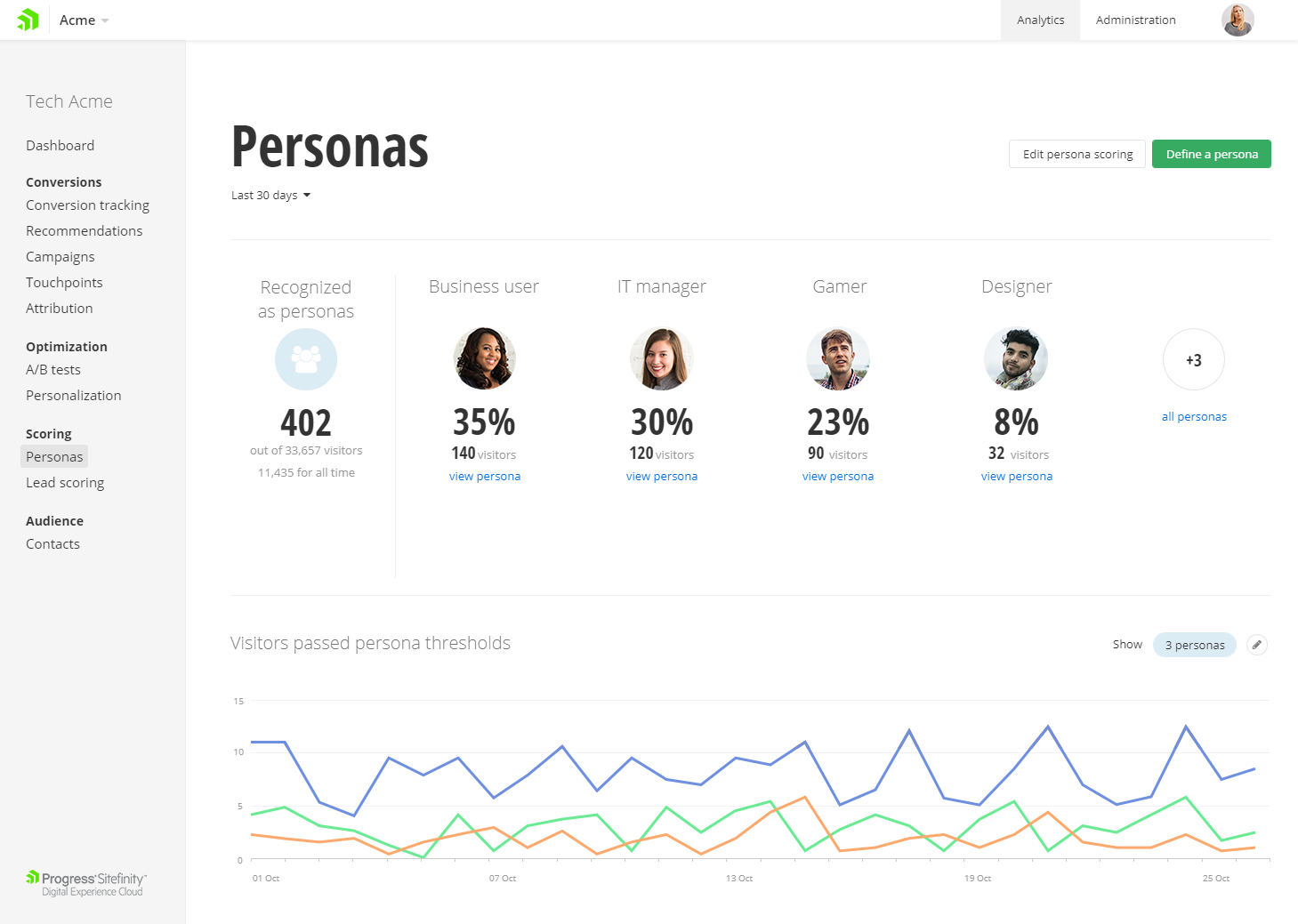
Analyze cross-channel data to get a detailed view of content and campaign performance. Gather data on visitors and build persona segments and track their behavior on your site. Get ML-driven recommendations for the next best update to introduce into your journey.

1 / 5

Top Performing Features

  • Role-based user permissions

    Permissions to perform actions or access or modify data are assigned to roles, which are then assigned to users, reducing complexity of administration.

    Category average: 8.2

  • API

    An API (application programming interface) provides a standard programming interface for connecting third-party systems to the software for data creation, access, updating and/or deletion.

    Category average: 8.2

  • WYSIWYG editor

    What-You-See-Is-What-You-Get editing tool allows users to build pages without writing code.

    Category average: 8.1

Areas for Improvement

  • Bulk management

    Users can change an attribute on a group of documents or sites all at once through features such as global search and replace, making bulk changes easier.

    Category average: 7.3

  • Availability / breadth of extensions

    There is a broad library of extensions, plug-ins, modules or add-ons that allow users to easily customize their websites without building custom code.

    Category average: 7.8

  • Community / comment management

    Users can put post/page comments through an approval process, auto-approve commenters based on their email addresses, block commenters by IP address, delete comments, etc.

    Category average: 7.8

Sitefinity - flexibility and affordability in the same package

Pros

  • Progress Sitefinity's user-friendly interface allows us to extend use of the platform to wide range of users across the business.
  • Constant feature updates continue to add valuable new features and resolve prior issues. This is one of our primary reasons for retaining Progress Sitefinity.
  • The Module Builder tool has given us enormous flexibility in enabling us to add new dynamic content items to our Progress Sitefinity platform and support a wide range of business requirements (e.g. course listings, custom news articles, scholarships, etc).

Cons

  • Image management.
  • It is still not possible to accurately determine whether a image is in active use on the website or not (i.e. embedded on a page/widget). This makes it extraordinarily hard to properly audit our image libraries, which continue to grow and increase our hosting costs. This is without a doubt our number one issue with the platform.
  • Requirement to deploy/restart application for many updates.
  • While acknowledging that Progress Sitefinity uses best practice when it comes to further development of the platform, the need to deploy new code and/or restart the platform continues to be an inconvenience when managing a production website.
  • Lack of granular permissions on site sync and multisite.
  • Site sync and multisite are two of Progress Sitefinity's most valuable features in terms of managing our website environment. However, there is no out-of-the-box method currently for assigning a user role to a specific site (a custom role has to be created). Similarly, it is not possible to assign granular permissions to the site sync tool (a user who has access to Site Sync has access to sync all content on all sites). Having more control over these features would reduce the overhead for our site admins.
  • The license model in respect of subdomains (whereby an entirely new, full-cost license is required for each subdomain) is relatively uncompetitive and severely limits options when creating a network of sites.

Return on Investment

  • Progress Sitefinity's ease of use, particularly when it comes to development, has enabled us to make considerable savings on potential agency costs by transferring the bulk of our website development in-house.
  • In addition, Progress Sitefinity's flexibility and range of features has allowed us to respond quickly to business demands and reduce our time to market for new content and features.
  • Use of best practice deployment methods allows us better control over associated hosting costs for the platform.

Alternatives Considered

Squiz Matrix, Kentico Kontent, Sitecore Experience Platform and TERMINALFOUR

Other Software Used

Azure App Service, Adobe Analytics, Bitbucket, Google Analytics

Sitefinity's usage from small project to large scale factory approach

Pros

  • 'Low-code structured content' (dynamic content types) is one of Sitefinity's most powerful features that allows you to structure content according to business needs, while at the same time dampening editorial freedom to ensure accessibility, meta enhancement, SEO and API consumption can be achieved.
  • Sitefinity's content provider model allows us to flexibly (by means of admin interface) easily aggregate or separate content sharing within a multi-site instance.
  • This proofs particularly powerful in emerging situations where there suddenly is a demand for content sharing across countries or regions.
  • Adaptability at its core.
  • While there's never a perfect fit for everything, it allows for easy code customization and extension being a .NET application at heart. Giving it a corporate edge over other custom solutions, whether it is on the development side or deployment side (on premise, IaaS or Azure DevOps Paas). And it has enabled us to put the system to use in its core feature - which is to manage content, where on other occasions we were able to take full advantage of its features such as A/B testing and personalization.

Cons

  • Roadmap visibility could be better.
  • Being a publicly traded company, long term roadmaps will have commercial impacts, however it would be great to see future visions expressed more clearly.
  • Video improvements.
  • While accessibility and concepts like 'low-bandwidth' are key these days, rich experiences are equally important. When it comes to 'videos', Sitefinity is trailing behind the current use cases where low/high-bandwidth versions, captions and subtitles are a requirement.

Return on Investment

  • Sitefinity's Microsoft Machine translation integration will allow us to cut production of localized content down from days to hours.
  • Sitefinity's architecture and adherance to industry standards of development have allowed us to re-use components, functionality across the various instances.
  • Sitefinity's responsive and scalable implementation allows us to build a design system and future digital economy of shared elements reducing the need of constant front-end implementations from scratch for every new initiative, site or application launched.

Alternatives Considered

Drupal and MS SharePoint

Other Software Used

MS SharePoint, Azure DevOps (formerly VSTS), Atlassian Confluence, Microsoft Powerpoint, Microsoft Project

Want an easy to use, but powerful CMS? Sitefinity is your choice!

Pros

  • Updates to the CMS software
  • Support on critical issues

Cons

  • Larger install base
  • Speed of support replies

Return on Investment

  • Lowered our support costs for customers (easier to use)
  • We are now able to push updates more easily to Azure (CI/CD Process)

Alternatives Considered

WordPress, Sitecore Web Content Management and Kentico

Sitefinity Allows Pages to be Deployed and Maintained at the Speed of Business

Pros

  • The interface for managing content and building pages is very intuitive.
  • The platform is extensible through custom modules, making it possible for our team to create any functionality we need.
  • Workflows make it easy to approve content before it goes live.
  • Insight allows us to assign personas based on user behavior and then customize content based on that persona.

Cons

  • I'd like to see more third-party integrations out of the box.

Return on Investment

  • Has had a definite positive impact on our ability to create and manage content without involving our developer team.
  • Insight feature (formerly DEC) and connection to HubSpot has made it easier to track and analyze leads.

Alternatives Considered

Ektron Web Content Management System (Discontinued), Sitecore Web Content Management, Kentico and Umbraco CMS

Progress Sitefinity Review

Pros

  • Able to organize our content
  • Easy to maintain and edit information

Cons

  • Have the ability to have multiple users working on the same page at the same time

Return on Investment

  • Old developers did not code the previous versions of Sitefinity correctly and had issues updating Sitefinity due to compatibility issues with code.

Alternatives Considered

WordPress

Other Software Used

Umbraco CMS, WordPress