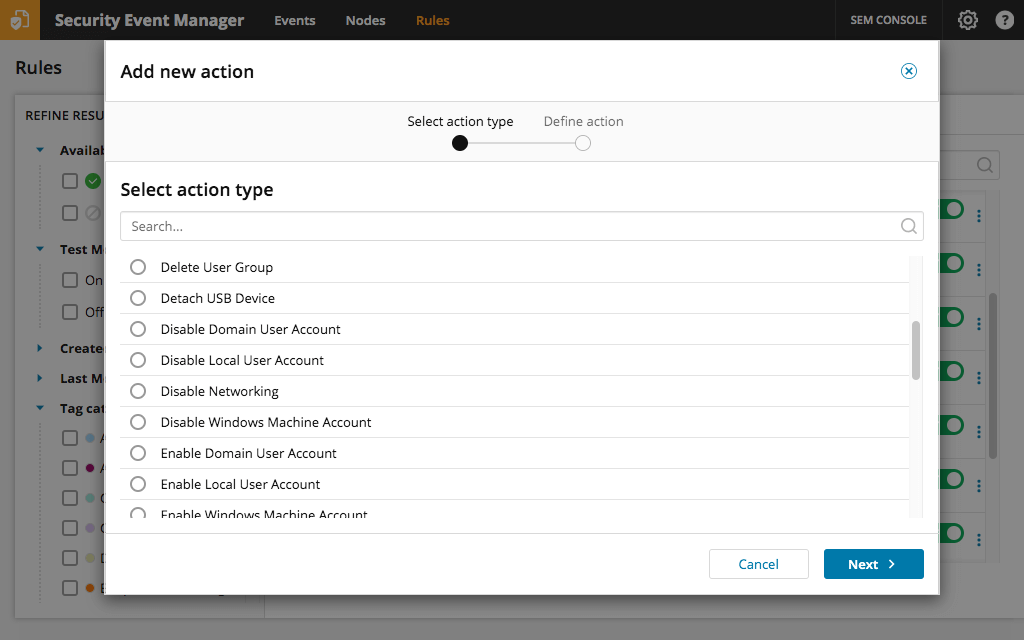
SolarWinds LEM is security information and event management (SIEM) software.
N/A
Splunk Enterprise Security
Score9.8 out of 10
N/A
Splunk Enterprise Security is an analytics-driven SIEM that helps to combat threats with actionable intelligence and advanced analytics at scale.
N/A
Pricing
SolarWinds Security Event Manager (SEM)
Splunk Enterprise Security
Editions & Modules
No answers on this topic
No answers on this topic
Offerings
Pricing Offerings
SolarWinds Security Event Manager (SEM)
Splunk Enterprise Security
Free Trial
Yes
No
Free/Freemium Version
No
No
Premium Consulting/Integration Services
No
No
Entry-level Setup Fee
No setup fee
No setup fee
Additional Details
—
—
More Pricing Information
Community Pulse
SolarWinds Security Event Manager (SEM)
Splunk Enterprise Security
Considered Both Products
SolarWinds
Verified User
Chose SolarWinds Security Event Manager (SEM)
We found that SolarWinds performed poorly when the Architecture included many large data centers spread across the globe. When evaluating the SolarWinds Security Event Manager (SEM) solution we quickly realized that we needed a distributed architecture with log aggregation to …
A de minimis incentive was given to thank the reviewer for their time. The incentive was not used to bias or drive a particular response, nor was the incentive contingent on a positive endorsement. More Info
Optimal for SolarWinds Security Event Manager needs for smaller companies - it is a very cool product but has some limitations around EPS (which gets chewed up quickly if you're doing it the right way & adding servers/storage/FW & other network devices)... Also pricing model is GREAT (not consumption-based, which is the greatest grift the SIEM industry has created).
A de minimis incentive was given to thank the reviewer for their time. The incentive was not used to bias or drive a particular response, nor was the incentive contingent on a positive endorsement. More Info
Well suited: Splunk ES is highly recommended in an environment with many data sources and experienced computer engineers. It has a steep learning curve, but once that hurdle is crossed, it is absolutely a beast. It is also very expensive, so a company putting a high amount of budget in Security is needed. Not well suited: Splunk ES is not recommended if a company has only a few sources and some non-technical IT users. The price won't justify the fewer data sources and scratching just the surface level. Moreover, non-technical IT users would be better off with something that has a query builder, unlike Splunk.
A de minimis incentive was given to thank the reviewer for their time. The incentive was not used to bias or drive a particular response, nor was the incentive contingent on a positive endorsement. More Info
It does a great job of notifying us when accounts have been locked out. We can then find out the device on the network where the login attempt occurred.
Searching for incidents is now a lot faster with the implementation of the HTML 5 interface.
A de minimis incentive was given to thank the reviewer for their time. The incentive was not used to bias or drive a particular response, nor was the incentive contingent on a positive endorsement. More Info
Advanced Threat Detection and Correlation: ES stands out in its ability to detect sophisticated threats by correlating data from multiple sources. For instance, it can identify unusual patterns in user behavior, cross-referencing with network logs to flag potential insider threats.
Real-time Monitoring and Alerting: ES offers robust real-time monitoring capabilities. It excels in promptly alerting us to critical security events, such as suspicious network traffic spikes or unauthorized access attempts, allowing for immediate response.
Comprehensive Log Analysis: ES ingests and analyzes an extensive range of log data. It's particularly adept at parsing and making sense of complex log formats, making it a versatile tool for understanding system activities and security events.
A de minimis incentive was given to thank the reviewer for their time. The incentive was not used to bias or drive a particular response, nor was the incentive contingent on a positive endorsement. More Info
All SolarWinds product suffer from slow response times in management portals. SolarWinds SEM is no exception. While it is much preferred over a "thick client" there is much room for improvement in speed.
If you use the email alert features with SolarWinds make sure to prepare you staff and team for the large amount of emails they could receive. Make sure to reduce the number of alerts so your team does not ignore the alerts.
A de minimis incentive was given to thank the reviewer for their time. The incentive was not used to bias or drive a particular response, nor was the incentive contingent on a positive endorsement. More Info
ES on the cloud (SaaS) has too many limitations with platform administration.
Supported integrations are not always on par with enterprise support especially when dependent on 3rd-party proprietary APIs.
In later versions, unforeseen glitches seem to show up that have no resolution except version upgrade. This used to not be the case in prior versions which were very stable.
It is pretty likely that we will renew SEM when the time comes up. It is easy to use and maintain so there isn't much of a need to replace this product. It is also a pretty fair price for the capabilities provided by the SEM
A de minimis incentive was given to thank the reviewer for their time. The incentive was not used to bias or drive a particular response, nor was the incentive contingent on a positive endorsement. More Info
A de minimis incentive was given to thank the reviewer for their time. The incentive was not used to bias or drive a particular response, nor was the incentive contingent on a positive endorsement. More Info
If you are familiar with SolarWinds then you can use this product it's as easy as that. If you have never used a SolarWinds product then it will take a minute to get how they do reports and make dashboards but that being said the tool is great and can make things very easy once you get a feel for how it works and get everything setup how you like it.
A de minimis incentive was given to thank the reviewer for their time. The incentive was not used to bias or drive a particular response, nor was the incentive contingent on a positive endorsement. More Info
You definitely need to learn how to use Splunk to get the most of the tool. There are many courses available for free to get up to speed on the usability of the tool but it's not that simple. It will take time to digest all the data and to understand how to query for what you are looking for.
A de minimis incentive was given to thank the reviewer for their time. The incentive was not used to bias or drive a particular response, nor was the incentive contingent on a positive endorsement. TR verified that a representative sample of customers was invited. More Info
A de minimis incentive was given to thank the reviewer for their time. The incentive was not used to bias or drive a particular response, nor was the incentive contingent on a positive endorsement. More Info
ES requires a very performant infrastructure: if it has it's performant, otherwise not. I had situation with a very performant infrastructure and I didn't notized that it was a distributed architecture, it seemed that there ware few data on my PC, othewise I experienced less performant infrastructures with less performaces.
A de minimis incentive was given to thank the reviewer for their time. The incentive was not used to bias or drive a particular response, nor was the incentive contingent on a positive endorsement. More Info
The quality of support can vary depending on whom you end up speaking with. I was fortunate enough to work with a support representative who was very familiar with the product. He had even authored some of the support documentation on the website. On the flip side, I had two other experiences where I was simply directed to online training material.
A de minimis incentive was given to thank the reviewer for their time. The incentive was not used to bias or drive a particular response, nor was the incentive contingent on a positive endorsement. More Info
It's good when it's responsive, but I've had times where I had to wait quite a while for a response. But these are typically the exceptions rather than the rule. When you do get a response it is always well-informed and appropriate. I would say they've been trending better over time with this.
A de minimis incentive was given to thank the reviewer for their time. The incentive was not used to bias or drive a particular response, nor was the incentive contingent on a positive endorsement. More Info
I experienced only on-line training, but the trainers were very professional and competent. Maybe it could be more useful if they also have an experience in projects because sometimes they didn't have a real project experience to communicate to the students. Anyway, it was very interesting and I learned many thing that's very difficoult (or maybe impossible!) to have by myself, aven if I have more than 10 years of Splunk activity experience.
A de minimis incentive was given to thank the reviewer for their time. The incentive was not used to bias or drive a particular response, nor was the incentive contingent on a positive endorsement. More Info
It was very interesting and I learned many thing that's very difficoult (or maybe impossible!) to have by myself. The only problem was that, when I worked with the Splunk Professional Services, I found some difference between the training contents and the information from PS. In addition is required a long experience on Splunk Enterprise for the data ingestion part, in other words I'm able to work with ES because I'm worling on Splunk since 11 years, otherwise I'd some problem.
A de minimis incentive was given to thank the reviewer for their time. The incentive was not used to bias or drive a particular response, nor was the incentive contingent on a positive endorsement. More Info
A de minimis incentive was given to thank the reviewer for their time. The incentive was not used to bias or drive a particular response, nor was the incentive contingent on a positive endorsement. More Info
Fortianalzyer can only do logs from FortiGate so usefulness is limited. Elasticsearch was a lot slower than Solarwinds and the filters were a lot harder to set up and use. The connectors for SEM were far more stable.
A de minimis incentive was given to thank the reviewer for their time. The incentive was not used to bias or drive a particular response, nor was the incentive contingent on a positive endorsement. TR verified that a representative sample of customers was invited. More Info
Splunk enterprise is the only solution that we’ve been able to identify that provides risk based alerting, which allows our SOC to reduce analyst fatigue which would be a huge problem without it. Before RBA, there were thousands of alerts a day and it was impossible to review all of them
A de minimis incentive was given to thank the reviewer for their time. The incentive was not used to bias or drive a particular response, nor was the incentive contingent on a positive endorsement. More Info
for my exterience, unit pricing and billing frequency are correct. As I already said, I hint to have more discount flexibility, expecially with new customers, because there are competitors less expensive and very aggressive that are dangerous. In addition the possibility to don't pay the license for the development period could be a very interesting feature for the final customers.
A de minimis incentive was given to thank the reviewer for their time. The incentive was not used to bias or drive a particular response, nor was the incentive contingent on a positive endorsement. More Info
- 8 out of 10 and took 2 for the data pipeline and administration part. Even if you'd like to improve yourself or your team, you have to pay a lot of money and it could be more than GIAC education + cert. - Normalization for Data models and CPU-based searches can be a problem sometimes.
A de minimis incentive was given to thank the reviewer for their time. The incentive was not used to bias or drive a particular response, nor was the incentive contingent on a positive endorsement. More Info
I had a fantastic experience with Splunk Professional Services: they worked with us in our last SON project (a SOC migration for a very large customer) and helped to build a multi tenent environment even if ES isn't a multi tenant platform. Th Splunk PS was a very professional and competent people, he is italian and was able to speak with our italian customers.
A de minimis incentive was given to thank the reviewer for their time. The incentive was not used to bias or drive a particular response, nor was the incentive contingent on a positive endorsement. More Info
For the price, it produced a decent value. It did a lot of the easy stuff well. I can't give any specific data given the objective of the product was to monitor very basic events in the environment.
A de minimis incentive was given to thank the reviewer for their time. The incentive was not used to bias or drive a particular response, nor was the incentive contingent on a positive endorsement. More Info
ES has highly impacted ROI because as the customer of the ES the work we do for creating use cases for clients in terms of security-related aspects by their logs has given more return than investment.
The correlation searches we run to get detailed results from the Data models are very less time-consuming than Splunk Enterprise itself we can get quick responses to the use cases and dashboards populated because of ES.
The CIM compliance feature is ES has made more jobs easy in the terms of finding more Authentication related data we can get data onboarded in the Email data model from O365 and search is email data model instead of searching for particular indexes.
A de minimis incentive was given to thank the reviewer for their time. The incentive was not used to bias or drive a particular response, nor was the incentive contingent on a positive endorsement. More Info