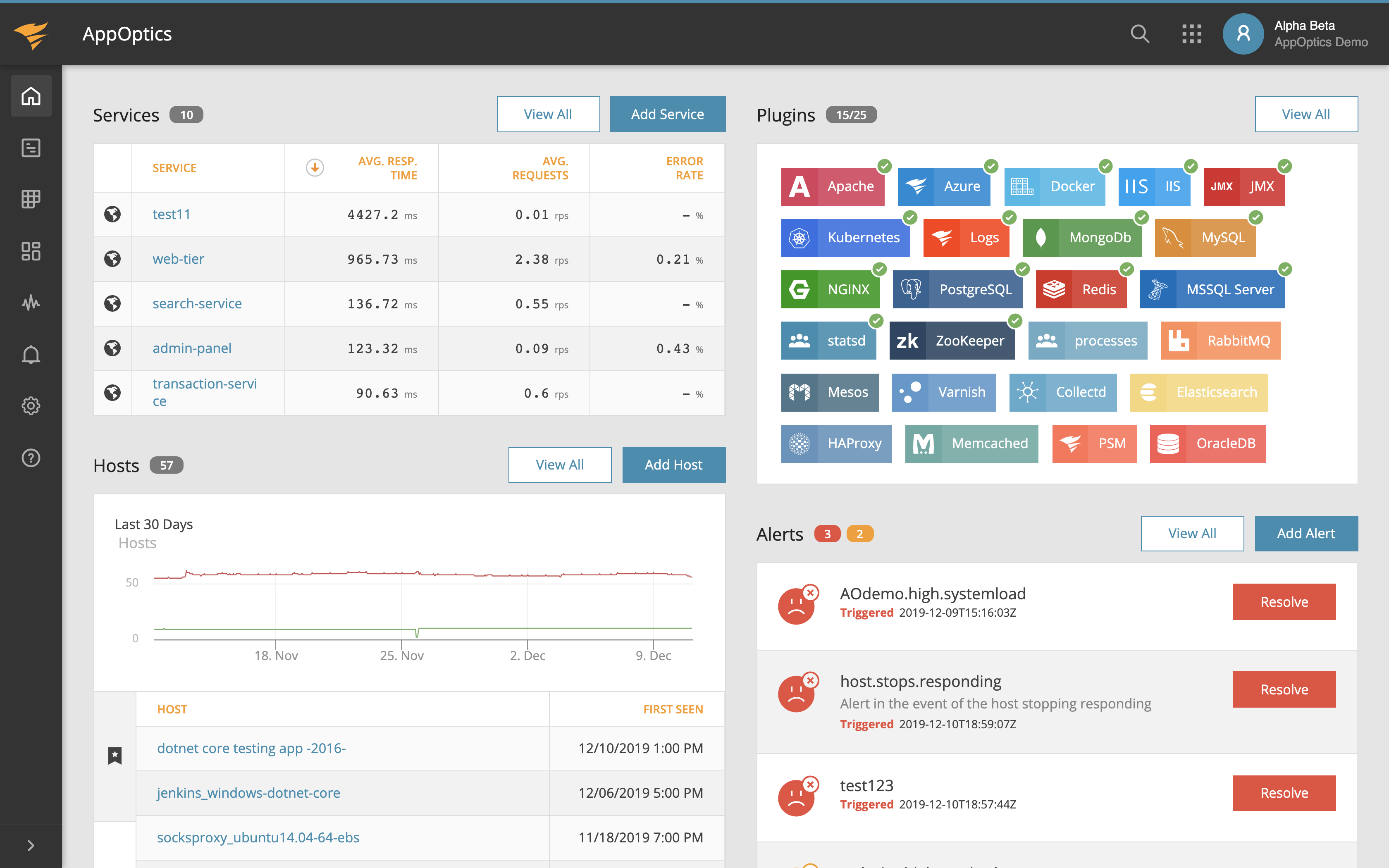
SolarWinds AppOptics (formerly Librato) is an IT infrastructure monitoring service and APM, based on technology acquired by SolarWinds with Librato in 2015 to expand its cloud monitoring portfolio.
N/A
Splunk AppDynamics
Score 8.2 out of 10
N/A
AppDynamics is an APM and Mobile APM program, with application mapping and predictive capabilities. These capacities enable automated remediation and code-level diagnostics in real time. It can be deployed on-premise or as a SaaS.
N/A
Pricing
SolarWinds AppOptics
Splunk AppDynamics
Editions & Modules
No answers on this topic
No answers on this topic
Offerings
Pricing Offerings
SolarWinds AppOptics
Splunk AppDynamics
Free Trial
Yes
Yes
Free/Freemium Version
No
Yes
Premium Consulting/Integration Services
No
No
Entry-level Setup Fee
No setup fee
No setup fee
Additional Details
—
—
More Pricing Information
Community Pulse
SolarWinds AppOptics
Splunk AppDynamics
Features
SolarWinds AppOptics
Splunk AppDynamics
Application Performance Management
Comparison of Application Performance Management features of Product A and Product B
AppOptics is good for small to medium-sized organizations with less than 150 servers or less than 40 services to monitor. It performs well for this use case where people need to get an overview of application performance, and 95%ile data is okay. Somewhere every data point and every record is critical; it should be avoided.
Platforms for software as a service (SaaS) frequently cater to a large number of users with a variety of needs and usage patterns. Because AppDynamics offers multi-tenant monitoring capabilities to track performance across various customer environments, it is a good choice for SaaS platform monitoring. SaaS providers can maximize resource utilization, proactively detect and resolve performance issues, and provide a dependable and consistent user experience for their clients with AppDynamics.
AppDynamics excels in creating dynamic baselines for application performance. For instance, during periods of varying workloads, it automatically adjusts performance baselines. This adaptive baseline creation helps in accurately detecting anomalies and deviations, ensuring that abnormal behavior is quickly identified and addressed.
The scalability of an organization's apps can be evaluated with the assistance of AppDynamics. It gives insights into how effectively programs can handle increased workloads, helping to proactively address scalability concerns before they impair performance.
The only thing that I would add is the possibility to display every single query our servers receive to eventually analyze them and query through them. We could also generate nice visualizations from that. Right now I believe we can only see averages.
The initial setup process of AppDynamics could be more user-friendly. Some users find the configuration and onboarding to be a bit complex. Improving the onboarding experience could make it more accessible, especially for smaller teams or those with limited resources.
It can be difficult for some users to get AppDynamics up and running for the first time. For new users, the platform's usability might be improved by streamlining the onboarding process or providing more user-friendly setup wizards.
AppOptics has performed well for all of the major functions we have needed it for. Especially when it comes to tracking down response time issues and researching app performance for different pages and different times of day we have been able to do everything we need to. We know there are some more advanced features that could help us in more niche areas, but haven't had the time to delve deeper into using or setting them up.
Actually, I would like to give it a score of 10 out of 10, but taking into account certain factors such as: the cost of the annual licence, the complexity of installation and configuration, the blurring of setting Splunk AppDynamics over the cloud and especially OpenShift since we use it as a container platform. So, 8 out of 10 looks perfect for it
Solarwinds AppOptics is rated as 9 out of 10 and the reason is there are still few areas where AppOptics needs to improve such as Service Now Integration, GCP Cloud Support, Better Dashboard visualization for application transactions flow. Other than these feature everything is there in AppOptics and that's a reason given 9 points out of 10.
AppDynamics has its own community site that includes forums and a knowledge base. On the forums, you can converse with other members of the community and ask technical questions as you have them. Though this forum isn’t filled with people there are active members for you to gain some valuable insights.
What we found positive in AppOptics from others is:
Easy to install and manage.
Various stack support.
Point to point deep-dive metrics and correlation.
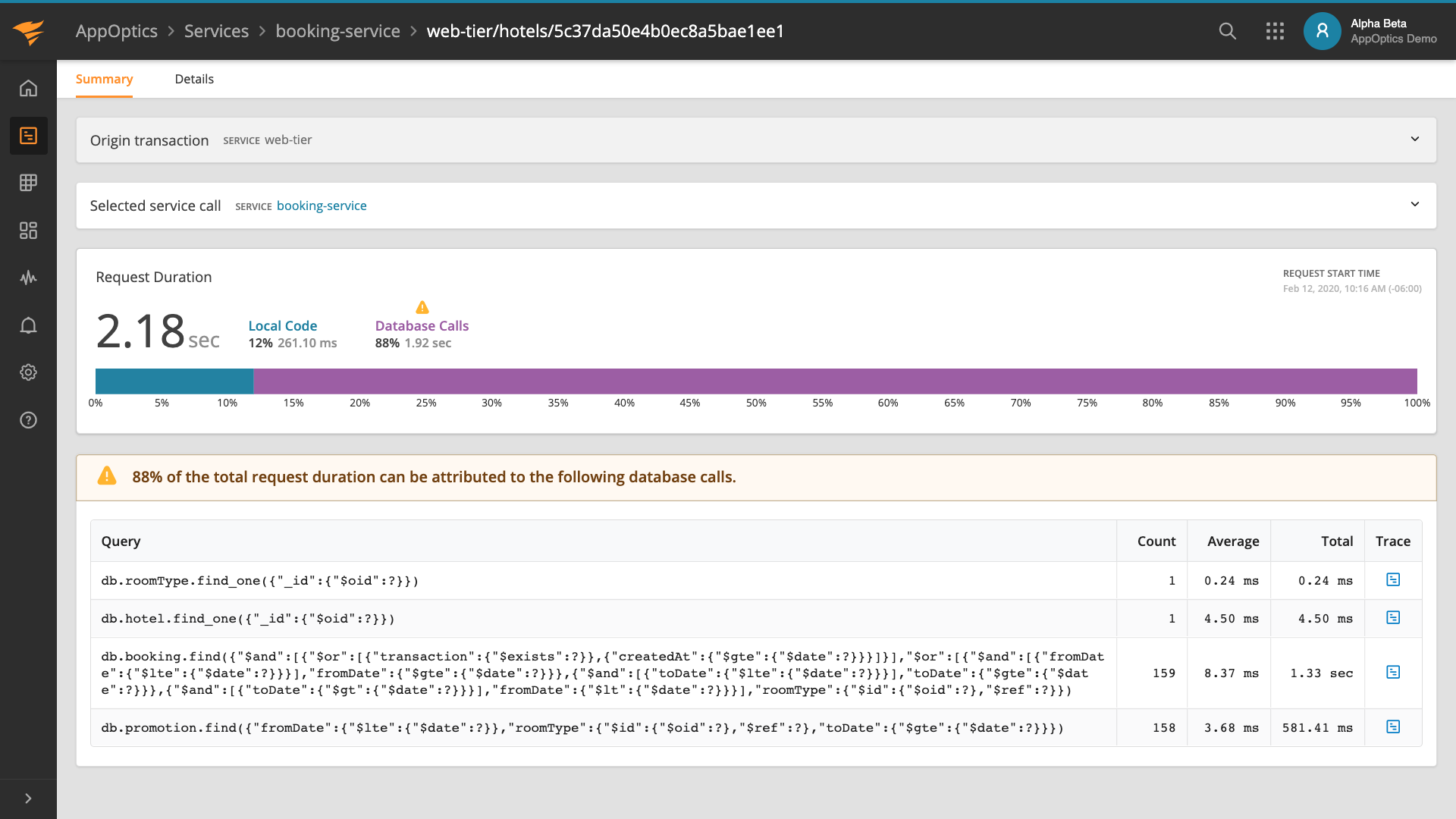
Metrics like DB connection, query analysis, latency in API calls, and other connections, response codes for various APIs, etc are the key ones in our case, which AppOptics provides efficiently.
It is distinguished from these programs because the platform provides visualizations of application processes, showing the interplay between various parts and services. Understanding the architecture of complicated apps and finding their weak spots is greatly aided by this.
We can optimize infrastructure utilization and lower cloud or server costs by locating and removing resource-intensive bottlenecks with the aid of AppDynamics.
Building trust with external stakeholders and encouraging accountability within our organization, AppDynamics' comprehensive reporting and monitoring capabilities offer transparency into the health of applications.
We can find bugs earlier and improve development workflows with the help of AppDynamics' real-time insights and code-level profiling.