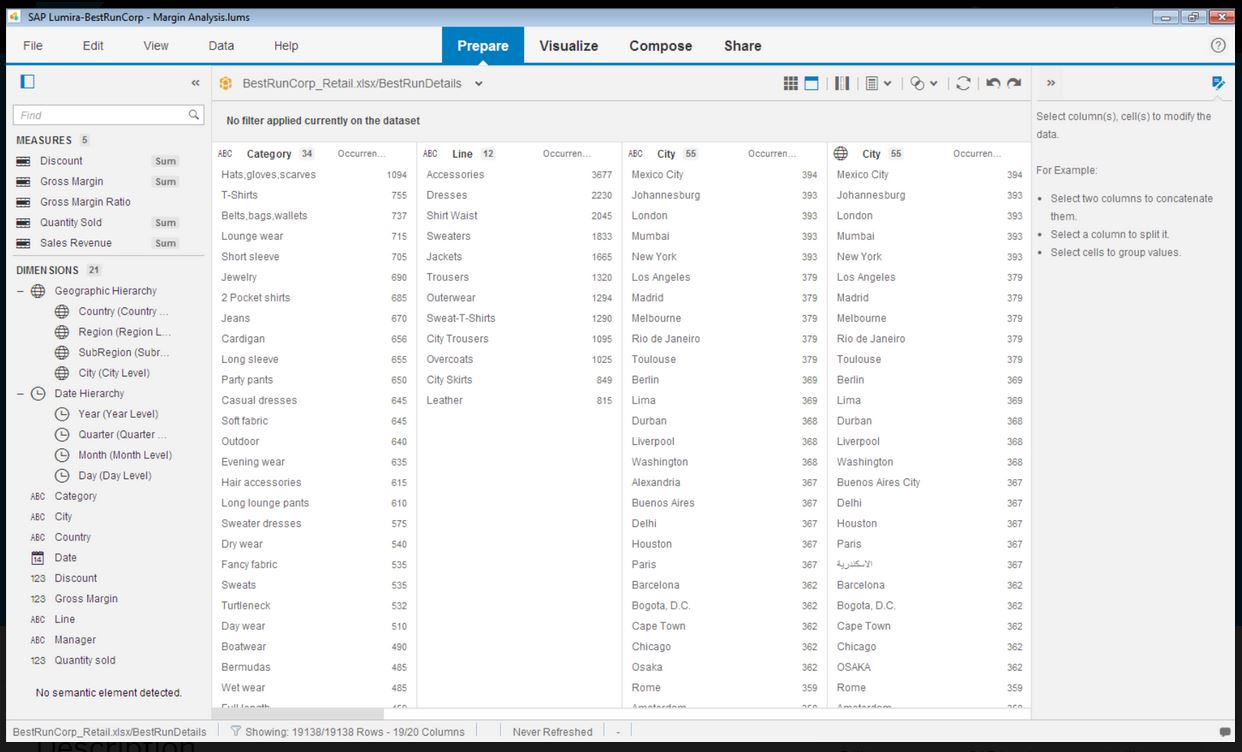
SAP Lumira Discovery is SAP’s data visualization and discovery application. It facilitates data discovery, visualization, and analysis by assisting users with creation of dashboards, infographics, presentations, data facets, tag clouds, and more.
$185
per user
Tableau Desktop
Score 8.1 out of 10
N/A
Tableau Desktop is a data visualization product from Tableau. It connects to a variety of data sources for combining disparate data sources without coding. It provides tools for discovering patterns and insights, data calculations, forecasts, and statistical summaries and visual storytelling.
$75
per month per user
Pricing
SAP Lumira Discovery
Tableau Desktop
Editions & Modules
SAP Lumira, standard edition
$185
per user
Tableau
$75
per month per user
Tableau Enterprise
$115
per month per user
Offerings
Pricing Offerings
SAP Lumira Discovery
Tableau Desktop
Free Trial
Yes
No
Free/Freemium Version
No
No
Premium Consulting/Integration Services
No
No
Entry-level Setup Fee
No setup fee
No setup fee
Additional Details
—
All pricing plans are billed annually.
More Pricing Information
Community Pulse
SAP Lumira Discovery
Tableau Desktop
Features
SAP Lumira Discovery
Tableau Desktop
BI Standard Reporting
Comparison of BI Standard Reporting features of Product A and Product B
SAP Lumira Discovery
8.0
Ratings
2% below category average
Tableau Desktop
8.3
Ratings
2% above category average
Customizable dashboards
8.00 Ratings
8.40 Ratings
Pixel Perfect reports
00 Ratings
8.80 Ratings
Report Formatting Templates
00 Ratings
7.80 Ratings
Ad-hoc Reporting
Comparison of Ad-hoc Reporting features of Product A and Product B
SAP Lumira Discovery
7.3
Ratings
10% below category average
Tableau Desktop
8.7
Ratings
8% above category average
Drill-down analysis
10.00 Ratings
8.60 Ratings
Formatting capabilities
7.00 Ratings
9.20 Ratings
Report sharing and collaboration
5.00 Ratings
9.20 Ratings
Integration with R or other statistical packages
00 Ratings
7.70 Ratings
Report Output and Scheduling
Comparison of Report Output and Scheduling features of Product A and Product B
SAP Lumira Discovery
6.1
Ratings
31% below category average
Tableau Desktop
8.1
Ratings
3% below category average
Publish to Web
7.00 Ratings
7.30 Ratings
Publish to PDF
5.00 Ratings
7.90 Ratings
Report Delivery Scheduling
6.30 Ratings
9.20 Ratings
Report Versioning
00 Ratings
8.20 Ratings
Delivery to Remote Servers
00 Ratings
8.00 Ratings
Data Discovery and Visualization
Comparison of Data Discovery and Visualization features of Product A and Product B
SAP Lumira helped to create intuitive and real-time dashboards in a story format to the organization. However with new capabilities of SAP, like SAP Analytics Cloud (SAC) providing more planning and analytical capabilities. Thus the identification of the use cases with the available products should be done. SAC is more integrated and the go to product in SAP roadmap.
The best scenario is definitely to collect data from several sources and create dedicated dashboards for specific recipients. However, I miss the possibility of explaining these reports in more detail. Sometimes, we order a report, and after half a year, we don't remember the meaning of some data (I know it's our fault as an organization, but the tool could force better practices).
The Visualizations graphics are really good and the color options help in designing attractive charts. They help to convey more information and can be made interactive.
You can add filters with offer you to plug and play with values and understand different outcomes.
You can drag and drop options while creating charts and dashboards. also it is a very fluid layout.
Control over data import formatting - for example where amount and currency values are imported there is not enough control over the transformation and formatting and this has caused us data import difficulties where values read have been truncated due to punctuation in the amount fields.
The user interface is simplified, but the terminology and screen layout do not always make it obvious how to start the process for a new user - for example to add a new data source or create a new report.
Because right now its the best option out there (disclosure: I haven't used Qlikview or some of the other direct competitors of Tableau). The big investment is in Tableau Server not desktop. For the cost of the license of Tableau desktop, its a pretty good deal. You can hook it up to pretty much any data source easily. You can easily share the visualizations with your team/colleagues easily. Tableau Desktop is generally easy to use for business users. But the more advanced stuff is better suited for a analyst or someone with a IT/CS background.
It has good features, the data connectivity and merging is really good, and it has helped our IT team. Nevertheless, it can sometimes be hard to use and some of the features can be found outdated. As we don't have a lot of data, it is a decent tool for our data analytics, but I wouldn't recommend for bigger or more complex businesses with large amounts of data.
Tableau Desktop has proven to be a lifesaver in many situations. Once we've completed the initial setup, it's simple to use. It has all of the features we need to quickly and efficiently synthesize our data. Tableau Desktop has advanced capabilities to improve our company's data structure and enable self-service for our employees.
Lumira is a desktop application runs in its own JVM. It installs its own java runtime libraries to avoid any core java version conflicts. The availability of the application is completely relies on individual machine hardware configuration. On a decent desktop, it performs well and always launches in either 32 or 64 bit environment based on the hosts system's OS
When used as a stand-alone tool, Tableau Desktop has unlimited uptime, which is always nice. When used in conjunction with Tableau Server, this tool has as much uptime as your server admins are willing to give it. All in all, I've never had an issue with Tableau's availability.
The performance is linear with amount of data that is being explored. We have done some benchmarks acquiring 10million data cells without having any performance problems. We need to make proper adjustments to jvm run time properties to start with higher heap size and other parameters that optimizes the run time performance
Tableau Desktop's performance is solid. You can really dig into a large dataset in the form of a spreadsheet, and it exhibits similarly good performance when accessing a moderately sized Oracle database. I noticed that with Tableau Desktop 9.3, the performance using a spreadsheet started to slow around 75K rows by about 60 columns. This was easily remedied by creating an extract and pushing it to Tableau Server, where performance went to lightning fast
It does not have many bugs or issues since not a lot of new features are being added. The customer support for SAP Lumira Discovery is good and anyone considering this as a self-service tool would be happy. It integrates well in the SAP BI suite of products and the overall experience is positive.
The Tableau Desktop's support team has been very helpful and tend to response very quickly. After all you have paid very premium price for the product and it goes to the services. This makes using the tool much easier for these who doesn't have such experience to get help quickly.
It is admittedly hard to train a group of people with disparate levels of ability coming in, but the software is so easy to use that this is not a huge problem; anyone who can follow simple instructions can catch up pretty quickly.
Most of the user guides are pretty comprehensive and very easy to understand. The product itself is designed to be self-serve tool, did not need much of the end-user training. Most of the training we had is to how to read the data, how to explore the data, how to acquire the data etc.
I think the training was good overall, but it was maybe stating the obvious things that a tech savvy young engineer would be able to pick up themselves too. However, the example work books were good and Tableau web community has helped me with many problems
Installing the desktop software on end-user machines is always challenging. The machine specifications are the biggest factor when running Lumira and be able to handle large datasets during data exploration. This often demands beefy machines at least for power-users. Although Lumira software licensing is not a big problem but managing partner's extensions and keeping track of their individual licenses may be an issue. If there is a way to bundle the more popular extensions such as vSQL or vOLAP should be bundled in core product and offer them as part of Lumira license instead of a separate license which causer operational burden.
Time needs to be spent ahead of implementation to make sure data sources are set up and ready. Consultants need to understand the data sources and the goals before setting foot on-site. Installation is easy, learning to use it takes time. The training resources available are great.
I have evaluated products such a Tableau Desktop and Splunk and the biggest difference I realized was the ability to include interactive controls in the output. For instance if I wanted to include the ability to filter by a category or filter by a date range, the controls can easily be embedded in other products.
Tableau Desktop is clearly one of the best in the business. It has incredible capabilities, and many features are extremely useful. The intuitiveness of the dashboards and the graphical nature of the visualizations are widely used features and super helpful. One of the other benefits is that both programmers and non-programmers can equally explore and create their own opportunities, and seamless integration is possible.
Enterprise wide implementation is a challenge with data security and trustedness. No easy installation can be done across the enterprise. no upgrade paths also available from SAP. They have so much of experience with desktop implementation, there it could be a controlled environment with a capital budget. These may be resolved in the upcoming releases
Tableau Desktop's scaleability is really limited to the scale of your back-end data systems. If you want to pull down an extract and work quickly in-memory, in my application it scaled to a few tens of millions of rows using the in-memory engine. But it's really only limited by your back-end data store if you have or are willing to invest in an optimized SQL store or purpose-built query engine like Veritca or Netezza or something similar.