Salesforce Commerce Cloud (formerly Demandware) is a cloud-based eCommerce solution that touts flexibility and scalability for enterprises. It features merchandising tools, such as sorting, filtering, and image zooming.
N/A
Volusion
Score 4.8 out of 10
N/A
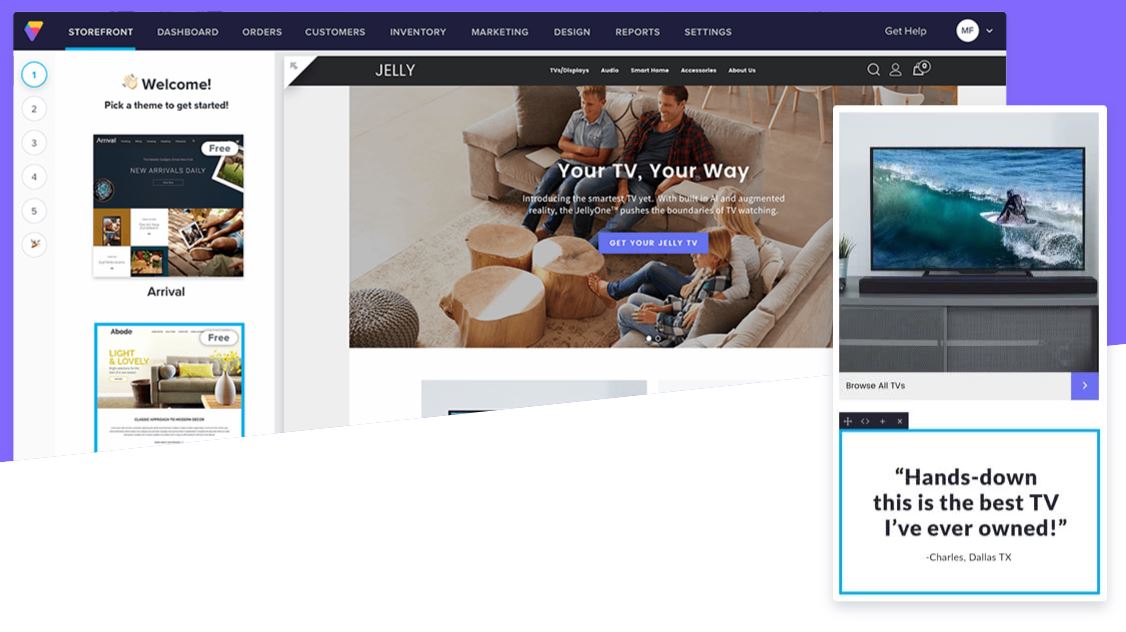
Volusion is a cloud-based ecommerce solution from the company of the same name in Austin, TX. It features an intuitive dashboard, built-in marketing and promos, SEO, templates, and tools to customize look and appearance.
$29
per month
Pricing
Salesforce Commerce Cloud
Volusion
Editions & Modules
No answers on this topic
Personal
$29
per month
Pro
$79
per month
Startup
$179
per month
Business
$299
per month
Offerings
Pricing Offerings
Salesforce Commerce Cloud
Volusion
Free Trial
No
Yes
Free/Freemium Version
No
No
Premium Consulting/Integration Services
No
No
Entry-level Setup Fee
No setup fee
No setup fee
Additional Details
B2B Commerce:
Starter - $4 price/order
Growth - $6 price/order
Plus - $8 price/order
B2C Commerce:
Starter - 1% Gross Merchandise Value
Growth - 2% Gross Merchandise Value
Plus - 3% Gross Merchandise Value
B2B2C Commerce:
1% Gross Merchandise Value
—
More Pricing Information
Community Pulse
Salesforce Commerce Cloud
Volusion
Features
Salesforce Commerce Cloud
Volusion
Online Storefront
Comparison of Online Storefront features of Product A and Product B
Salesforce Commerce Cloud
7.9
Ratings
1% above category average
Volusion
3.6
Ratings
74% below category average
Product catalog & listings
8.30 Ratings
4.30 Ratings
Product management
8.90 Ratings
4.30 Ratings
Bulk product upload
8.20 Ratings
4.20 Ratings
Branding
7.10 Ratings
3.60 Ratings
Mobile storefront
7.60 Ratings
1.20 Ratings
Product variations
7.60 Ratings
4.70 Ratings
Website integration
5.60 Ratings
3.30 Ratings
Visual customization
9.20 Ratings
5.10 Ratings
CMS
8.90 Ratings
2.20 Ratings
Online Shopping Cart
Comparison of Online Shopping Cart features of Product A and Product B
Salesforce Commerce Cloud
7.8
Ratings
2% above category average
Volusion
3.6
Ratings
72% below category average
Abandoned cart recovery
7.80 Ratings
3.60 Ratings
Checkout user experience
7.80 Ratings
3.70 Ratings
Online Payment System
Comparison of Online Payment System features of Product A and Product B
Salesforce Commerce Cloud
7.9
Ratings
5% below category average
Volusion
4.1
Ratings
68% below category average
eCommerce security
7.90 Ratings
4.10 Ratings
eCommerce Marketing
Comparison of eCommerce Marketing features of Product A and Product B
Salesforce Commerce Cloud
8.6
Ratings
11% above category average
Volusion
2.6
Ratings
99% below category average
Promotions & discounts
8.20 Ratings
4.80 Ratings
Personalized recommendations
9.40 Ratings
1.80 Ratings
SEO
8.20 Ratings
1.20 Ratings
eCommerce Business Management
Comparison of eCommerce Business Management features of Product A and Product B
Salesforce Commerce Cloud is well suited for medium to large sized eCommerce platforms (mainly B2C but B2B could work as well) who are looking to streamline their web processes and website functionalities while incorporating multiple departments. If you are a small business and have tighter margins, this may not be the best choice for you as there may not be as many opportunities to utilize all of the CRM's features and you may be at a financial loss because of it. Otherwise, this platform is great for organization and providing a helping hand in your eCommerce roadmap!
For a small business in need of a few more tools than basic platforms, Volusion is a good option. However, if you want infinitely customizable [tools] or to have multiple integrations extracting your orders and products data, then Volusion is quite limited. Additionally, if you lack in-house development teams, Volusion is a good product that is friendly for users who are not necessarily tech-savvy.
Demandware business manager features a very robust set of options to accomplish many merchandising and content tasks out of the box. For typical retailers, there are usually very simple ways to accomplish common tasks.
The ability to schedule content and tie unique content to session data is particularly useful and fully featured.
Many features that would typically be missing from a home-grown CMS and would require development are included in business manager and easily controlled by marketers.
Easy to Use. Non-technical employees can be simply trained. If you can use a social network, you can manage the backend of Volusion.
All-In-One -- without any add-ons, Volusion is a turnkey solution for eCommerce. No programming knowledge is required, no modules are needed (unless you have very advanced needs), and it features everything from website text, products, email marketing, customer accounts, shipping calculations, and back-end payment and order processing.
Allows for inventory tracking (such as Small, Medium, Large or Male/Female)
Allows for kitting (creating product bundles, up-sells, add-ons, and more)
Easy to customize -- with a little HTML knowledge, you can easily customize the free templates included in Volusion to create a personalized, dynamic web presence without the need for hiring expensive designers
Provides a great experience for the customer. Everything from search results, product display, shopping carts, wishlists, and the actual order process are delivered in a professional manner that will keep your customer feeling confident about making their purchase.
Easily integratable with Google Analytics with Sales Goal tracking -- this allows you to see where customers are coming from, what they are looking at, what they are purchasing, and when they are abandoning their carts.
The #1 pain with Demandware as a developer has been Pipelines. Originally development on this platform was designed as a visual drag, drop, and configure model. You would create these logic flows (pipelines) in the visual editor, made up of nodes (pipelets) and connectors. These quickly got out of hand and turned into a spiderweb. Worse they were not like anything that most developers are used to. Pipelines save to XML but the markup was not clean and difficult to merge or diff, to say the least. I guess they were aiming for a more simple model but quickly realized that was not sufficient for real-world applications. To their credit, Demandware recognized this and has been steadily moving toward a clean, pure-code model.
The benefits of SaaS and the quick release cycle can be a mixed blessing. Features and API's can and do change from time to time. When you're using a platform like this you cannot build it and forget about it. It's not obvious to everyone but you're signing up for some amount of maintenance over time to keep things up to date.
The platform has a flaw that still hasn't been resolved. Each Demandware customer "realm" has many instances for development, staging, production, etc. All of the instances have their own user accounts and passwords, and you have to log in to each instance separately. It's very frustrating as an admin or developer, though less so to business users who will only need to access one instance. Demandware could really use a Single Sign On!
Demandware has a marketplace for third-party extensions to add pre-build integrations with other systems. While there is a reasonably broad selection of third-party vendors, I have to point out that the quality of many of these components has been sub-par. There are a few gems but many are clunky and quickly cobbled together, and surely require further investment of time. Demandware needs to do a better job of quality assurance with third-party vendors.
Feature implementation. While they have a ton of features, they're often released haphazardly in my opinion. Sometimes it seems like they don't have testers. Typically, I'm unable to use new features until about 6 months after they're released (and over a year after I asked for them) because it takes that long to get the quirks smoothed out well enough for us to use them. It seems that they often don't understand programs that they integrate with well enough to do a proper implementation.
Timeliness of features. This can be taken with a grain of salt for many looking to compare. I'm a super-experienced user with many, many needs. We're often limited when it comes to Google (and other platform) beta programs, and even just early adoption because I have to wait for Volusion to catch up. What's tough is that I often NEED them to make a change in order for me to move forward, it's not my own limitation (but that's what you can expect when you use a third party software to run your site rather than your own team of developers).
Customer service in regards to live chat. While I LOVE that they have live chat (I'm needy, I constantly need support) - the operators are rude 75% of the time. They come into the conversation assuming I have no idea what I'm talking about and have a 'customer's always wrong' attitude. I'm sure it's frustrating to deal with ecommerce customers who don't know the first thing about websites - but I'm not one of those and I deserve respect. Our conversations nearly always begin with "Clear your cache" and "I don't see the problem" from the operator and end in "Oh, you're right. Well I don't know." from them. I will say I've dealt with one or two who actually know what they're talking about. Live chat is useless when the operators know less about the software than I do.
Slow to updates. They are often way behind when it comes to development and code. Example: They use jQuery v 1.4. We're up to 1.10 now and I'm experiencing issues for which the blame has been passed back on to me. I'm keeping up. They should be too. For me personally, the quality of development should come first. THEN worry about all of those features.
New live editor. It's seen a lot of scrutiny, which you'll find easily by Googling. My problem is that I don't need a WYSIWYG. I write in html. You have to pass through the WYSIWYG to get to the html editor. This has caused my javascript to get executed, so once I get to the html editor, I have to re-write my script because it's now shown as the execution. That's poor development. They should have an option to disable.
Inability to access pages in FTP. If you are someone who needs customization and writes in html, have fun. You can't actually access your product or category pages unless you do it through the content editors. You can absolutely access & edit your template and css files. But if you need a unique header in a product page - say a script to run, you'll have to put it in the template - adding overhead to ALL of your pages. The only workaround is hard-coding pages as "articles," which can make a mess of things.
A huge factor influencing our decision to remain on the Demandware platform is that our new parent company is standardizing all its luxury brands in the US on it. We are fortunate. However, even if we had remained an independent company, I believe we would continue on the Demandware platform for all the reasons outlined in this review. I appreciate the stability the platform has provided to our eCommerce site in the last three years as well as the continuous improvements and technological advances being rolled out that will allow us to keep the site fresh, engaging, modern and stable. I've heard many horror stories from colleagues on other platforms who struggle with the expense and complexity involved with making what should be minor and simple changes and updates to their sites.
When you spend so much time with a product like this and not only have you witnessed its growth, but you almost feel like you are next those that make the decisions of building features a certain way, you can't help but want to stay and be a part of their continued growth. It's simply a great product. Can it improve? By all means! But it will only improve because of users and avid resellers like me.
The overall ease of using the system. Consolidation in location for our team members. Mobile application for on the go research, as many of our team members are constantly traveling to job sites or to meet clients. No more duplicate calls to current customers, since we have 12 different divisions that span the company. Mostly the ability to look at the database when our team members begin cultivating a new lead/prospect with a potential customer to see if anyone within the team has a relationship with that person or the company they work for.
They are very responsive and a support technician will be assigned quickly. Even if there is further clarification needed for the ticket, or a solution is not immediately available, you feel that someone is there and staying on top of the issue. Most common issues are resolved quickly and satisfactorily.
You have to wait on hold for at least 45 minutes every call—the tech support person never knows the answer right away so they put you on 10 minute holds only to come back and say they're still looking for answers. The chat function could take days to get a response. Our "Dedicated Account Manager" never checks in or answers, nor are they ever in the office when we call. It's like they try to be as unavailable as possible until you forget why you even called in the first place. Insane.
It is best to use the built-in features and recommended services for the most turn-key experience (ie. Skipjack for payment processing so that it can all be done from the Volusion backend).
All relative to your organizational size. Shopify works for small to mid, Magento for small to large, commerce tools would be a large-scale plus. Hire a skilled consultant to help you make a decision of this caliber!
I've also used Shopify as a base platform, as well as Magento. Both are better. My company has looked into moving there twice since I've been here, and the only thing stopping them is the complications of making such a move. I think Shopify offers similar value for the money with a cleaner albeit more minimalist look. Both are better options in my opinion. I would only recommend Volusion if someone had used it before and doesn't plan on making it a crucial part of their business plan.
Salesforce Commerce Cloud ends up paying for itself in the long run so long as customers are taking advantage of its full capabilities.
I would highly recommend trying it or consulting a partner like us about it if you have an interest and think you could benefit. A thorough business analysis will tell you if this segment of Salesforce is right for your objectives.
Increased product database efficiency. It's really easy to import and export products/categories. Has likely saved us hundreds of hours.
Integration with other platforms. Integrations with comparison shopping feeds, email auto-responder tools and fulfillment tools is quite easy. This saves us on the cost for custom integrations.
Because it is a hosted solution, Volusion takes care of all the PCI and other security compliancies. Not having to monitor this and update ourselves saves money and gives us piece of mind.