The Red Hat Ansible Automation Platform (acquired by Red Hat in 2015) is a foundation for building and operating automation across an organization. The platform includes tools needed to implement enterprise-wide automation, and can automate resource provisioning, and IT environments and configuration of systems and devices. It can be used in a CI/CD process to provision the target environment and to then deploy the application on it.
$5,000
per year
SolarWinds Network Configuration Manager (NCM)
Score 8.3 out of 10
N/A
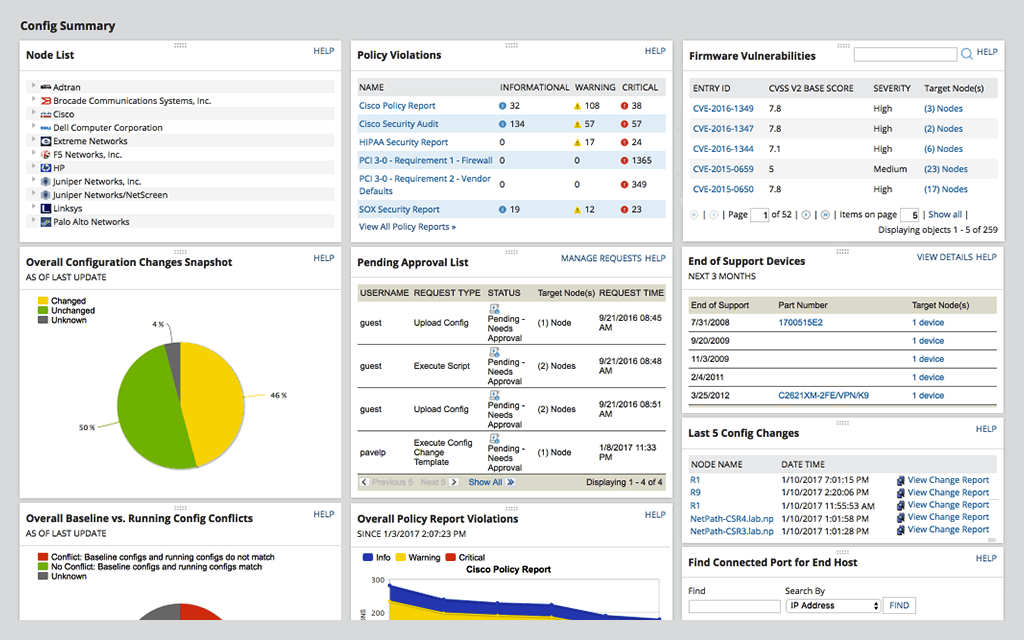
SolarWinds Network Configuration Manager is network diagnostics and troubleshooting technology, from Austin-based SolarWinds.
N/A
Pricing
Red Hat Ansible Automation Platform
SolarWinds Network Configuration Manager (NCM)
Editions & Modules
Basic Tower
5,000
per year
Enterprise Tower
10,000
per year
Premium Tower
14,000
per year
No answers on this topic
Offerings
Pricing Offerings
Ansible
SolarWinds Network Configuration Manager (NCM)
Free Trial
No
Yes
Free/Freemium Version
No
No
Premium Consulting/Integration Services
No
No
Entry-level Setup Fee
No setup fee
Optional
Additional Details
—
—
More Pricing Information
Community Pulse
Red Hat Ansible Automation Platform
SolarWinds Network Configuration Manager (NCM)
Features
Red Hat Ansible Automation Platform
SolarWinds Network Configuration Manager (NCM)
Configuration Management
Comparison of Configuration Management features of Product A and Product B
I'm going to say it is best suited for configuration management. Like I said, patching even with security, things of that nature. Probably less suited is hardware management, but Red Hat IBM/IBM has Terraform for that. So it's a trade off.
There was a need to find an old configuration of a network switch that was accidentally wiped clean. Fortunately, SolarWinds Network Configuration Manager (NCM) kept and archived a backup copy of the switch device in question! We were easily able to upload the configuration file to the switch and restore the device back on the network in a matter of minutes!
Debugging is easy, as it tells you exactly within your job where the job failed, even when jumping around several playbooks.
Ansible seems to integrate with everything, and the community is big enough that if you are unsure how to approach converting a process into a playbook, you can usually find something similar to what you are trying to do.
Security in AAP seems to be pretty straightforward. Easy to organize and identify who has what permissions or can only see the content based on the organization they belong to.
For our use case, it does everything great and some of the features we underutilize but I would like to be able to set a configuration baseline when initially adding a node instead of after the configuration is pulled but it's not a particularly big deal to let it pull the configuration then set it as the baseline.
Even is if it's a great tool, we are looking to renew our licence for our production servers only. The product is very expensive to use, so we might look for a cheaper solution for our non-production servers. One of the solution we are looking, is AWX, free, and similar to AAP. This is be perfect for our non-production servers.
Medium complexity to set up in the beginning if using any non-standard devices or configurations, else fairly easy (e.g. Cisco Nexus or IOS-based devices). Reports are fairly straightforward to set up. Updates to the platform are fairly straightforward and don't take a major effort. Easy to add or remove devices.
Overall it's good but the new architecture can be complex. Improvements can be made in the Config as Code capabilities for managing Red Hat Ansible Automation Platform. Sometimes it can be difficult for those unfamiliar to understand the relationship between Projects/Credentials/Job Templates, etc.
The user interface is lacking. It is difficult to navigate at times and things can be done multiple ways. Quite often I am confused by how their notification structure works. It is not very intuitive. They do offer a free Academy. They also offer a community of other technical folks. I have enjoyed both.
Great in almost every way compared to any other configuration management software. The only thing I wish for is python3 support. Other than that, YAML is much improved compared to the Ruby of Chef. The agentless nature is incredibly convenient for managing systems quickly, and if a member of your term has no terminal experience whatsoever they can still use the UI.
There is a lot of good documentation that Ansible and Red Hat provide which should help get someone started with making Ansible useful. But once you get to more complicated scenarios, you will benefit from learning from others. I have not used Red Hat support for work with Ansible, but many of the online resources are helpful.
To be fair, I have not had to involve Support in a number of years, but when I did, I was greeted with enthusiastic engineers who wanted to understand and solve the issue. It was a fairly complex scenario and I have discovered in my most recent implementation that engineering included that option as a standard now.
Solarwinds has actually produced new training since I last used it that is available on their site at any time. Their previous training was more than enough to get us started but now there is significantly more content. Since I'm comfortable with the Orion platform and the products we use I haven't checked the new training out yet but we have new staff go through portions of that training and they always come away with an understanding of the platform and ready to use it
As I said earlier, Red Hat Ansible remains a top choice because it is a perfect combination of multiple capabilities. Terraform is good in IAC but not in config automation. Puppet is well-suited for developers, but not for system administrators and infrastructure integrators. OpenShift and Kubernetes are generic automators only.
At the time SolarWinds was the biggest player in the space and their whole portfolio was very comprehensive. As time progressed and newer technologies came about (i.e. SDWAN) their products couldn't keep up with the consumer demands and changing market. Security became such a big focus that once Solarwinds got hacked we had to remove all their products from our environment
We are still early in our implementation and don't have much yet - but I can say that it has already improved the time it takes to deploy a new virtual server for us, as well as making them more consistent.
In working through what jobs are required, it has really improved the communication between our different teams
Saves 100s of hours a year in man hours over manual configuration.
Saved easily 50k in lost revenue when a switch rebooted with months old unsaved configuration. NCM let us quickly restore a snapshot of the running config from the previous day.
Saves us several man hours per week of config auditing by reducing all changes to a summary email.