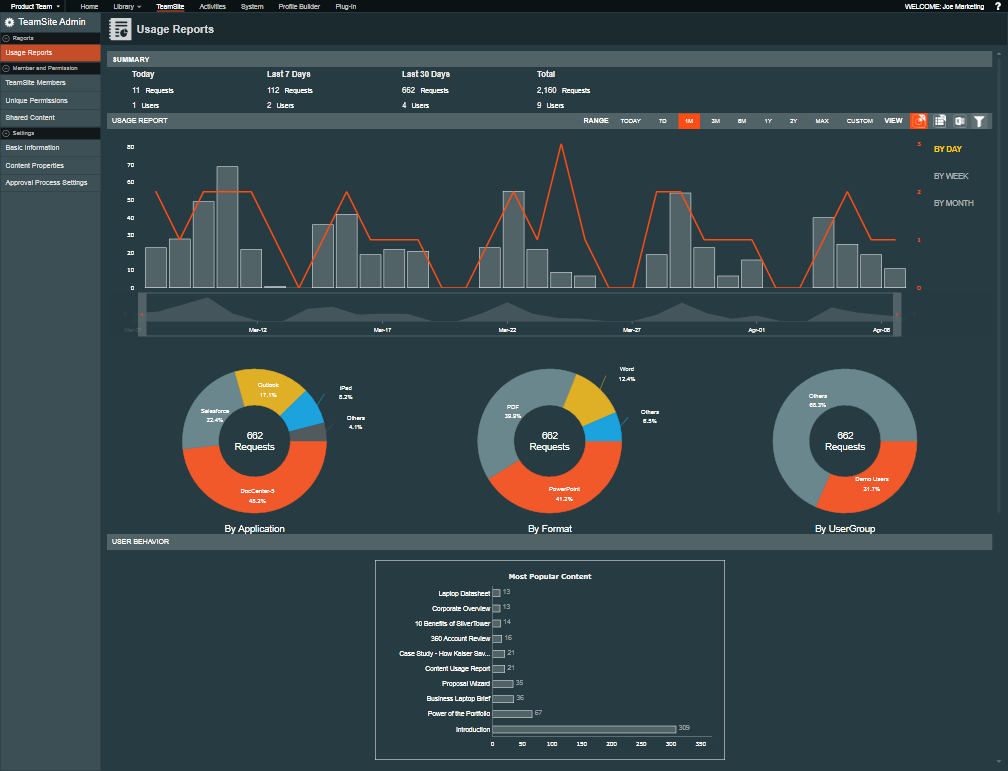
Seismic is a recognized leader in sales and marketing enablement. The vendor's value proposition is that their solution equips global sales teams with the knowledge, messaging, and automatically personalized content proven to be the most effective for any buyer interaction. Additionally, the vendor says powerful content intelligence and analytics enable marketers to prove and improve their impact on the bottom line, revealing what is really driving revenue and what needs to be…
N/A
Pricing
Qvidian RFP & Proposal Automation
Seismic Content
Editions & Modules
No answers on this topic
No answers on this topic
Offerings
Pricing Offerings
Qvidian RFP & Proposal Automation
Seismic Content
Free Trial
No
No
Free/Freemium Version
No
No
Premium Consulting/Integration Services
No
No
Entry-level Setup Fee
Optional
No setup fee
Additional Details
—
—
More Pricing Information
Community Pulse
Qvidian RFP & Proposal Automation
Seismic Content
Features
Qvidian RFP & Proposal Automation
Seismic Content
Proposal Creation & Organization
Comparison of Proposal Creation & Organization features of Product A and Product B
Qvidian RFP & Proposal Automation
7.6
Ratings
5% below category average
Seismic Content
-
Ratings
Proposal branding
7.90 Ratings
00 Ratings
Proposal templates
8.00 Ratings
00 Ratings
Proposal content library updates
8.00 Ratings
00 Ratings
Guided proposal creation
7.10 Ratings
00 Ratings
Searchable proposal database
7.00 Ratings
00 Ratings
Proposal Collaboration & Workflow
Comparison of Proposal Collaboration & Workflow features of Product A and Product B
Functionality and support are my two main areas. I want to be able to speak to someone when I have an issue. To Quvidian's defense, my company didn't see the value in sending someone to NH for the training. I'd used an RFP machine before so they thought that was sufficient. It was a poor decision on the company's part because although it was similar, it was not the same.
It is excellent for a cloud-based workspace between you and your customers. I find the chat feature to be a cool and underutilized tool. I appreciate how you can consolidate all your information on one page, rather than having multiple attachments. Easy to clone DSRs (Digital Sales Rooms), which saves a significant amount of time. Especially when all you have to do is make minor changes between customers.
The search function ranks information based upon usage and is adaptive, learning/improving rankings with every search. This makes finding the right piece of information quick and easy.
The tool offers flexibility to build various types of sales documents (proposals, presentations, case studies). This drastically reduces the time it takes to put together a client-facing document.
The content management functionality allows for various content formats and related content can be connected. This simplifies tracking content updates by knowing which other pieces of information may also need review and update when a change is made outside the normal update cycle.
Seismic allows for one location to store all relevant content so that associates are not having to spend as much time searching for what they need.
Seismic provides the ability to fully customize content such that one template can serve many needs with the simple ability to answer questions that drive the customization in the content. This customization can range from simple to quite complex depending on your level of expertise with the tool.
Seismic provides a lot of flexibility when it comes to organizing your content and how to make the experience of accessing that content unique to the needs of each user in the system.
This is a weird one but when adding content to the 'Q' the tab in word sometimes disappears. Not sure why that happens and we haven't really tried to trouble shoot yet. My solution at the moment is just closing it and re-opening it. Sometimes it works and sometimes I have to do it a few times.
While being a great place to keep content for our team to access, there is always the thought of whether the information is still accurate. Especially when comes to statistics and facts. We at times get so used to just using what is in our boilerplate that we forget to question whether information is accurate or not. This is more of an observation for users rather than an issue with 'Q' however the information is only as good as it's accuracy.
There have been a few times where issues with a server leads to a slow user experience or users are unable to use the platform for a small period of time. Bringing these to a minimum would greatly enhance the user experience.
We've already renewed our contract with Qvidian and plan on using it for the foreseeable future. Apart from the fact that Qvidian has all the features we need to respond to RFPs and maintain a large informational database, the time that would need to be spent researching and testing out a different piece of software just wouldn't be worth it. All of our users are well learned in Qvidian, and it's easy to teach to new users. Having to learn a brand new application when the current one works great is pointless. "If it ain't broke, don't fix it" applies here.
The shift they made in architecting documents from content to outline, is now reversed allowing outline creation first, then content which is more natural. But, due to the fact that we went through a migration of content to get to the new version, it feels less optimized than if we would have re-implemented.
End users having to configure settings more often than desired
Seismic is super easy to use and has so many different features and functionality to take advantage of. But being a company who utilizes Google platform a lot we have some issues with the api connections and integrations across the board. But all in all it is not a huge issue, I would just like to see them improve the integration more
They are very much in support of great customer service. They respond quickly with emails and in some cases phone calls to resolve any issues and often times user questions in the past when I could not figure something out.
I have never tried chatting/calling with Support for Seismic. However, from others that I have talked to that use Seismic in more of an administrative role, they have been easy to work with and are of great assistance. I think it's a good thing I've never needed to talk to support, as it means I haven't had any issues to this point.
Live instructor training is expensive, though we have had instructors come to our offices for a ‘refresher’ before. The refresher was more of a “let us fix that for you” than a training on how to do it ourselves.
Of the competitive vendor demos I have reviewed over the years, each may have its own strength. Some may be set up to drive compelling differentiators or solutions (E.g., propLIBRARY.com). Some may be built on existing CRMs (E.g., Qorus). Some may have tablet-friendly interfaces (E.g., SAVO). Others focus on collaboration (E.g., XaitPorter). There is nothing wrong with any of these models. You will just have to perform your own gap analysis and see what best addresses your needs. For Blackboard Inc., none of the aforementioned competition offered a holistic and robust replacement for our current PA tool. We have senior writers to craft compelling differentiators. We use SFDC, not SharePoint as our EA CRM. While our strategic writing and architectural needs outweigh having the slickest tablet-friendly user interface, we still have an interface and user experience that is geared toward usability and performance while being cognizant of adoption. New collaborative tools are a big draw, especially when responding to private sector proposals with a 10-to-20 day turnaround. However, not only has this not been a pain point for us (we currently have a versioning process in place) but the conversion and adoption hurdles just for one feature where there is already a workaround in place does not justify the migration.
Both Highspot and Seismic are great tools. They each provide an extensive library that can be easily customized based on the rep/team/deal cycle stage etc. Seismic has a much cleaner look and feel. As a rep, I felt it was much easier to navigate the tool and organize my content the way I wanted to. Highspot tended to feel cluttered and even overwhelming at times. Along with that, the AI and saved search feature ran smoother in Seismic. I could easily find the document or sales deck I was looking for, whereas in Highspot I felt I had to look around longer than I would have liked.
Our experience has been largely positive. It's allowed our RFP team to quickly and efficiently produce very professional documents. This has lead to more time being able to speak to the clients needs specifically. We've received lots of positive feedback from clients saying that the RFP looked tailored to them, and not just some content dumped in a binder. That was our goal.
The bespoke resources we have created and implemented in Seismic have increased our reps efficiency and effectiveness and ultimately increased their confidence with our prospects.
Better time management as connecting different lines of businesses and/or functions like Marketing with Compliance allows for a smoother workflow and less time consumption.
Improved workflows as Seismic allows the distribution of resources either internally or externally quickly with links & PDF files directly into email correspondence or Slack messages.