productboard, from the company of the same name in San Francisco, is a product management system designed to help product managers understand what users need, prioritize what to build, and rally everyone around a roadmap.
$25
per month
Roadmunk
Score 9.0 out of 10
N/A
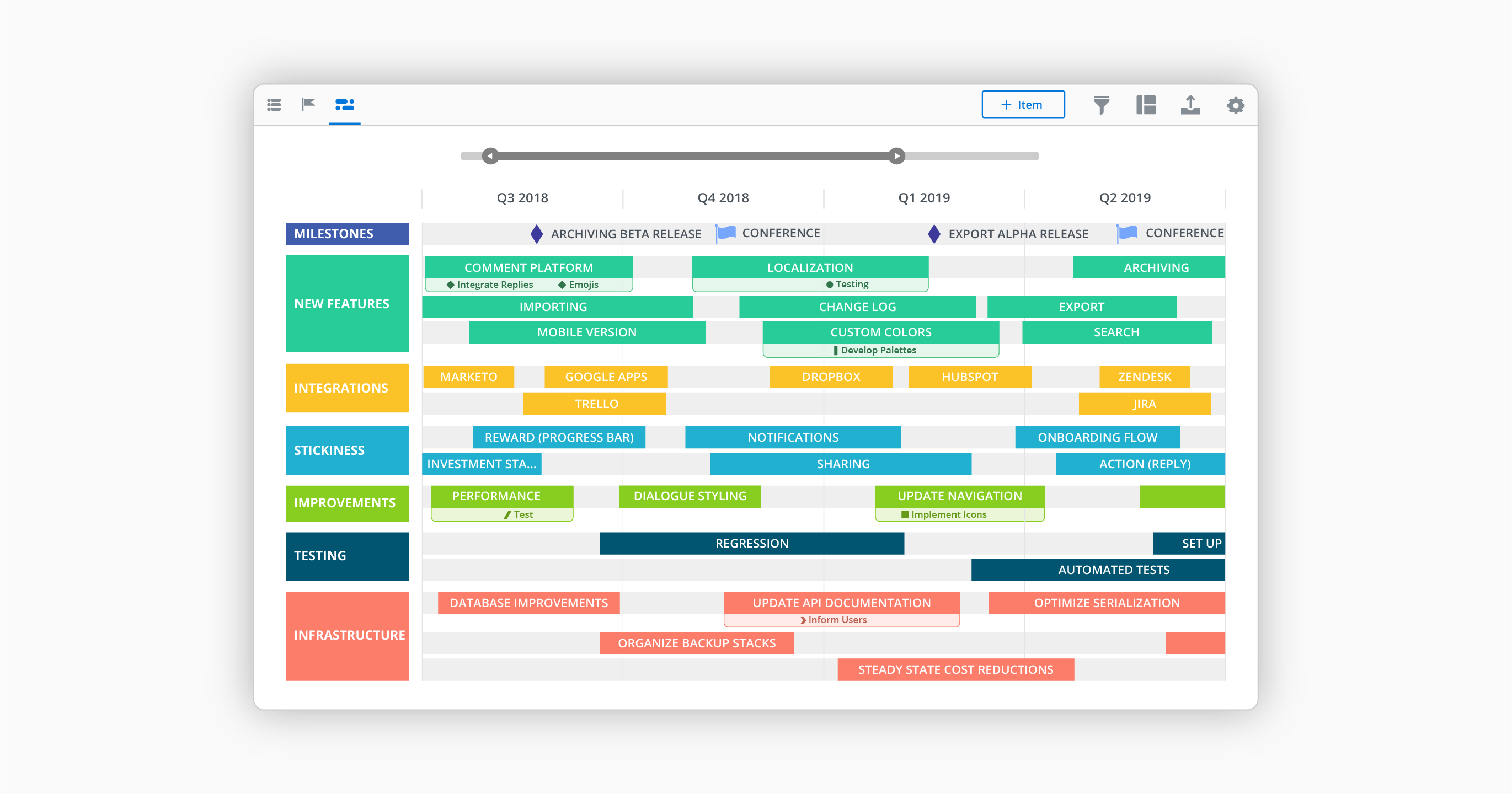
Roadmunk is a roadmap visualization platform that is designed to enable product managers and their teams to communicate the strategic roadmap throughout their organization. The vendor says product leaders can easily input milestones, roadmap data and create unlimited pivots in real time. The vendor says it has differentiated itself through intuitive user-centric design, seamless manipulation of roadmap views and enterprise data security. Since late 2021, Roadmunk is part of Tempo.
$19
per seat
Pricing
productboard
Roadmunk
Editions & Modules
Essential
$25.00
per month
Pro
$60.00
per month
Scale
$120.00
per month
Starter
$19
per seat
Business
$49
per seat
Professional
$99
per seat
Enterprise
Custom
per seat
Offerings
Pricing Offerings
productboard
Roadmunk
Free Trial
No
Yes
Free/Freemium Version
No
No
Premium Consulting/Integration Services
No
No
Entry-level Setup Fee
No setup fee
No setup fee
Additional Details
—
Ready to roadmap? All our plans start with a free 14-day trial.
The best feature of productboard is organized features, it has a very simple structure and can be read and understood by anyone. If your roadmap is very dynamic and the executive team needs to be on top of it, productboard is the best application out there. But if you have a small product and features do not change very often, then maybe you can look at other alternatives since productboard is expensive.
Roadmunk allows us to configure and share customized views of our roadmaps. As a platform, it has demonstrated progress in its scalability and performance, which has accommodated the growth our team has seen over the last two-plus years. Particular strengths include configurability and customization, along with options for views, exports, and sharing with internal and external audiences.
Collaboration – Roadmunk makes it very easy to work and edit within a team structure.
User Experience – The usability of the product made it quite easy for the entirety of the team to hit the ground running (i.e. very little training was required).
Rollups – Each product line and therefore each product owner could easily focus on their particular roadmap without having to sort through the master roadmap making it highly efficient, while at the same time making it quite easy to pull all updates into one high-level document.
Performance has improved meaningfully over the last 12 months or so, especially in our views that contain many roadmap items. Some challenges remain, however, particularly when changing the timeline and in scenarios of multiple users interacting with the roadmap simultaneously.
The Roadmunk team has been great to work with...whether proactive communications about new features or the occasional outage, or when we reach out to them with feature requests, assistance/support, or even license management and renewals - they are top notch.
I have previously used Aha another product road mapping/ insights driven software. Aha had great features for the userbase of my previous products. They were allowed to create their own suggestions for the products and other users could then like or dislike the suggestion. This created a real reflection on need for product enhancements. productboard handles this slightly differently. Each user creates their own suggestions and doesn't necessarily have visibility on other users suggestions. The product/ R&D team can then tag suggestions together into the same overall suggestion. This requires more input from product/R&D with productboard. I would however, suggest that productboard is better than Aha. Aha is great for an external user point of view; however, there may be case for users to not have visibility on wider user requirements. productboard keeps more of this element hidden and would perhaps stir up less negative correlation to seeing a system requirement/suggest having had a lot of traffic and no action, compared to a more closed system that would individually update each user on the enhancement progress.
Roadmunk has an actual product management workflow design built into it vs trying to use eg generic e-post-it software like Trello. Trello is better at free-forming prioritization, which is actually much better than (again) the awkward item navigation in Roadmunk, but the other Roadmunk advantages post-prioritization win out in the end.
Roadmunk has reduced the number of meetings that product needs to attend with customers by 20-25%
Roadmunk has eliminated a whole set of churn in our workstream management tool (JIRA) by abstracting the planning step away from the steps where we monitor work progress