Plone is a free and open source content management system built on top of the Zope application server. Plone can be used for any kind of website, including blogs, internet sites, webshops, and internal websites.
N/A
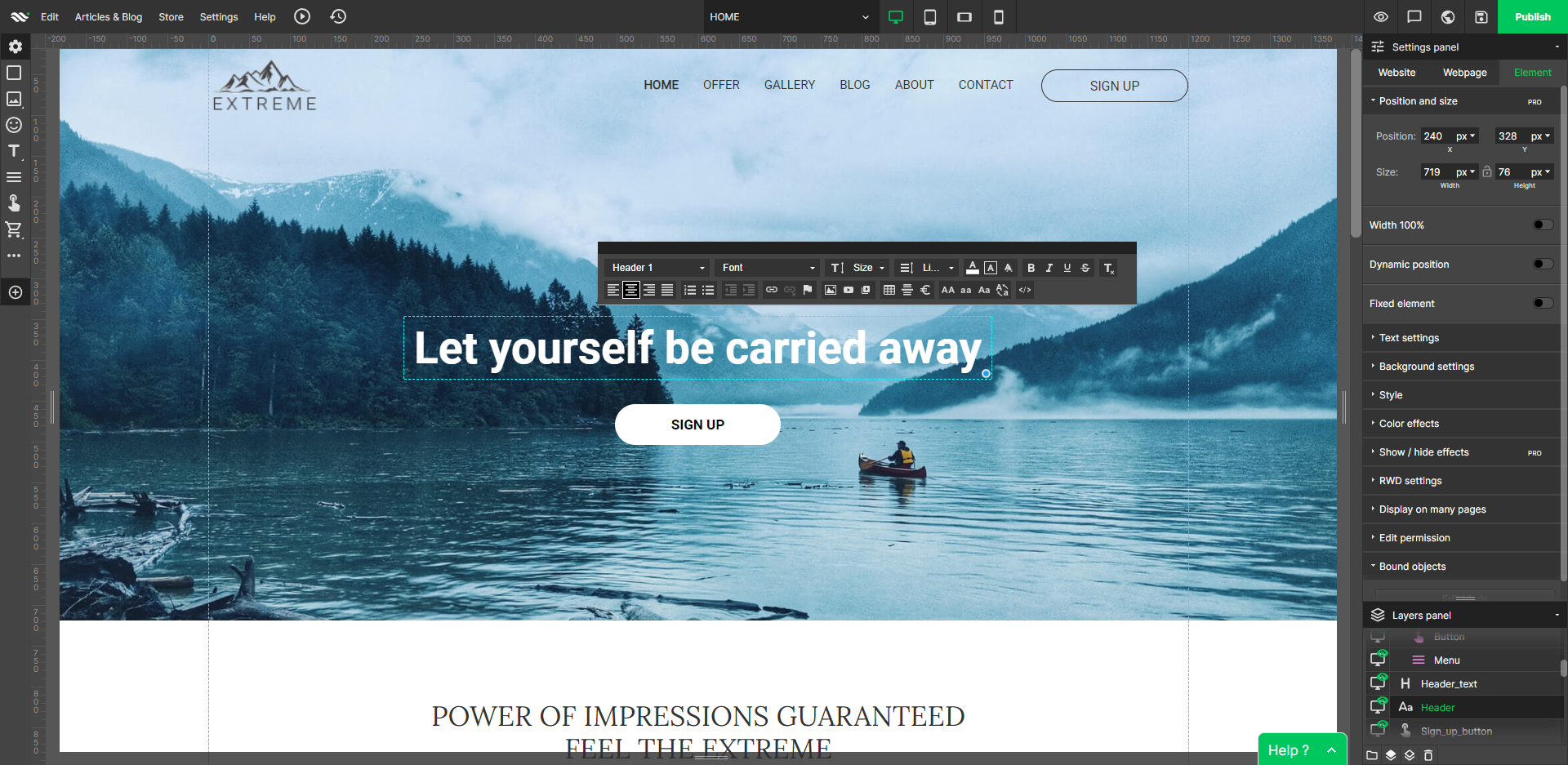
WebWave
Score 9.5 out of 10
N/A
WebWave — an alternative for agencies and freelancers for creating custom websites for clients with the support of CMS. Using CMS with no sacrifices WebWave is a CMS platform that gives a designer precision up to 1 px in every single detail just like in more sophisticated graphic programs such as Photoshop while remaining a drag and drop software. This is to make creating websites much faster without loosing on details. Spend less time talking WebWave…
N/A
Pricing
Plone
WebWave
Editions & Modules
No answers on this topic
No answers on this topic
Offerings
Pricing Offerings
Plone
WebWave
Free Trial
No
Yes
Free/Freemium Version
No
Yes
Premium Consulting/Integration Services
No
No
Entry-level Setup Fee
No setup fee
$7 per month
Additional Details
—
—
More Pricing Information
Community Pulse
Plone
WebWave
Features
Plone
WebWave
Security
Comparison of Security features of Product A and Product B
Plone
8.0
Ratings
1% below category average
WebWave
-
Ratings
Role-based user permissions
8.00 Ratings
00 Ratings
Platform & Infrastructure
Comparison of Platform & Infrastructure features of Product A and Product B
Plone
8.5
Ratings
11% above category average
WebWave
-
Ratings
API
9.00 Ratings
00 Ratings
Internationalization / multi-language
8.00 Ratings
00 Ratings
Web Content Creation
Comparison of Web Content Creation features of Product A and Product B
Plone
8.0
Ratings
4% above category average
WebWave
-
Ratings
WYSIWYG editor
8.00 Ratings
00 Ratings
Code quality / cleanliness
8.00 Ratings
00 Ratings
Admin section
7.00 Ratings
00 Ratings
Page templates
10.00 Ratings
00 Ratings
Library of website themes
8.00 Ratings
00 Ratings
Mobile optimization / responsive design
7.00 Ratings
00 Ratings
Publishing workflow
8.00 Ratings
00 Ratings
Form generator
8.00 Ratings
00 Ratings
Web Content Management
Comparison of Web Content Management features of Product A and Product B
The larger your organization, the more appropriate Plone will be. This is not to say that Plone is a worse choice for small websites, only that the minimum investment for a Plone site is certainly higher than for other platforms. If you already use Plone for your site and are looking for a redesign or an overhaul, I would only advise switching to a different platform such as WordPress or Drupal if your organization is downsizing. For any other situation, Plone is the natural choice for your growth.
The WYSIWYG web builder marketspace is saturated, but there are not many solutions out there that eschew table-based design in favor of letting creators build sites where anything goes wherever you want. You’ll likely want to skip this product if you need a plug-and-play solution where everything is automatically responsively. However, if you have an eye for design, love creative control, and like to sweat the details until you have made the perfect website, WebWave is a must buy.
WebWave's site builder is the platform's truly innovative feature. I've never come across another service that deploys a layer-based approach in web design, as most of them usually deploy a grid-based system. This is an incredible alteration that ensures WebWave behaves much like a traditional graphic design tool, thereby resulting in an experience that is a lot more intuitive and instinctive. I believe this has the potential to radically change the way people approach no-code web design.
WebWave provides automatic, daily backups and a free SSL certificate for every website. This results in excellent security.
WebWave's support team is first-class! I had some teething-issues in the beginning, but the support team quickly got me back on track.
WebWave's community/forum is an excellent place to vote and request new features. This proves the development team is committed to making WebWave better by listening to their users.
Bullets and formatting sometimes make it difficult to add text to an existing paragraph. The 'code' button is useful in those cases, but only to those who know html.
Sometimes the pages don't save correctly and you use information.
Uploading and displaying images is a bit too much work.
Some scope for improvement in UX (colors are not very appealing). It is simple to use but design is a little dated. Especially in the builder section, I'd like to see modern design for buttons and maybe gradients also: as this is where visual motivation is also important
Some edits take effect only after pressing OK. That should be eliminated as it's an unnecessary addition. It's also kind of annoying to do that again and again, which can add up to a lot as we do so many small tweaks while building the website.
Few things (maybe glitches) in design. The rectangle below the footer was uneditable for me. I spent quite some time trying to figure it out so I'm convinced it's a glitch.
Plone has been used for more than ten years and it already has an interesting roadmap for its future. I do not know any other open source CMS with the same story of continuous evolution and security track. Interesting new features are added at each release and new modules are created continuously
Compared to the amount of Plone sites, users and customizations we have in our organization, the amount of support requests and training needed is really small.
The new user interface in Plone 6 is even better, it is super fast, has lots of different blocks for enhancing the page, has flexible layout system and is easy to extend with more features.
Our Plone sites are very robust. We have critical systems on Plone and we have been running sites on Plone for over 20 years with very little unexpected downtime.
Plone is very intensive in its operations, and if not configured well it can be slow. However it is designed and built with speed in mind and with proper use of coding, templates and caching can perform extremely well under high loads. It is capable of scaling to very high load availability environments with no specific coding requirements.
1. The support person does not seem to understand the issues, and seems like they go off to talk to somebody and revert back every 5 to 10 minutes. It takes up a lot of time. 2. There is a lack of reading material to address simple issues like changing the website name in the dashboard, pasting a code, etc.
Plone is much harder to learn then Wordpress. Development in Wordpress is learnt in day's, where development in Plone really takes years to get to the full depth. That said, once you're able to develop in Plone, is it a rock solid system, with readable code. In my experience Wordpress websites need to be updated so often, and the code feels bad organised. I have been building Wordpress websites, choosing Wordpress only when the client has almost no money. But I can never deliver the quality I want to deliver when using Wordpress. Plone does offer the possibility to deliver professional websites. As for Joomla, in the past I have done some Joomla development, but the whole CMS-paradigm could not settle in my brain. Being a web developer for over 15 years now, Joomla always felt contra-intuitive. Let alone the task of teaching this to my clients. Plone is now my only choice. It gives me a fast development-cycle, a user-friendly CMS and a rock stable and very secure system.
Fast load times: WebWave's websites have fast load times, which is critical for ensuring a positive user experience and better SEO performance. Responsive design: WebWave's websites are optimized for mobile devices, ensuring that they look great and function well on any screen size. Wix simply just doesn't have that and I was really struggling with this issue. Cost-effective: WebWave's pricing plans are affordable and provide excellent value for money, making it a cost-effective option for small businesses and entrepreneurs.
We thought that tapping into the user/content management tooling of Plone would be a good and useful thing, however it turned out to be a major pain to tie into those parts of Plone.
I wish we would have built the extra functionality completely outside Plone and found a way to integrate it. It would have been much easier.