Plastic SCM vs. Salt Project

Overview
ProductRatingMost Used ByProduct SummaryStarting Price
Plastic SCM
Score 8.2 out of 10
Enterprise companies (1,001+ employees)
Plastic SCM is a full stack version control system that aims to make software configuration easy. It focuses on enabling dev teams get work done by facilitating branching, diffing and merging. The vendor says that for those purposes it provides cross-platform apps and GUIs with: Branch explorer Diffing and merging tools (both syntactic and semantic) On-premises and cloud repo management Code review mergebots (last mile…
$6.95
per user
Salt
Score 6.2 out of 10
N/A
Built on Python, Salt is an event-driven automation tool and framework to deploy, configure, and manage complex IT systems. Salt is used to automate common infrastructure administration tasks and ensure that all the components of infrastructure are operating in a consistent desired state.N/A
Pricing
Plastic SCMSalt Project
Editions & Modules
Cloud Edition
$6.95
per user
Team Edition (on prem)
$9.95
per user
Enterprise Edition
$23.25
per user
Enterprise Edition (perpetual)
$595.00
per user
No answers on this topic
Offerings
Pricing Offerings
Plastic SCMSalt
Free Trial
YesNo
Free/Freemium Version
YesNo
Premium Consulting/Integration Services
NoNo
Entry-level Setup FeeOptionalNo setup fee
Additional Details* Educational institutions receive a substantial discount on Plastic SCM licensing fees * Corporate/volume pricing is available * For more information, please contact sales at sales@codicesoftware.com
More Pricing Information
Community Pulse
Plastic SCMSalt Project
Best Alternatives
Plastic SCMSalt Project
Small Businesses
Salt
Salt
Score 6.2 out of 10
HashiCorp Terraform
HashiCorp Terraform
Score 8.5 out of 10
Medium-sized Companies
Salt
Salt
Score 6.2 out of 10
Ansible
Ansible
Score 9.2 out of 10
Enterprises
Perforce P4
Perforce P4
Score 7.7 out of 10
Ansible
Ansible
Score 9.2 out of 10
All AlternativesView all alternativesView all alternatives
User Ratings
Plastic SCMSalt Project
Likelihood to Recommend
8.4
(0 ratings)
8.0
(0 ratings)
Support Rating
-
(0 ratings)
8.2
(0 ratings)
User Testimonials
Plastic SCMSalt Project
Likelihood to Recommend
Plastic SCM is well suited for the distributed development environment, where branching and merging can easily be handled. Its a good tool for version controlling, especially for a big team which is contributing to a big project simultaneously. Situation where Plastic SCM is not at all well suited are : If the project is smaller one and need to be handled by couple of people. So in that case setting up Plastic SCM and educating people to work on it is not at all efficient
Read full review
Managing heterogeneous environments of large numbers of nodes, especially nodes which may need sudden changes (security updates, for instance), or frequent replacement, is a strength for Saltstack. Simplicity is not a strength for Saltstack. In a homogenous environment (all CentOS 7, for example, with no Debian or Windows) I might recommend using Ansible instead - it is less flexible and granular, but simpler to configure.
Read full review
Pros
  • Version Control
  • Organizing Workflow
  • Transparency
Read full review
  • A superb remote execution framework! SaltStack allows us to easily program numerous functions on top of it. For example, we developed a fast parallel asynchronous deployment tool that handles all software deployment, including interdependent service management.
  • Configuration management is now easy. We take advantage of this to automate (in tandem with AWS tools) the stand-up of all servers and services. It is also relatively easy to create new configuration management states for software not yet supported by the community (e.g. Grafana).
  • Flexibility. Numerous small utilities have been built which simply wrap around SaltStack to allow tedious tasks to become easy.
Read full review
Cons
  • Interface
  • Documentation
  • Learning curve
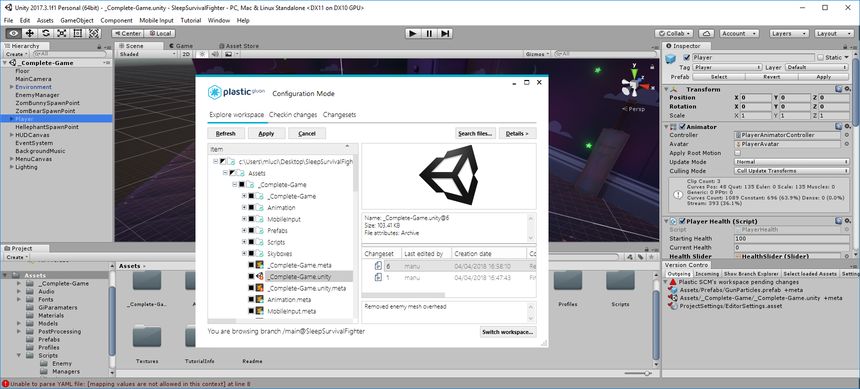
  • Unity integration
Read full review
  • Managing network hardware should be more native and easy
  • SaltStack should buffer jobs and, when a client returns, make sure it is executed proberly
  • SaltStack should provide basic pillar and states structures to help get newbies started
Read full review
Support Rating
No answers on this topic
We haven't had to spend a lot of time talking to support, and we've only had one issue, which, when dealing with other vendors is actually not that bad of an experience.
Read full review
Alternatives Considered
Plastic has best integration with unity - zero issues, native, straightforward. GitHub feels more stable but for smaller and or indie teams plastic s version control feels much more under control - you click, you feel safe. moreover, there is no need for extra tools such as gitkraken, gitlab, Sourcetree, fork, etc. it is really easy to develop games this way.
Read full review
I've used shell scripts over ssh, custom in-house deployment tools, Chef, and SaltStack. I've evaluated Ansible, but I was never happy with performance over SSH. Chef's loose configuration data model and lack of philosophy and conventions around use makes it difficult for a team to share responsibility for configuration code. Needing to use additional tools to do orchestration for cross-host/agent dependency relationships made me look for more. SaltStack, while not as mature when I first tried it, impressed me with its speed and elegant design
Read full review
Return on Investment
  • Easy to use
  • Cheap
  • Better than git for us
  • Artists love it
Read full review
  • SaltStack has reduced the time it takes to deploy new machines for us 10-fold.
  • It is much easier for us to maintain compliance with industry standards with SaltStack.
  • No negative impacts!
Read full review
ScreenShots

Plastic SCM Screenshots

Screenshot of Screenshot of Screenshot of Screenshot of Screenshot of Screenshot of