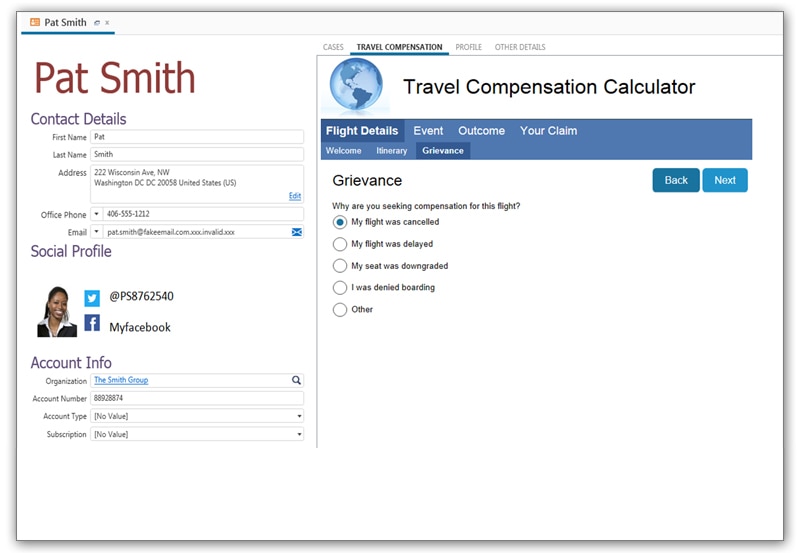
Oracle Service is the help desk and customer experience management platform from Oracle. The technology was developed and supported by RightNow Technologies as RightNow CX for cloud-based call center automation, until that company's acquisition by Oracle in 2011 for about $1.5 billion.
N/A
SysAid
Score9.1 out of 10
Mid-Size Companies (51-1,000 employees)
SysAid is an ITSM platform that enhances service delivery with AI Agents, chatbots, workflow automation, and asset management. AI Copilot categorizes tickets, provides case summaries, and offers sentiment analysis. The AI chatbot, available via chat, email, and Teams, speeds support.
N/A
Pricing
Oracle Service
SysAid
Editions & Modules
No answers on this topic
No answers on this topic
Offerings
Pricing Offerings
Oracle Service
SysAid
Free Trial
No
Yes
Free/Freemium Version
No
No
Premium Consulting/Integration Services
No
Yes
Entry-level Setup Fee
No setup fee
Required
Additional Details
—
SysAid Copilot is available as an add-on for any plan. It bakes generative AI into every aspect of service management.
Oracle Right (Oracle Service Cloud) was an important evolution in the group's ombudsman channel management processes. We brought the Oracle Service Cloud to digitize the processes for capturing and managing the group's ombudsman channel, no longer operating manually (MS Excel).
Oracle Service Cloud (Right Now) brought about an important evolution in the management processes of the group's ombudsman channel, where activities that were performed manually, repetitively and with risk of errors, are now operated by the Right Now platform itself, whether by API, or by automation of the tool.
A de minimis incentive was given to thank the reviewer for their time. The incentive was not used to bias or drive a particular response, nor was the incentive contingent on a positive endorsement. More Info
SysAid just works. For the number of built in features, it is relatively easy to use and get started with. Getting started with SysAid is hassle free as well. Once setting up the RDS on prem, rolling out to all of the machines is a breeze. The cloud service takes over from there. Device scans will immediately begin sending data to SysAid cloud that provides hardware and software information.
A de minimis incentive was given to thank the reviewer for their time. The incentive was not used to bias or drive a particular response, nor was the incentive contingent on a positive endorsement. More Info
A de minimis incentive was given to thank the reviewer for their time. The incentive was not used to bias or drive a particular response, nor was the incentive contingent on a positive endorsement. TR verified that a representative sample of customers was invited. More Info
Email integration. End-users can interact with the ticketing system exclusively through email, and admins can message exclusively within a ticket. All communications are linked directly to user accounts including SysAid admin accounts.
Ticket management is very customizable. You can add categories, statuses, action and communication automation, ticket sorting, and much more.
knowledge base links directly to tickets, so repeat issues are easy to solve.
A de minimis incentive was given to thank the reviewer for their time. The incentive was not used to bias or drive a particular response, nor was the incentive contingent on a positive endorsement. More Info
Oracle Service Cloud needs a better built in integration with Oracle Social Cloud or it needs to build in more Social network capabilities.
SMS is handle via a third party application but could be built in as part of the product.
The knowledge foundation product needs a better way to handle multiple languages. Currently you have to purchase an additional interface for each language. You can purchase the more expensive Knowledge Advance which does have a better language feature.
The Help tool could use some refining. Particularly indicating the order in which steps must be done. A clear example is the creation of customized fields or lists.
Formatting of the ticket. There is no possibility to create dynamic tables, use more than one column. I would want to have more flexibility without having to pay for Professional Services
A de minimis incentive was given to thank the reviewer for their time. The incentive was not used to bias or drive a particular response, nor was the incentive contingent on a positive endorsement. More Info
Although RightNow is extremely flexible, the flexibility comes with a price. It is often not intuitive which settings you need to change (and under which menus these setting are buried) to enable the system to do what you want. Also, sometimes the system can do things you need, but you don't initially realize it. When RightNow sells a system to a new customer, I think it should come with X hours of consulting time with a RightNow expert. The customer should be able to consult with this expert over the next year to get advice concerning how to configure the system to achieve desired needs. Often RightNow Support would just answer "no" when I asked if I could do something, but then I would find another way to achieve my goals after talking with other companies using RightNow.
This rating reflects our overall satisfaction with the platform’s performance, reliability, and flexibility in meeting our IT service management needs. SysAid has streamlined our ticketing processes, enhanced asset management, and improved operational efficiency through automation and reporting. The system’s adaptability across multiple departments has added significant value beyond IT. An excellent service tool.
A de minimis incentive was given to thank the reviewer for their time. The incentive was not used to bias or drive a particular response, nor was the incentive contingent on a positive endorsement. More Info
The learning curve is fairly steep; but for something that has this much capability, it's nearly impossible to make it "easy". The layout and organization are at least reasonably intuitive. The hardest part-- the "weakest link"-- is the portal development (where you can build help centers and other end-user pages.) The capabilities there are significant, but the learning curve for that part is especially steep and it takes a fair amount of expertise to be able to update it.
Whilst it delivers on most of the features it comes with, I feel Change Management needs a complete re-do as it is really complicated, and think it should be made to be straightforward. For the free services of their Market Place, they should develop a platform where one can just browse for the script (downloaded) and apply the patch, without having to go into various places in code to activate the service. or at least, build the integrations into the system and have [a] section under settings, or even straight from the Market Place, where one can just enable the service, and if required, be prompted to input additional information, including credentials.
A de minimis incentive was given to thank the reviewer for their time. The incentive was not used to bias or drive a particular response, nor was the incentive contingent on a positive endorsement. TR verified that a representative sample of customers was invited. More Info
Another of the benefits of sysaid is that it is highly available when working in on-premise environments.The only times the system is down is when a restart of the services is required to add a new feature. Apart from that, we have not had any problems.In the case of the cloud, the only condition I have seen where sysaid is not available is because the internet link is down or damaged.
A de minimis incentive was given to thank the reviewer for their time. The incentive was not used to bias or drive a particular response, nor was the incentive contingent on a positive endorsement. More Info
We use a lot of tabs and fields on our incident workspace, which should slow the system down, but it's still quite fast, and we continue to optimize whatever is possible.
A de minimis incentive was given to thank the reviewer for their time. The incentive was not used to bias or drive a particular response, nor was the incentive contingent on a positive endorsement. TR verified that a representative sample of customers was invited. More Info
In the case of system performance, I have seen that no matter the number of assets and users, Sysaid responds in the same way and at the same speed. The reports that are scheduled do not have any details because they arrive directly to your email. In the same way, when it is integrated with other systems, for example through the API or by email, we have not seen any failure due to the integration. It works very well with or without integrations.
A de minimis incentive was given to thank the reviewer for their time. The incentive was not used to bias or drive a particular response, nor was the incentive contingent on a positive endorsement. More Info
Technicians seem to be assessed based solely on how quickly they close the issues. I've had to reopen requests multiple times because they didn't actually solve my problem. Also, when the issue has even a moderate amount of complexity, the technicians often instruct me to "open another SR" to handle the other issue. I'm the customer, I shouldn't have to follow their processes, they should handle that for me. But even when I create the new SR, it seems like their right hand isn't talking to their left - they aren't reading back to the previous issue for context. So I get bounced around a lot, and I have to tell them how to do their job
A de minimis incentive was given to thank the reviewer for their time. The incentive was not used to bias or drive a particular response, nor was the incentive contingent on a positive endorsement. More Info
SysAid support is fast and effective. They support their own product, so they know it well. I can expect a response to my request in less than 24 hours and often in less than an hour. Their sales, customer support, and technical support staff are experts in the area of the support request ticket, so we seldom are transferred to another support agent. Their system is well designed and one of the best of all the applications we use.
A de minimis incentive was given to thank the reviewer for their time. The incentive was not used to bias or drive a particular response, nor was the incentive contingent on a positive endorsement. More Info
Most of our training was given while doing user acceptance testing, and getting the system approved by the market. When ever we were in doubt, our implementer helped us along. Later on we started exploring by our selves.
A de minimis incentive was given to thank the reviewer for their time. The incentive was not used to bias or drive a particular response, nor was the incentive contingent on a positive endorsement. TR verified that a representative sample of customers was invited. More Info
My team was greatly assisted and trained well. Despite the time zone difference the trainer made every effort to be available during times that were suitable for us and the assistance and help offered was extremely appreciated by my team. A wonderful experience by the team.
A de minimis incentive was given to thank the reviewer for their time. The incentive was not used to bias or drive a particular response, nor was the incentive contingent on a positive endorsement. More Info
The training I received was very good, they gave me tasks to carry out and then they checked what I had done.It was gratifying that the instructor noticed that I had made very fast progress because I had done the implementation myself and it was very fast. At least I remember that after 5 days I had already finished almost 90% of all the implementation tasks.
A de minimis incentive was given to thank the reviewer for their time. The incentive was not used to bias or drive a particular response, nor was the incentive contingent on a positive endorsement. More Info
Work with a RightNow expert during the implementation. Explain features that would you like to have. Often, somebody who really knows the system can show you what you need to do to achieve the desired results. Where a RightNow support engineer or a consultant might say "the system can't do that," a RightNow application engineer will listen to what you need, and often come up with an alternate path to achieve it
It is recommended that it be synchronized with the active directory for a better experience, also using the network scanning tools are very useful both to maintain your hardware and software inventory. See all the documentation found on the portal where they suggest good practices for the use of SysAid and exploit it from the first time
TCS' customers who also selected Oracle Service Cloud over Salesforce Service Cloud and GE's ServiceMax in the Mfg. vertical in which I work, did so because of the robust ability of Oracle Service Cloud and its APIs to integrate with other value-add solutions for manufacturers such as IoT applications, Big Data Analytics, and Field Service applications.
A de minimis incentive was given to thank the reviewer for their time. The incentive was not used to bias or drive a particular response, nor was the incentive contingent on a positive endorsement. More Info
There are many items offered on the other platforms that SysAid does not have. However, for a smaller or medium-sized business that needs a simple and easy way to get tickets flowing and allow users to help themselves, this is an excellent way to start.
A de minimis incentive was given to thank the reviewer for their time. The incentive was not used to bias or drive a particular response, nor was the incentive contingent on a positive endorsement. More Info
When we purchase it, the plans were different and mainly we acquired lifetime licenses. in the past year, we migrated to the cloud version. In both cases, the pricing structure was accurate, although they could provide some extra flexibility to pay for exactly what we need in the business.
A de minimis incentive was given to thank the reviewer for their time. The incentive was not used to bias or drive a particular response, nor was the incentive contingent on a positive endorsement. TR verified that a representative sample of customers was invited. More Info
Le doy esta calificación porque los módulos que contiene se pueden usar para casi cualquier departamento, tanto gestión de tickets como inventarios de equipos, hemos utilizado una versión gratuita en Ingeniería para gestionar sus tiempos en las tareas asignadas, es lo único que utilizan pero podrían usar fácilmente el módulo de inventario para su herramienta y el módulo de proyectos también
We have used SysAid since 2008. Through out these years, we find that SysAid support is very helpful and professional. The respond that we get is very fast and they will help us until we have solved our problem that we reported to them. So far, we are very happy with SysAid support.
A de minimis incentive was given to thank the reviewer for their time. The incentive was not used to bias or drive a particular response, nor was the incentive contingent on a positive endorsement. More Info
A de minimis incentive was given to thank the reviewer for their time. The incentive was not used to bias or drive a particular response, nor was the incentive contingent on a positive endorsement. TR verified that a representative sample of customers was invited. More Info
How easy it is to configure the app to our existing ITIL process. The ability to pick what services we would like to have as well as the ability to integrate using API as well as the marketplace.
Intuitive interface. Integration to Outlook. Easy reporting.
It has a very user-friendly interface and effective management capabilities.
A de minimis incentive was given to thank the reviewer for their time. The incentive was not used to bias or drive a particular response, nor was the incentive contingent on a positive endorsement. More Info