Oracle Sales guides sellers with intelligent recommendations to help them focus on the most valuable prospects at the right time. These machine learning-based CRM selling tools center around clean, complete customer data from internal and external sources.
$65
Per User Per Month
Salesforce Revenue Cloud
Score 8.8 out of 10
Mid-Size Companies (51-1,000 employees)
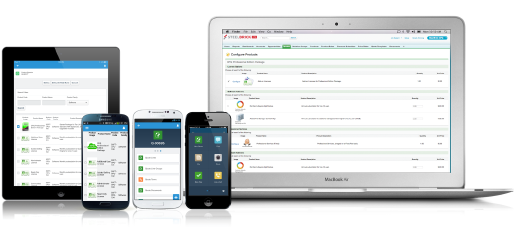
Salesforce Revenue Cloud (formerly Salesforce CPQ or SteelBrick) is built and delivered on the Salesforce Platform and Salesforce1 Mobile App which enables users to create accurate sales quotes quickly and submit error-free orders on the fly from any device.
$30
Per User per Month
Pricing
Oracle Sales
Salesforce Revenue Cloud
Editions & Modules
Professional
$65.00
Per User Per Month
Standard
$100.00
Per User Per Month
Enterprise
$200.00
Per User Per Month
Premium
$300.00
Per User Per Month
Basic
$30
Per User per Month
Professional
$50
Per User per Month
Enterprise
$75
Per User per Month
Offerings
Pricing Offerings
Oracle Sales
Salesforce Revenue Cloud
Free Trial
Yes
Yes
Free/Freemium Version
No
No
Premium Consulting/Integration Services
No
No
Entry-level Setup Fee
No setup fee
Optional
Additional Details
—
—
More Pricing Information
Community Pulse
Oracle Sales
Salesforce Revenue Cloud
Features
Oracle Sales
Salesforce Revenue Cloud
Sales Force Automation
Comparison of Sales Force Automation features of Product A and Product B
Oracle Sales
7.3
Ratings
5% below category average
Salesforce Revenue Cloud
-
Ratings
Customer data management / contact management
7.00 Ratings
00 Ratings
Workflow management
8.50 Ratings
00 Ratings
Territory management
5.00 Ratings
00 Ratings
Opportunity management
6.00 Ratings
00 Ratings
Integration with email client (e.g., Outlook or Gmail)
8.50 Ratings
00 Ratings
Contract management
7.00 Ratings
00 Ratings
Quote & order management
7.00 Ratings
00 Ratings
Interaction tracking
8.20 Ratings
00 Ratings
Channel / partner relationship management
8.20 Ratings
00 Ratings
Customer Service & Support
Comparison of Customer Service & Support features of Product A and Product B
Oracle Sales
4.7
Ratings
46% below category average
Salesforce Revenue Cloud
-
Ratings
Case management
6.00 Ratings
00 Ratings
Call center management
4.00 Ratings
00 Ratings
Help desk management
4.00 Ratings
00 Ratings
Marketing Automation
Comparison of Marketing Automation features of Product A and Product B
Oracle Sales
8.5
Ratings
11% above category average
Salesforce Revenue Cloud
-
Ratings
Lead management
9.20 Ratings
00 Ratings
Email marketing
7.70 Ratings
00 Ratings
CRM Project Management
Comparison of CRM Project Management features of Product A and Product B
Oracle Sales
8.4
Ratings
10% above category average
Salesforce Revenue Cloud
-
Ratings
Task management
9.20 Ratings
00 Ratings
Billing and invoicing management
8.00 Ratings
00 Ratings
Reporting
8.00 Ratings
00 Ratings
CRM Reporting & Analytics
Comparison of CRM Reporting & Analytics features of Product A and Product B
Oracle Sales
5.0
Ratings
41% below category average
Salesforce Revenue Cloud
-
Ratings
Forecasting
5.00 Ratings
00 Ratings
Pipeline visualization
4.00 Ratings
00 Ratings
Customizable reports
6.00 Ratings
00 Ratings
Customization
Comparison of Customization features of Product A and Product B
Oracle Sales
5.5
Ratings
31% below category average
Salesforce Revenue Cloud
-
Ratings
Custom fields
6.00 Ratings
00 Ratings
Custom objects
6.00 Ratings
00 Ratings
Scripting environment
5.00 Ratings
00 Ratings
API for custom integration
5.00 Ratings
00 Ratings
Security
Comparison of Security features of Product A and Product B
Oracle Sales
8.0
Ratings
4% below category average
Salesforce Revenue Cloud
-
Ratings
Single sign-on capability
8.00 Ratings
00 Ratings
Role-based user permissions
8.00 Ratings
00 Ratings
Social CRM
Comparison of Social CRM features of Product A and Product B
Oracle Sales
8.2
Ratings
11% above category average
Salesforce Revenue Cloud
-
Ratings
Social data
8.50 Ratings
00 Ratings
Social engagement
8.00 Ratings
00 Ratings
Integrations with 3rd-party Software
Comparison of Integrations with 3rd-party Software features of Product A and Product B
Oracle Sales
8.2
Ratings
11% above category average
Salesforce Revenue Cloud
-
Ratings
Marketing automation
8.30 Ratings
00 Ratings
Compensation management
8.00 Ratings
00 Ratings
Platform
Comparison of Platform features of Product A and Product B
Oracle Sales
4.0
Ratings
59% below category average
Salesforce Revenue Cloud
-
Ratings
Mobile access
4.00 Ratings
00 Ratings
CPQ
Comparison of CPQ features of Product A and Product B
In the market for Sales and Service, Oracle CX is the best especially in integrating with other systems. It has a stable and huge database that can handle a bunch of data. It gathers all data of customers, accounts, leads, opportunities, service requests in one place and related in a good way. The tools used for reports and analytics as BI is strong and great to use also it is not hard[.]
CPQ is great if you can devote the time to it to make it perfect for your sales team. It requires a lot of time and energy to build it out and customize, but once that's done it is one of the most powerful tools you will have. Having an expert in CPQ is really helpful as well.
Salesforce CPQ is great for being able to quickly and easily build product bundles in an intuitive and visually appealing way.
The product catalog and ability to easily add fields to product records makes setting up products really simple and adds a lot of value to reporting within Salesforce.
Basic product and configuration rules are very easy to understand and set up.
Oracle CRM is incredibly complex making it fairly difficult to learn from scratch
The original implementation of Oracle CRM was a lengthy and involved process
We have had outages where we cannot connect to Oracle CRM which leaves us at a loss. I'm not sure what the solution to this is, but less outages would be ideal.
Our Salesforce is very messy, which tells me it's not super easy to clean up.
I always have a really hard time removing a contacts from an account - it seems like you can't simply remove the relationship so we have lots of people named DO NOT CONTACT or things of that nature.
Sometimes when saving it doesn't seem like things actually save.
Overall our organization has completely moved to Oracle CX Sales and now is able to utilize the latest technology backed by AI to provide a much better experience to customers and saving money at the same time. So it's a Win-Win situation. I believe there is a slight learning curve to derive [the] full value out of this but once you are there, you can delight your customers.
The support the Oracle team gives is generally very good. They are patient, willing to help, and their training methods are collaborative and inclusive. They have conducted multiple support sessions and it’s always been a great user experience. The stellar team [is] always on hand to lend support when the right time comes and their helpdesk is always on hand to help.
There have been some issues with multi-year pricing of certain products and services which we have been assured will be resolved but I guess are still underway, the support team apart from this has not been needed much and in the rare scenarios, it has been needed the resolutions of conflicts has been prompt and quick, so the overall support would have my high regards for being so helpful and customer-oriented so as to assure good performance of their toolset and customer satisfaction.
Excellent online training material. On-demand always helps to access anytime, anywhere. Also, it is essential that in this day and age, video tutorials with actual product screenshots make the learning more useful and fun at the same time. Certifications help test knowledge gained during these tutorial sessions. This was a blessing for fresh users.
If you have never used a CRM program is is hard to know exactly what you need. We had lots of changes during implementation and even more afterward once the users started working in it everyday. Also the partner we used didn't inform us about Allotments and not being able to Batch delete custom objects (you can now in recent releases). There were so many unknowns, that if I had it to do over, I would educate myself more and ask more questions of the partner that we used for implementation.
As compared to other CRM, this happens to be one of the best and most affordable as there are some cons, but the pros are great, and I have seen an increase in sales by using this platform. It works great for the sales process from start to end, like lead generation to closure.
This has better product capabilities like Manage Order, Mobile, pricing module, select product offers service channel. What I like best is the integration with Salesforce, the ability to create and connect opportunities and there is a lot of flexibility in this tool. It has a very user-friendly platform & navigation across pages is the best Also I like how fast I can create quotes. I also like how detailed you can get with reporting. Any possible metric we can think of can be tracked, measured, and integrated.
It allows you to stay on top of reorder points for your existing customers. We call them attrition calls.
When you orders flowing in, it makes it easier to follow up with buyers for other business units since you already have pre-existing business.
As a sales organization, everyone in the company has visibility across the board into what is our profit at any given moment for the day, week, month and year. This keeps up on track for each of our goals.
Easy access to reporting on closed-won, closed-lost, and open quotes.
Accuracy in data referenced in a quote - it's typically accurate as it is pulled directly from opportunity, looking up to associated subscription start/end dates, etc..
We lose valuable time in creating quotes ourselves. Quotes were requested and created through sales ops previously, sales did not have access to the excel templates used to generate quotes.