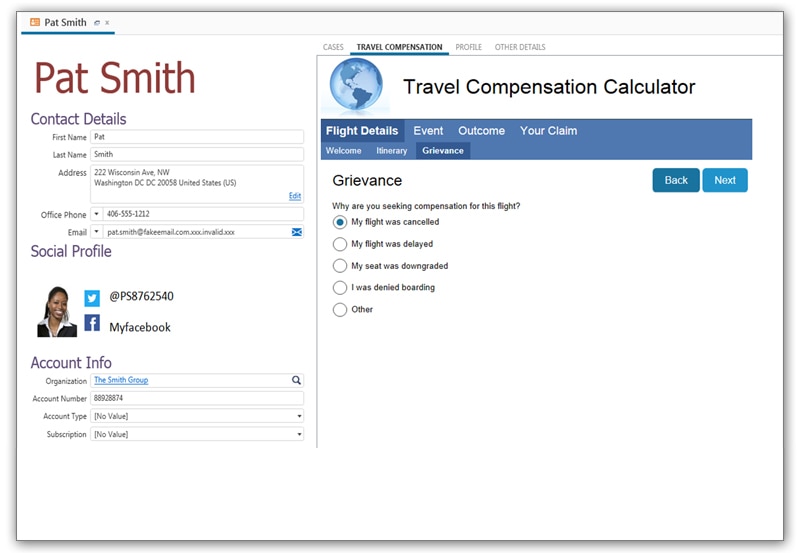
Oracle Sales guides sellers with intelligent recommendations to help them focus on the most valuable prospects at the right time. These machine learning-based CRM selling tools center around clean, complete customer data from internal and external sources.
$65
Per User Per Month
Oracle Service
Score 5.1 out of 10
N/A
Oracle Service is the help desk and customer experience management platform from Oracle. The technology was developed and supported by RightNow Technologies as RightNow CX for cloud-based call center automation, until that company's acquisition by Oracle in 2011 for about $1.5 billion.
N/A
Pricing
Oracle Sales
Oracle Service
Editions & Modules
Professional
$65.00
Per User Per Month
Standard
$100.00
Per User Per Month
Enterprise
$200.00
Per User Per Month
Premium
$300.00
Per User Per Month
No answers on this topic
Offerings
Pricing Offerings
Oracle Sales
Oracle Service
Free Trial
Yes
No
Free/Freemium Version
No
No
Premium Consulting/Integration Services
No
No
Entry-level Setup Fee
No setup fee
No setup fee
Additional Details
—
—
More Pricing Information
Community Pulse
Oracle Sales
Oracle Service
Features
Oracle Sales
Oracle Service
Sales Force Automation
Comparison of Sales Force Automation features of Product A and Product B
Oracle Sales
7.3
Ratings
5% below category average
Oracle Service
-
Ratings
Customer data management / contact management
7.00 Ratings
00 Ratings
Workflow management
8.50 Ratings
00 Ratings
Territory management
5.00 Ratings
00 Ratings
Opportunity management
6.00 Ratings
00 Ratings
Integration with email client (e.g., Outlook or Gmail)
8.50 Ratings
00 Ratings
Contract management
7.00 Ratings
00 Ratings
Quote & order management
7.00 Ratings
00 Ratings
Interaction tracking
8.20 Ratings
00 Ratings
Channel / partner relationship management
8.20 Ratings
00 Ratings
Customer Service & Support
Comparison of Customer Service & Support features of Product A and Product B
Oracle Sales
4.7
Ratings
46% below category average
Oracle Service
-
Ratings
Case management
6.00 Ratings
00 Ratings
Call center management
4.00 Ratings
00 Ratings
Help desk management
4.00 Ratings
00 Ratings
Marketing Automation
Comparison of Marketing Automation features of Product A and Product B
Oracle Sales
8.5
Ratings
11% above category average
Oracle Service
-
Ratings
Lead management
9.20 Ratings
00 Ratings
Email marketing
7.70 Ratings
00 Ratings
CRM Project Management
Comparison of CRM Project Management features of Product A and Product B
Oracle Sales
8.4
Ratings
10% above category average
Oracle Service
-
Ratings
Task management
9.20 Ratings
00 Ratings
Billing and invoicing management
8.00 Ratings
00 Ratings
Reporting
8.00 Ratings
00 Ratings
CRM Reporting & Analytics
Comparison of CRM Reporting & Analytics features of Product A and Product B
Oracle Sales
5.0
Ratings
41% below category average
Oracle Service
-
Ratings
Forecasting
5.00 Ratings
00 Ratings
Pipeline visualization
4.00 Ratings
00 Ratings
Customizable reports
6.00 Ratings
00 Ratings
Customization
Comparison of Customization features of Product A and Product B
Oracle Sales
5.5
Ratings
31% below category average
Oracle Service
-
Ratings
Custom fields
6.00 Ratings
00 Ratings
Custom objects
6.00 Ratings
00 Ratings
Scripting environment
5.00 Ratings
00 Ratings
API for custom integration
5.00 Ratings
00 Ratings
Security
Comparison of Security features of Product A and Product B
Oracle Sales
8.0
Ratings
4% below category average
Oracle Service
-
Ratings
Single sign-on capability
8.00 Ratings
00 Ratings
Role-based user permissions
8.00 Ratings
00 Ratings
Social CRM
Comparison of Social CRM features of Product A and Product B
Oracle Sales
8.2
Ratings
11% above category average
Oracle Service
-
Ratings
Social data
8.50 Ratings
00 Ratings
Social engagement
8.00 Ratings
00 Ratings
Integrations with 3rd-party Software
Comparison of Integrations with 3rd-party Software features of Product A and Product B
Oracle Sales
8.2
Ratings
11% above category average
Oracle Service
-
Ratings
Marketing automation
8.30 Ratings
00 Ratings
Compensation management
8.00 Ratings
00 Ratings
Platform
Comparison of Platform features of Product A and Product B
Oracle Sales
4.0
Ratings
59% below category average
Oracle Service
-
Ratings
Mobile access
4.00 Ratings
00 Ratings
Incident and problem management
Comparison of Incident and problem management features of Product A and Product B
Oracle Sales
-
Ratings
Oracle Service
7.5
Ratings
7% below category average
Organize and prioritize service tickets
00 Ratings
7.00 Ratings
Expert directory
00 Ratings
7.50 Ratings
Subscription-based notifications
00 Ratings
7.00 Ratings
ITSM collaboration and documentation
00 Ratings
6.70 Ratings
Ticket creation and submission
00 Ratings
9.00 Ratings
Ticket response
00 Ratings
8.00 Ratings
Self Help Community
Comparison of Self Help Community features of Product A and Product B
Oracle Sales
-
Ratings
Oracle Service
7.3
Ratings
7% below category average
External knowledge base
00 Ratings
6.80 Ratings
Internal knowledge base
00 Ratings
7.70 Ratings
Multi-Channel Help
Comparison of Multi-Channel Help features of Product A and Product B
In the market for Sales and Service, Oracle CX is the best especially in integrating with other systems. It has a stable and huge database that can handle a bunch of data. It gathers all data of customers, accounts, leads, opportunities, service requests in one place and related in a good way. The tools used for reports and analytics as BI is strong and great to use also it is not hard[.]
Oracle Right (Oracle Service Cloud) was an important evolution in the group's ombudsman channel management processes. We brought the Oracle Service Cloud to digitize the processes for capturing and managing the group's ombudsman channel, no longer operating manually (MS Excel).
Oracle Service Cloud (Right Now) brought about an important evolution in the management processes of the group's ombudsman channel, where activities that were performed manually, repetitively and with risk of errors, are now operated by the Right Now platform itself, whether by API, or by automation of the tool.
Oracle Service cloud handles incident management extremely well. It can accept requests from multiple channels. That includes email, website, phone, chat, SMS & some social.
Oracle Service cloud provides a knowledge base that can be used by customers or by agents. It can move consumers to self service for most issues. It also has good feedback from customers and agents so that the knowledge can continue to be updated to push people to more self service.
Oracle has a good consumer portal that can be used as a website or typically is used in conjunction with a main website as a contact center or help center site. This allows the contact center to manage both the knowledge and the request and the interactions with the customers.
Oracle Service cloud is built to provide a turn key solution for CRM/Contact center with some minor configuration. But it also has the ability to be highly customized to meet any companies needs. Much of that work can be done via the configuration options already in the system. It also have a full set of SOAP and Rest APIs for integrating to other systems.
Oracle CRM is incredibly complex making it fairly difficult to learn from scratch
The original implementation of Oracle CRM was a lengthy and involved process
We have had outages where we cannot connect to Oracle CRM which leaves us at a loss. I'm not sure what the solution to this is, but less outages would be ideal.
This is only an occasional, user problem; when searching for specific records, at times we receive an error that the maximum size has been exceeded and therefore does not yield any results. This is particularly frustrating when trying to search for a specific street address across several years.
I give this rating to RightNow because I believe that it's a strong CRM (I know RightNow doesn't like this term) product with virtually limitless possibilities. I like how flexible RightNow is, allowing businesses to fully customize it for their needs. I also like that it's cloud based and doesn't require additional local installation and management.
Overall our organization has completely moved to Oracle CX Sales and now is able to utilize the latest technology backed by AI to provide a much better experience to customers and saving money at the same time. So it's a Win-Win situation. I believe there is a slight learning curve to derive [the] full value out of this but once you are there, you can delight your customers.
The learning curve is fairly steep; but for something that has this much capability, it's nearly impossible to make it "easy". The layout and organization are at least reasonably intuitive. The hardest part-- the "weakest link"-- is the portal development (where you can build help centers and other end-user pages.) The capabilities there are significant, but the learning curve for that part is especially steep and it takes a fair amount of expertise to be able to update it.
We use a lot of tabs and fields on our incident workspace, which should slow the system down, but it's still quite fast, and we continue to optimize whatever is possible.
The support the Oracle team gives is generally very good. They are patient, willing to help, and their training methods are collaborative and inclusive. They have conducted multiple support sessions and it’s always been a great user experience. The stellar team [is] always on hand to lend support when the right time comes and their helpdesk is always on hand to help.
Technicians seem to be assessed based solely on how quickly they close the issues. I've had to reopen requests multiple times because they didn't actually solve my problem. Also, when the issue has even a moderate amount of complexity, the technicians often instruct me to "open another SR" to handle the other issue. I'm the customer, I shouldn't have to follow their processes, they should handle that for me. But even when I create the new SR, it seems like their right hand isn't talking to their left - they aren't reading back to the previous issue for context. So I get bounced around a lot, and I have to tell them how to do their job
Most of our training was given while doing user acceptance testing, and getting the system approved by the market. When ever we were in doubt, our implementer helped us along. Later on we started exploring by our selves.
Excellent online training material. On-demand always helps to access anytime, anywhere. Also, it is essential that in this day and age, video tutorials with actual product screenshots make the learning more useful and fun at the same time. Certifications help test knowledge gained during these tutorial sessions. This was a blessing for fresh users.
If you have never used a CRM program is is hard to know exactly what you need. We had lots of changes during implementation and even more afterward once the users started working in it everyday. Also the partner we used didn't inform us about Allotments and not being able to Batch delete custom objects (you can now in recent releases). There were so many unknowns, that if I had it to do over, I would educate myself more and ask more questions of the partner that we used for implementation.
Work with a RightNow expert during the implementation. Explain features that would you like to have. Often, somebody who really knows the system can show you what you need to do to achieve the desired results. Where a RightNow support engineer or a consultant might say "the system can't do that," a RightNow application engineer will listen to what you need, and often come up with an alternate path to achieve it
As compared to other CRM, this happens to be one of the best and most affordable as there are some cons, but the pros are great, and I have seen an increase in sales by using this platform. It works great for the sales process from start to end, like lead generation to closure.
TCS' customers who also selected Oracle Service Cloud over Salesforce Service Cloud and GE's ServiceMax in the Mfg. vertical in which I work, did so because of the robust ability of Oracle Service Cloud and its APIs to integrate with other value-add solutions for manufacturers such as IoT applications, Big Data Analytics, and Field Service applications.
It allows you to stay on top of reorder points for your existing customers. We call them attrition calls.
When you orders flowing in, it makes it easier to follow up with buyers for other business units since you already have pre-existing business.
As a sales organization, everyone in the company has visibility across the board into what is our profit at any given moment for the day, week, month and year. This keeps up on track for each of our goals.