Oracle Cloud Infrastructure (OCI) is Oracles's infrastructure-as-a-service (IaaS) platform which combines the utility of public cloud with the granular control, security, and predictability of on-premises infrastructure.
N/A
Oracle Integration (OIC)
Score 5.0 out of 10
N/A
The Oracle Integration Cloud Service is an iPaaS providing prebuilt integration flows between applications, including other Oracle products. The Integration Cloud Service is scaled for enterprises, with prebuilt codeless adapters for on-premises and SaaS systems and low-code automation capabilities.
N/A
Pricing
Oracle Cloud Infrastructure
Oracle Integration (OIC)
Editions & Modules
No answers on this topic
No answers on this topic
Offerings
Pricing Offerings
OCI
Oracle Integration (OIC)
Free Trial
Yes
Yes
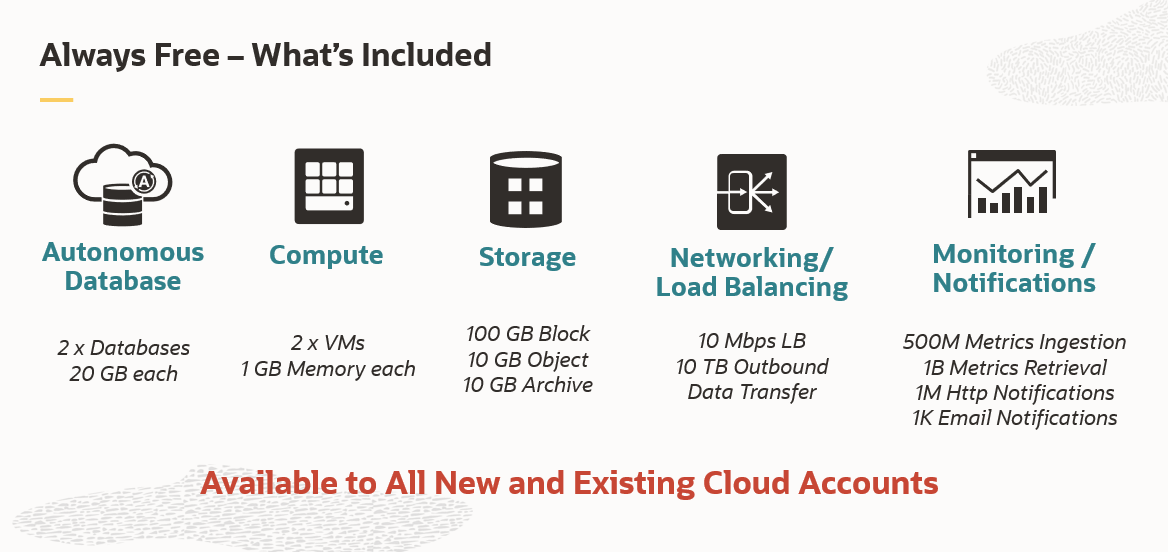
Free/Freemium Version
Yes
No
Premium Consulting/Integration Services
No
No
Entry-level Setup Fee
Optional
Optional
Additional Details
—
—
More Pricing Information
Community Pulse
Oracle Cloud Infrastructure
Oracle Integration (OIC)
Features
Oracle Cloud Infrastructure
Oracle Integration (OIC)
Infrastructure-as-a-Service (IaaS)
Comparison of Infrastructure-as-a-Service (IaaS) features of Product A and Product B
Oracle Cloud Infrastructure
6.8
Ratings
17% below category average
Oracle Integration (OIC)
-
Ratings
Service-level Agreement (SLA) uptime
8.30 Ratings
00 Ratings
Dynamic scaling
7.50 Ratings
00 Ratings
Elastic load balancing
8.40 Ratings
00 Ratings
Pre-configured templates
4.80 Ratings
00 Ratings
Monitoring tools
8.40 Ratings
00 Ratings
Pre-defined machine images
6.60 Ratings
00 Ratings
Operating system support
5.20 Ratings
00 Ratings
Security controls
5.30 Ratings
00 Ratings
Automation
6.90 Ratings
00 Ratings
Cloud Data Integration
Comparison of Cloud Data Integration features of Product A and Product B
Oracle Cloud Infrastructure (OCI) is a great fit when you need High-performance infrastructure for mission-critical apps that require low latency and high availability. Scalable compute services for big data analytics workloads that process massive datasets. Support for DevOps teams looking to streamline their development and deployment pipelines. But it might not be the best choice for Small-scale or low-traffic applications where you can find cheaper options elsewhere. Legacy workloads running on older tech like Oracle Solaris or Windows Server, where OCI's support may be limited.
Oracle Process Cloud is suited for medium-sized companies and up who want to create applications that can automate tasks without the need of recruiting more software developers. With a couple hours of training, any member of the organization's business team will be well-equipped with all of the knowledge that is needed to use Oracle Process Cloud effectively. If your IT team is large and able to take upon the task of making the given application, then something like Oracle BPM is a better solution.
Block Volume provides durability and stability to data. IOPS can be changed on the fly. Always stay true to the promised performance.
Block Volume can be encrypted with ease to meet compliance. Can also be easily integrated with OCI vault service for extra security.
Object Storage and File Storage are other forms of storage that are secure and extremely easy to configure. FSS is one of the best in the industry when it comes to reliability and performance.
SSD block volumes are persistent in OCI unlike many other clouds.
Auto-association of Oracle applications prepopulates the application connector select box and preconfigures Oracle Integration (OIC) using secure credential access for faster integration.
Various other system connectors are available to use readily.
User-intuitive experience--Connectors, integrators, and dashboard can be seen on one page.
Navigating the UI takes lots of getting used to. It reminds me of older GCP (just to get used to where everything is).
Permission for different things always seemed to be more difficult than it really needed to be. Once you got them set up you were good but updating anything or creating new permissions for just about anything took longer than I thought it should.
Based on how the buttons were laid out, it was pretty easy to delete all of your DNS records, and backing them up was not as intuitive as I'd like with the UI, but it was easy to do using a script.
Currently, it is not retaining the logs for more than 3 days, which it needs to address.
We also need some functionality inside the interface to re-push the same transaction again so that it will be helpful while testing and fixing the issue.
Also, some log errors are not giving the correct details. Oracle needs to rectify those.
We have been using this product for the last 6 years, and we keep renewing it yearly as we have no issues with this cloud provider. Maybe till we have our products, we will use this cloud and will be renewing it.
The services & products in Oracle Cloud Infrastructure needs more improvement to beat other Cloud service providers. The price is good & Security processes are good. We are requiring to put more effort in supporting this Oracle Cloud Infrastructure than other Cloud service providers. Probably better ways are there but is not super easy to find or not super available
Yeah sometimes we had to face unplanned outages due to underlying infrastructure issues, so not every time,e but once in a while we face issues with availability. But the good thing is we have redundancy with DR setup and multi region so we can manage.
Oracle Cloud Infrastructure performance is good in terms of querying large datasets, and is also consistent. It integrates well with other third party applications, and doesn't noticeably seem to slow down. Complex analytical queries and reports are processed efficiently even with larger datasets. Auto-scaling has been useful for traffic handling as this is a major challenge for any application.
Overall it is amazing, there is always room for improvement. We have weekly updates that tend to slow the program used more and more. We had to change some reports within Oracle because the others wouldn’t load. This is tied to our payroll and the delays are causing many time constraint issues and panic. We have to create a new report when one breaks. Otherwise awesome!
Performance and latency are excellent in Oracle Cloud Infrastructure. Except for AWS baremetal, I don't find anything like that. I found that, aside from conventional compute that works really good, they also offer HPC VDI. That's one of the strengths that should have more hype in OC advertising. After my tests, that were limited by the trial, I'm a net promoter of the service. I really miss the depth of my RDP connections and response times.
The nearest thing I have used to OIC is UiPath, as it is often used as a tool to integrate software together. However, it is much more suited to legacy software which have little to no API endpoints. If the infrastructure already exists I understand why people use RPA for integration, however for when API's are easily accessible and you're using Oracle tools, OIC is better.
We have hosted around 500 + customers on this cloud so till day not faced any major issues, so we can use it for any kind of products and it can hold the load and easily scale based on need.
We run big integration practices and that practice is pretty successful. We have seen the customer getting quick ROI as the initial investment is not much. The customer can also get a free 1-month trial instance of OICS to try out. All of our customers are happy with this investment so far.