Whether launching a first test or scaling a sophisticated experimentation program, Optimizely Web Experimentation aims to deliver the insights needed to craft high-performing digital experiences that drive engagement, increase conversions, and accelerate growth.
N/A
Salesforce Marketing Cloud
Score 8.1 out of 10
N/A
Marketing Cloud is an AI-powered, cloud-based digital marketing platform within the Salesforce Customer 360 ecosystem. Marketers can segment their audience, deliver personalized messages, track campaign performance, engage leads and accounts, and optimize strategies based on real-time insights.
$1,250
per month
Pricing
Optimizely Web Experimentation
Salesforce Marketing Cloud
Editions & Modules
No answers on this topic
Account Engagement
$1,250
per month
Engagement
$1,250
per month
Intelligence
$3,000
per month
Loyalty Management
$20,000
per month
Personalization
$100,000
per year
Data Cloud for Marketing
$108,000
per year
Offerings
Pricing Offerings
Optimizely Web Experimentation
Salesforce Marketing Cloud
Free Trial
Yes
Yes
Free/Freemium Version
No
No
Premium Consulting/Integration Services
No
No
Entry-level Setup Fee
Optional
No setup fee
Additional Details
—
—
More Pricing Information
Community Pulse
Optimizely Web Experimentation
Salesforce Marketing Cloud
Features
Optimizely Web Experimentation
Salesforce Marketing Cloud
Testing and Experimentation
Comparison of Testing and Experimentation features of Product A and Product B
Optimizely Web Experimentation
8.0
Ratings
3% below category average
Salesforce Marketing Cloud
-
Ratings
a/b experiment testing
9.00 Ratings
00 Ratings
Split URL testing
8.50 Ratings
00 Ratings
Multivariate testing
8.40 Ratings
00 Ratings
Multi-page/funnel testing
7.90 Ratings
00 Ratings
Cross-browser testing
8.10 Ratings
00 Ratings
Mobile app testing
8.00 Ratings
00 Ratings
Test significance
8.40 Ratings
00 Ratings
Visual / WYSIWYG editor
8.20 Ratings
00 Ratings
Advanced code editor
8.00 Ratings
00 Ratings
Page surveys
6.20 Ratings
00 Ratings
Visitor recordings
8.40 Ratings
00 Ratings
Preview mode
7.60 Ratings
00 Ratings
Test duration calculator
7.90 Ratings
00 Ratings
Experiment scheduler
8.20 Ratings
00 Ratings
Experiment workflow and approval
7.80 Ratings
00 Ratings
Dynamic experiment activation
7.50 Ratings
00 Ratings
Client-side tests
7.80 Ratings
00 Ratings
Server-side tests
7.20 Ratings
00 Ratings
Mutually exclusive tests
8.20 Ratings
00 Ratings
Audience Segmentation & Targeting
Comparison of Audience Segmentation & Targeting features of Product A and Product B
Optimizely Web Experimentation
8.2
Ratings
4% below category average
Salesforce Marketing Cloud
-
Ratings
Standard visitor segmentation
8.40 Ratings
00 Ratings
Behavioral visitor segmentation
7.60 Ratings
00 Ratings
Traffic allocation control
9.10 Ratings
00 Ratings
Website personalization
7.80 Ratings
00 Ratings
Results and Analysis
Comparison of Results and Analysis features of Product A and Product B
Optimizely Web Experimentation
8.3
Ratings
1% below category average
Salesforce Marketing Cloud
-
Ratings
Heatmap tool
9.30 Ratings
00 Ratings
Click analytics
8.80 Ratings
00 Ratings
Scroll maps
8.50 Ratings
00 Ratings
Form fill analysis
8.00 Ratings
00 Ratings
Conversion tracking
8.70 Ratings
00 Ratings
Goal tracking
8.20 Ratings
00 Ratings
Test reporting
7.90 Ratings
00 Ratings
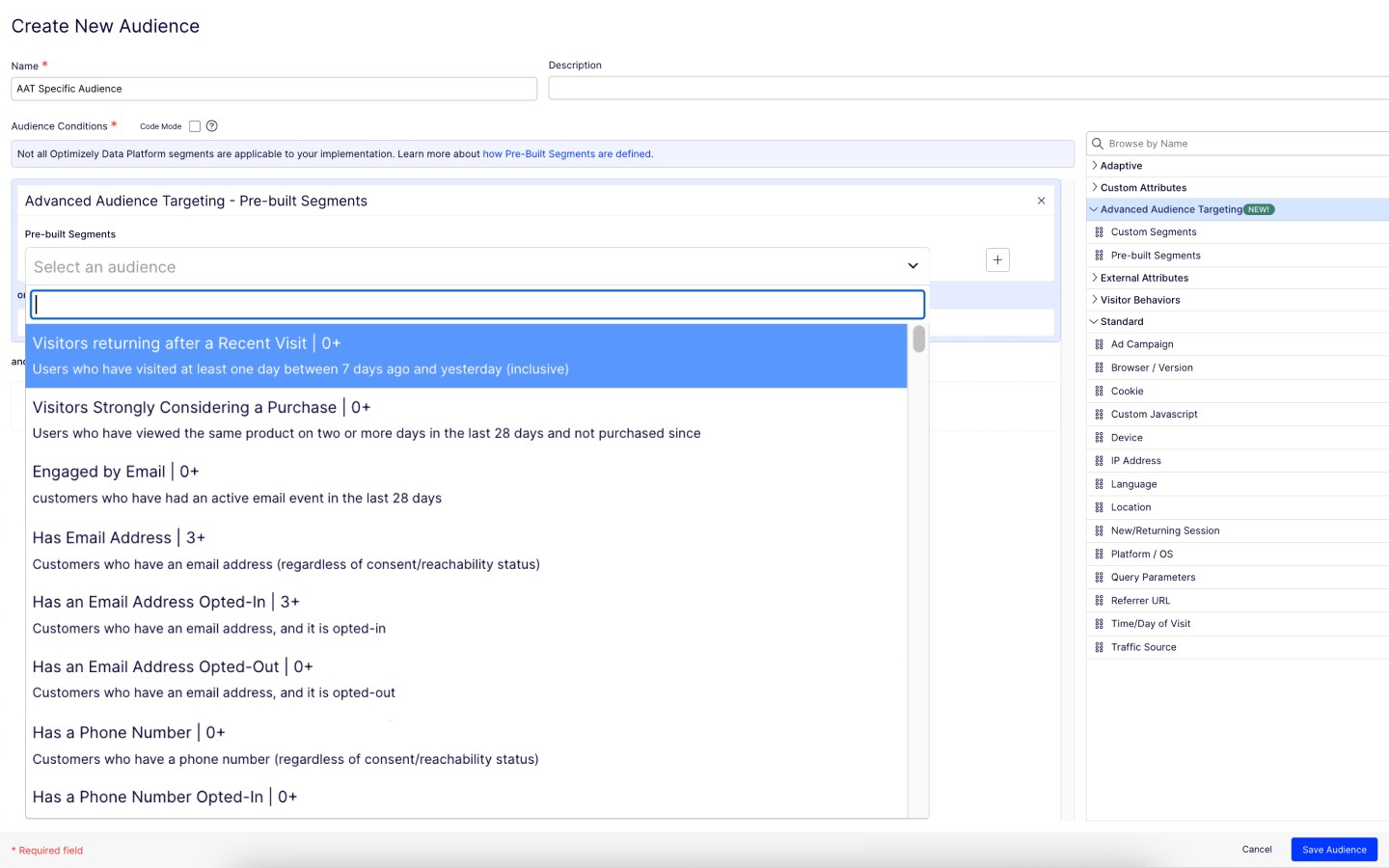
Results segmentation
7.70 Ratings
00 Ratings
CSV export
7.90 Ratings
00 Ratings
Experiments results dashboard
8.00 Ratings
00 Ratings
Email & Online Marketing
Comparison of Email & Online Marketing features of Product A and Product B
Optimizely Web Experimentation
-
Ratings
Salesforce Marketing Cloud
7.9
Ratings
4% above category average
WYSIWYG email editor
00 Ratings
8.10 Ratings
Dynamic content
00 Ratings
7.60 Ratings
Ability to test dynamic content
00 Ratings
7.70 Ratings
Landing pages
00 Ratings
7.80 Ratings
A/B testing
00 Ratings
7.90 Ratings
Mobile optimization
00 Ratings
7.30 Ratings
Email deliverability reporting
00 Ratings
8.20 Ratings
List management
00 Ratings
8.60 Ratings
Triggered drip sequences
00 Ratings
8.10 Ratings
Lead Management
Comparison of Lead Management features of Product A and Product B
Optimizely Web Experimentation
-
Ratings
Salesforce Marketing Cloud
8.3
Ratings
6% above category average
Lead nurturing automation
00 Ratings
8.30 Ratings
Lead scoring and grading
00 Ratings
8.20 Ratings
Data quality management
00 Ratings
8.10 Ratings
Automated sales alerts and tasks
00 Ratings
8.60 Ratings
Campaign Management
Comparison of Campaign Management features of Product A and Product B
Optimizely Web Experimentation
-
Ratings
Salesforce Marketing Cloud
7.8
Ratings
5% above category average
Calendaring
00 Ratings
8.30 Ratings
Event/webinar marketing
00 Ratings
7.30 Ratings
Social Media Marketing
Comparison of Social Media Marketing features of Product A and Product B
Optimizely Web Experimentation
-
Ratings
Salesforce Marketing Cloud
8.2
Ratings
9% above category average
Social sharing and campaigns
00 Ratings
8.40 Ratings
Social profile integration
00 Ratings
8.00 Ratings
Reporting & Analytics
Comparison of Reporting & Analytics features of Product A and Product B
Optimizely Web Experimentation
-
Ratings
Salesforce Marketing Cloud
8.2
Ratings
11% above category average
Dashboards
00 Ratings
8.40 Ratings
Standard reports
00 Ratings
8.40 Ratings
Custom reports
00 Ratings
7.90 Ratings
Platform & Infrastructure
Comparison of Platform & Infrastructure features of Product A and Product B
I think it can serve the whole spectrum of experiences from people who are just getting used to web experimentation. It's really easy to pick up and use. If you're more experienced then it works well because it just gets out of the way and lets you really focus on the experimentation side of things. So yeah, strongly recommend. I think it is well suited both to small businesses and large enterprises as well. I think it's got a really low barrier to entry. It's very easy to integrate on your website and get results quickly. Likewise, if you are a big business, it's incrementally adoptable, so you can start out with one component of optimizing and you can build there and start to build in things like data CMS to augment experimentation as well. So it's got a really strong a pathway to grow your MarTech platform if you're a small company or a big company.
At least for us, what we noticed is the best use case is that it replaces the use of cloud teams, which has a more complex platform to navigate; since we are already using Salesforce, it was just more straightforward to allow the teams to continue to do that as opposed to giving them a new system. This also works for us because they are both selling the same product in different ways. Any team collaboration is where this product shines.
The Platform contains drag-and-drop editor options for creating variations, which ease the A/B tests process, as it does not require any coding or development resources.
Establishing it is so simple that even a non-technical person can do it perfectly.
It provides real-time results and analytics with robust dashboard access through which you can quickly analyze how different variations perform. With this, your team can easily make data-driven decisions Fastly.
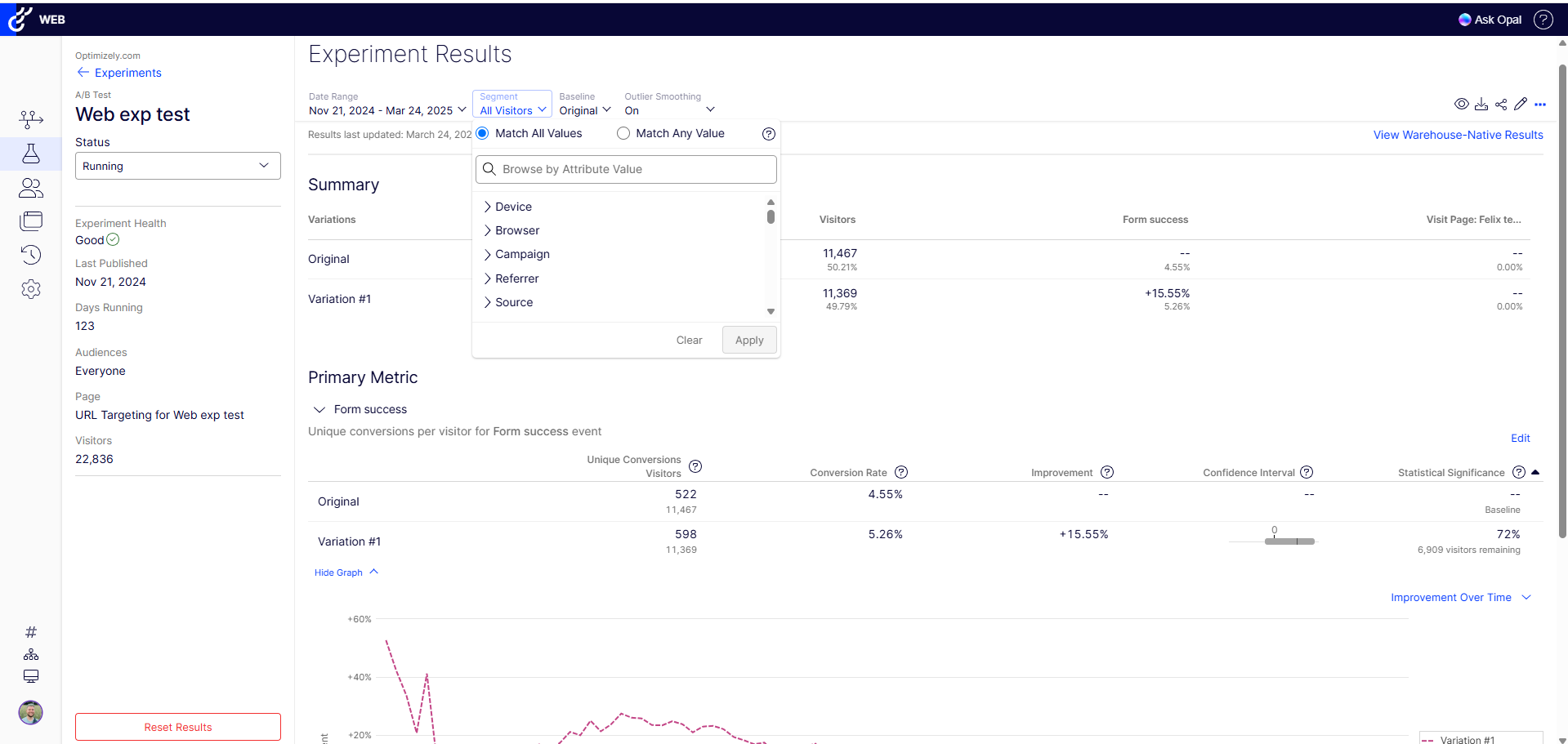
The results view is dense and difficult to package easily for leadership, and when filtering by segment it's hard to read comparative outcomes without clearing or swapping filters
The organization of experiments and statuses is a cluttered list and the search is limited in use - would love to see that improve with time
There are so many other MarTech products out there, would love to see more dedicated integrations so we don't have to invest in something like Zapier or Tray to build hacky automations
Because it's an incredible and essential tool for my line of work as a conversion optimization specialist. Really couldn't do my job nearly as effectively without it. It's paid for itself many times over and I feel like I'm only beginning to unlock the tools potential.
We are happy with Pardot. It has made our jobs easier and installed some reporting functions that have increased our ROI with the company. We have worked hard to set-up the functions in Pardot and it has taken time, but paid off.
Optimizely Web Experimentation's visual editor is handy for non-technical or quick iterative testing. When it comes to content changes it's as easy as going into wordpress, clicking around, and then seeing your changes live--what you see is what you get. The preview and approval process for sharing built experiments is also handy for sharing experiments across teams for QA purposes or otherwise.
You won't find another solution that has as many features as Salesforce Marketing Cloud Interaction Studio. We all know Salesforce, we all know how big they are and it's not for nothing... Their tools do most of the things you want, need and even imagine. Using it is complicated, but the usability is infinite.
I would rate Optimizely Web Experimentation's availability as a 10 out of 10. The software is reliable and does not experience any application errors or unplanned outages. Additionally, the customer service and technical support teams are always available to help with any issues or questions.
Upgrades and timing of the upgrades were communicated well and planned during off hours for our work. If we did have a campaign scheduled during that time, it would kick-off after the system was back active. There were a few unplanned system down times, but it was a rare occurrence and those times were also short in duration.
I would rate Optimizely Web Experimentation's performance as a 9 out of 10. Pages load quickly, reports are complete in a reasonable time frame, and the software does not slow down any other software or systems that it integrates with. Additionally, the customer service and technical support teams are always available to help with any issues or questions.
Though the make up of MA apps is not built this way today, it would be nice to see them become more real-time. The integration between Salesforce and Pardot is not a true real-time integration. If I modify something in Salesforce, those changes are not automatically reflected in Pardot immediately. There is a delay of about 15 minutes before the systems sync. This delay, although not long, is less than ideal We would love the systems to be integrated real time such that changes are propagated from one system to the other immediately.
They always are quick to respond, and are so friendly and helpful. They always answer the phone right away. And [they are] always willing to not only help you with your problem, but if you need ideas they have suggestions as well.
They are really responsive and more than not solve the problem or give you insight to how you can manage the solution yourself. I do find however sometimes a long delay on the more complex issues when they need to loop in other departments. but overall a good experience with support
Training program is not very well established. There is very little documentations. More often than not it's in-person training. I wish there were more video tutorials so that somebody can learn the system quickly. Their documentation is very much like an RFP. Long and very technichal. They should definitly improve on this area.
The tool itself is not very difficult to use so training was not very useful in my opinion. It did not also account for success events more complex than a click (which my company being ecommerce is looking to examine more than a mere click).
Pardot's online training touches on all topics briefly and vaguely without much indepth exploration into how a final outcome could look, such as Nurturing Campaigns, Email templates, landing page templates, etc... The only true way to uncover Pardot's full capabilities is to have Front End design and coding experience. Without this key skill set, I would not recommend Pardot to another business.
The implementation through the tag management system took a bit of trial and error at first, mostly due to the asynchronous nature of the TMS. We had to manipulate the implementation to assure that the Optimizely code was written to the page at the right time to allow the experiment content load in the browser without showing any of the original content first. We also needed to make some adjustments to the TMS code to get the integration with Site Catalyst timed appropriately.
From an IT perspective, once you set up the Javascript beacon and start collecting data there is a waiting game. During this time you can start labeling your site actions which can be labor intensive for a single person, but you don't really have the final end-users on the platform yet. We did a lot of training so users were experienced, but it wasn't until they had their first tasks to accomplish that they started using the system and had questions. I'd recommend setting up some immediate goals for an end-user to start segmenting for the purpose of displaying message campaigns so you can jump start end-user action.
The ability to do A/B testing in Optimizely along with the associated statistical modelling and audience segmentation means it is a much better solution than using something like Google Analytics were a lot more effort is required to identify and isolate the specific data you need to confidently make changes
We use Salesforce Marketing Cloud for lead management, generating reports, tracking customer and dealer information, inputting orders, and more. I prefer HubSpot for email marketing and automation because it is easier to use and the emails are designed much better. We currently use Salesforce and HubSpot, and we are very happy to have both, as they have different pros/cons.
It's incredibly flexible and adapts well to organizations of all sizes, whether you’re running a single site or managing multiple departments and platforms. The ability to deploy experiments seamlessly across different environments is a huge plus, especially for growing businesses. While it’s highly scalable, the last point would depend on the right team leveraging its full potential.
Salesforce Marketing Cloud does a great job at what it is designed to do. There are several SaaS products in the Marketing Automation arena and SFMC is one of the top providers. There are several things it does well, such as email marketing and automation, leads generation/segmentation/qualification, and reporting/analytics. There are a few areas of improvement when it comes to the product and they surround legacy systems and architecture, outdated UI/UX, as well as targeting data in the activity logs for reporting and segmentation.