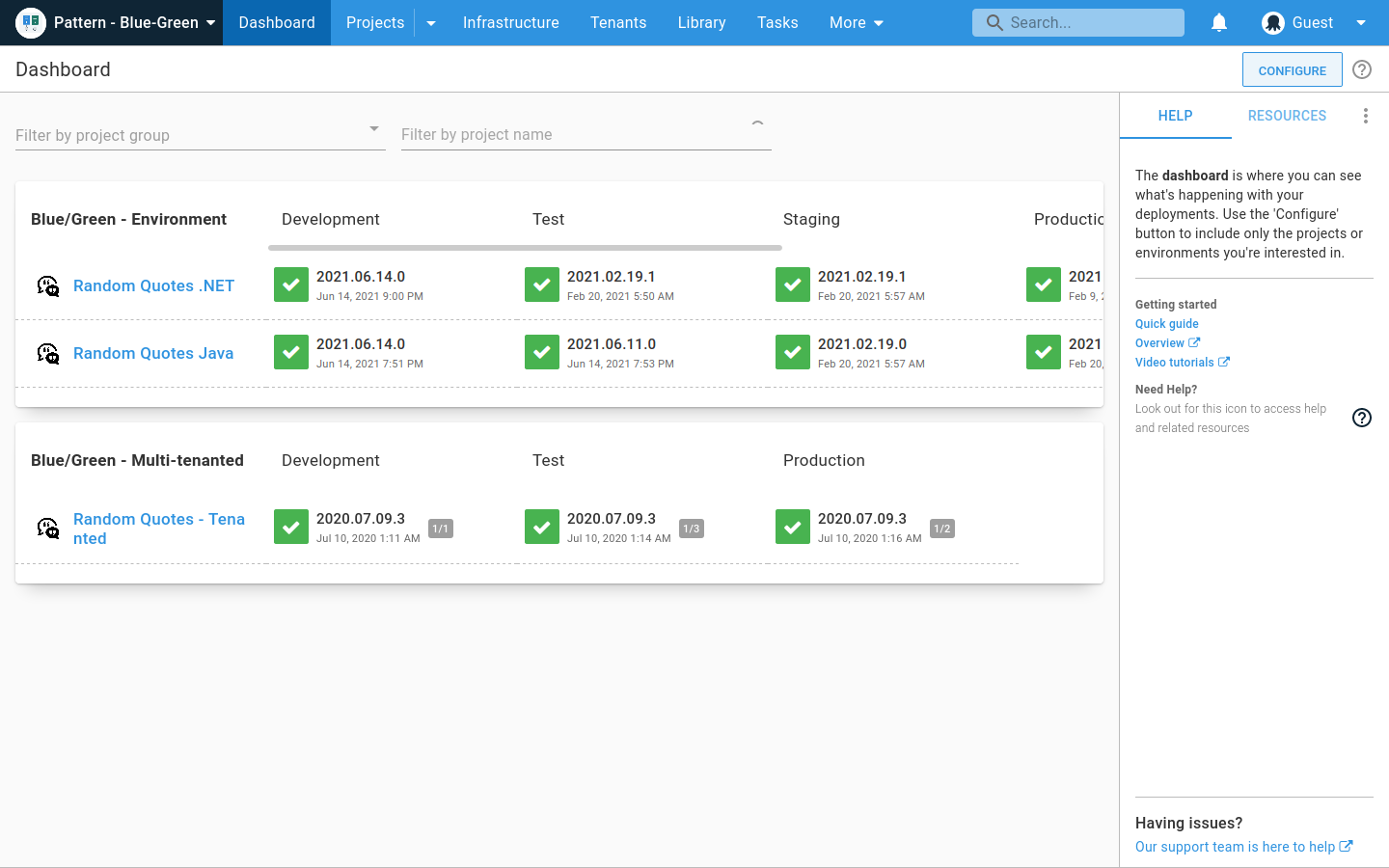
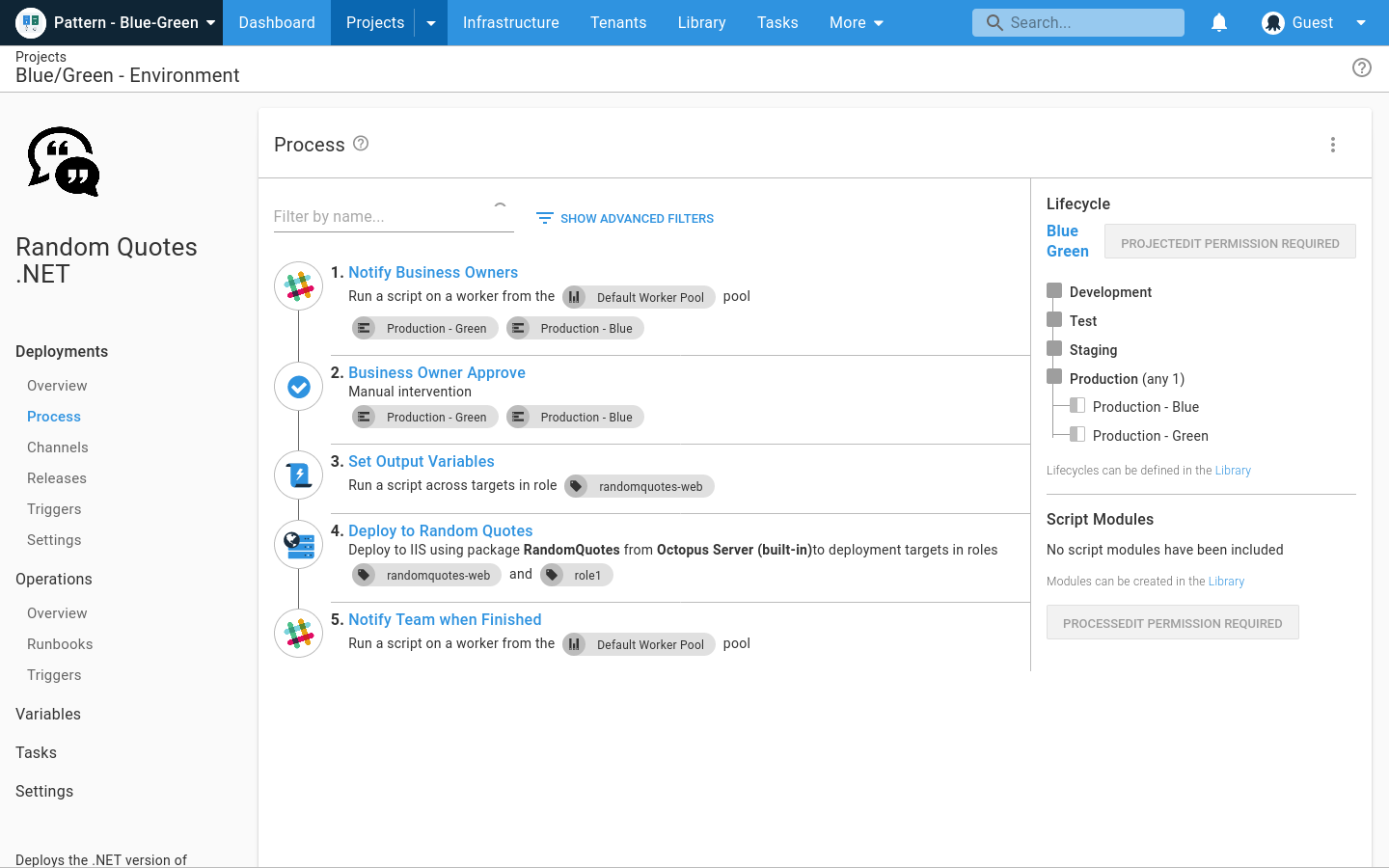
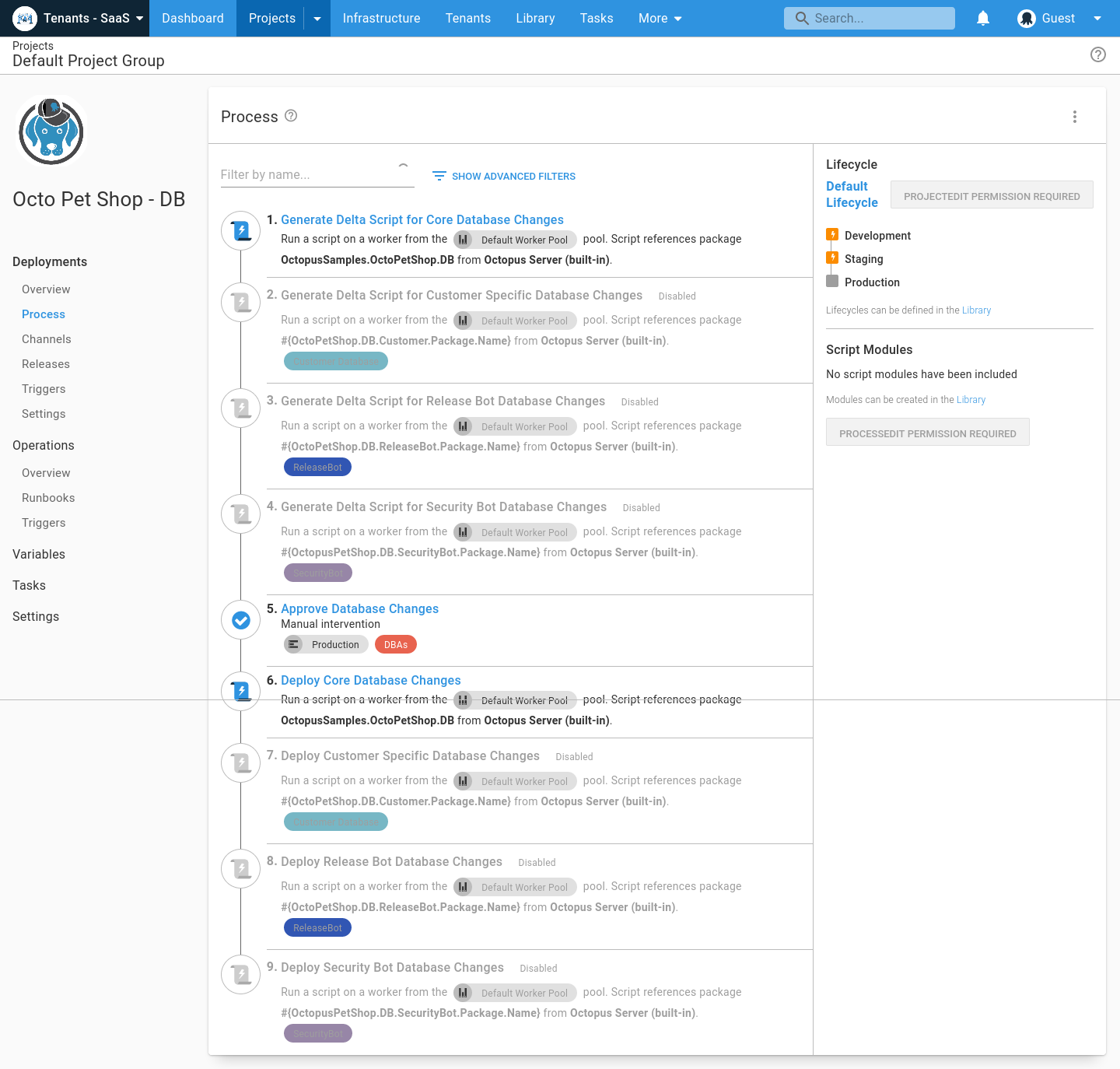
Australian company Octopus Deploy offers their eponymous automated deployment and release management software that integrates with the user's preferred CI server and adds deployment & ops automation capabilities. Octopus Deploy enables developers, release managers, and operations folks to bring all automation into a single place. The vendor states that by reusing configuration variables, environment definition, API keys, connection strings, permissions, service principals, and automation logic,…
$12
per month
TeamCity
Score7.4 out of 10
N/A
TeamCity is a continuous integration server from Czeck company JetBrains.
N/A
Pricing
Octopus Deploy
TeamCity
Editions & Modules
Cloud
Free 30 day trial
unlimited targets/users/projects
Server
Free 30 day trial
unlimited targets/users/projects
Enterprise
Starting at $18 per month
Enterprise
Starting at $18 per month
Server
Starting at $12 per month
Cloud
Starting at $12 per month
No answers on this topic
Offerings
Pricing Offerings
Octopus Deploy
TeamCity
Free Trial
Yes
No
Free/Freemium Version
Yes
No
Premium Consulting/Integration Services
Yes
No
Entry-level Setup Fee
Optional
No setup fee
Additional Details
Octopus Server edition is available as a 30 day free trial on our unlimited tier for any scenario, including production, and commercial use. After the trial period ends you can keep your working configuration and upgrade to a paid license and continue deploying uninterrupted.
Octopus Cloud is an alternative that is hosted by us, and is also available as a 30 day unlimited trial. No credit card is needed to create a Octopus Cloud trial instance. You can convert the Cloud trial to a paid instance at any time during or after the trial period, and keep all of your instance configuration.
Octopus also offers an Enterprise tier which offers advanced features for teams at scale including, advanced high availability, insights & DORA metrics, ServiceNow & Jira Service Management integration, unlimited instances, 24/7 support & service credits, and a Customer Success Manager.
Volume discounts are available above 500 targets, and temporary bursting for certain scenarios is supported.
Software Architect in Information Technology at Omega Creations, LLC (Apparel & Fashion, 51-200 employees)
Chose Octopus Deploy
TeamCity is focused more on the build process. It's deployment capabilities are weak compared to Octopus. Bamboo is a proper competitor, but it is far more costly for our needs. The free version of Octopus has proven incredibly competent and sufficient for our needs, and Bamb…
A de minimis incentive was given to thank the reviewer for their time. The incentive was not used to bias or drive a particular response, nor was the incentive contingent on a positive endorsement. More Info
DevOps Manager in Information Technology at Advanced Imaging Solutions (Information Technology and Services, 51-200 employees)
Chose Octopus Deploy
Octopus Deploy is a deployment focused tool. Its purpose is to manage deployment environments. Tools like TeamCity and Visual Studio Team Services are Continuous Integration tools. You can accomplish many of the same tasks in TeamCity and VSTS but their focus on CI also means …
A de minimis incentive was given to thank the reviewer for their time. The incentive was not used to bias or drive a particular response, nor was the incentive contingent on a positive endorsement. More Info
Verified User
Chose Octopus Deploy
Octopus showed better cost numbers than Azure DevOps and more flexibility against GitLab CI/CD. Octopus customization in step templates that can be reused and easily created gives big advantages against many of its competitors. Octopus was selected for these features and …
A de minimis incentive was given to thank the reviewer for their time. The incentive was not used to bias or drive a particular response, nor was the incentive contingent on a positive endorsement. More Info
Software Developer in Research & Development at iModules (Computer Software, 51-200 employees)
Chose Octopus Deploy
This software, unlike Chef, is much easier to configure or manage, since its platform provides documentation or tutorials on how to use it, besides its interface is much more modern and easy to use, it allows you to choose where you want carry out the implementations of the …
A de minimis incentive was given to thank the reviewer for their time. The incentive was not used to bias or drive a particular response, nor was the incentive contingent on a positive endorsement. More Info
Sr. Integration Developer / DevOps Engineer in Information Technology at NRECA (Non-Profit Organization Management, 51-200 employees)
Chose Octopus Deploy
We looked at IBM UrbanCode Deploy and Release and Microsoft VSTS while looking for Application Release Automation tools. While VSTS doesn't work with cross-platform technologies IBM UrbanCode Deploy commands a premium price for the features it offers. Also, it needs UrbanCode …
A de minimis incentive was given to thank the reviewer for their time. The incentive was not used to bias or drive a particular response, nor was the incentive contingent on a positive endorsement. More Info
Sr. Integration Developer / DevOps Engineer in Information Technology at NRECA (Non-Profit Organization Management, 51-200 employees)
Chose TeamCity
TeamCity competes against the TFS build, Visual Studio Team services and Jenkins the open source workhorse. The reason for selecting TeamCity was because it was found to be a great fit for all the diverse projects on a spectrum of technologies we have which the TFS Build …
A de minimis incentive was given to thank the reviewer for their time. The incentive was not used to bias or drive a particular response, nor was the incentive contingent on a positive endorsement. More Info
A de minimis incentive was given to thank the reviewer for their time. The incentive was not used to bias or drive a particular response, nor was the incentive contingent on a positive endorsement. More Info
A de minimis incentive was given to thank the reviewer for their time. The incentive was not used to bias or drive a particular response, nor was the incentive contingent on a positive endorsement. More Info
UI is very fluffy and padded. It looks pretty but it could benefit from a more compact, information-focused design
Deployment process options are not always laid out in an intuitive manner. Choosing which steps to exclude, which environments or targets to deploy to, etc., is not immediately clear
Lack of useful reports and metrics for tracking active deployments and historical data
A de minimis incentive was given to thank the reviewer for their time. The incentive was not used to bias or drive a particular response, nor was the incentive contingent on a positive endorsement. More Info
The customization is still fairly complex and is best managed by a dev support team. There is great flexibility, but with flexibility comes responsibility. It isn't always obvious to a developer how to make simple customizations.
Sometimes the process for dealing with errors in the process isn't obvious. Some paths to rerunning steps redo dependencies unnecessarily while other paths that don't are less obvious.
A de minimis incentive was given to thank the reviewer for their time. The incentive was not used to bias or drive a particular response, nor was the incentive contingent on a positive endorsement. More Info
A de minimis incentive was given to thank the reviewer for their time. The incentive was not used to bias or drive a particular response, nor was the incentive contingent on a positive endorsement. More Info
Octopus Deploy has greatly helped us to improve our reliability and frequency of our deployments and given us the confidence to deploy much more often, with a direct benefit to customers. Cross-platform support and release to Cloud require more focus on the product side.
A de minimis incentive was given to thank the reviewer for their time. The incentive was not used to bias or drive a particular response, nor was the incentive contingent on a positive endorsement. More Info
Octopus Deploy is a software that runs very effectively, is easy to use, does not require such a high learning curve, provides the necessary tools to carry out the functions it offers, making it a very flexible software, it also allows that can be configured according to the needs of the user and provides integrations with other very advantageous tools since they are carried out in a very favorable way.
A de minimis incentive was given to thank the reviewer for their time. The incentive was not used to bias or drive a particular response, nor was the incentive contingent on a positive endorsement. More Info
TeamCity runs really well, even when sharing a small instance with other applications. The user interface adequately conveys important information without being overly bloated, and it is snappy. There isn't any significant overhead to build agents or unit test runners that we have measured.
A de minimis incentive was given to thank the reviewer for their time. The incentive was not used to bias or drive a particular response, nor was the incentive contingent on a positive endorsement. More Info
Octopus Deploy support has always been there for us, even when using the free tier, we get responsive hands-on help. We haven't needed to use that level of support since the documentation is clearly written, and help is readily available within the interface itself. Using Octopus Deploy is a truly joyful experience.
A de minimis incentive was given to thank the reviewer for their time. The incentive was not used to bias or drive a particular response, nor was the incentive contingent on a positive endorsement. More Info
There aren't really any competitors in the land of ASP.NET. Deployment is too ad-hoc. Other tools exist that have massive downsides, like Web Deploy. Most aren't even supported anymore. You could argue that containers (Docker) are a competitor, but containers cannot be used for everything and solve a somewhat different problem. Octopus Deploy is even able to help with containers. To us, Octopus Deploy was really the only really polished solution.
A de minimis incentive was given to thank the reviewer for their time. The incentive was not used to bias or drive a particular response, nor was the incentive contingent on a positive endorsement. More Info
TeamCity is a great on-premise Continuous Integration tool. Visual Studio Team Services (VSTS) is a hosted SAAS application in Microsoft's Cloud. VSTS is a Source Code Repository, Build and Release System, and Agile Project Management Platform - whereas TeamCity is a Build and Release System only. TeamCity's interface is easier to use than VSTS, and neither have a great deployment pipeline solution. But VSTS's natural integration with Microsoft products, Microsoft's Cloud, Integration with Azure Active Directory, and free, private, Source Code repository - offer additional features and capabilities not available with Team City alone.
A de minimis incentive was given to thank the reviewer for their time. The incentive was not used to bias or drive a particular response, nor was the incentive contingent on a positive endorsement. More Info
A de minimis incentive was given to thank the reviewer for their time. The incentive was not used to bias or drive a particular response, nor was the incentive contingent on a positive endorsement. More Info