Notion aims to present users with an all-in-one workspace — for notes, tasks, wikis, and databases, from Notion Labs in San Francisco.
$0
Zimbra
Score 6.9 out of 10
N/A
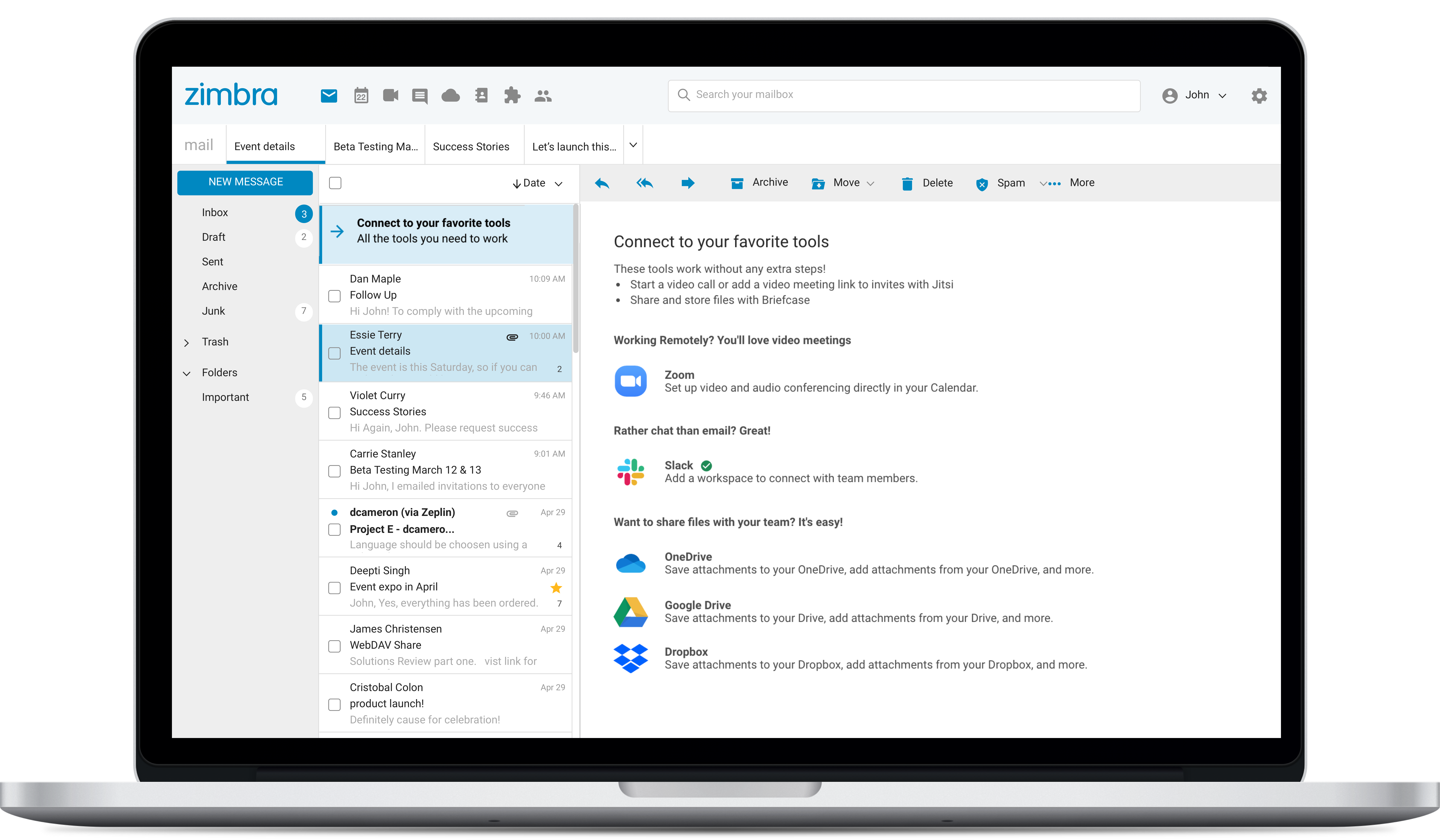
Zimbra is an email and collaboration platform and productivity suite that includes contacts, calendar, tasks, chat and file sharing, plus videoconferencing, document editing, and file storage.
N/A
Pricing
Notion
Zimbra by Synacor
Editions & Modules
Free
$0
Plus
$12
per month per user
Business
$24
per month per user
Enterprise
Custom Pricing
No answers on this topic
Offerings
Pricing Offerings
Notion
Zimbra
Free Trial
Yes
Yes
Free/Freemium Version
Yes
No
Premium Consulting/Integration Services
No
No
Entry-level Setup Fee
No setup fee
No setup fee
Additional Details
A discount is offered for annual billing.
—
More Pricing Information
Community Pulse
Notion
Zimbra by Synacor
Features
Notion
Zimbra by Synacor
Project Management
Comparison of Project Management features of Product A and Product B
Notion
9.9
Ratings
25% above category average
Zimbra by Synacor
9.0
Ratings
16% above category average
Task Management
9.60 Ratings
9.80 Ratings
Gantt Charts
10.00 Ratings
8.10 Ratings
Scheduling
10.00 Ratings
9.80 Ratings
Workflow Automation
10.00 Ratings
7.20 Ratings
Mobile Access
10.00 Ratings
9.70 Ratings
Search
10.00 Ratings
9.80 Ratings
Visual planning tools
10.00 Ratings
8.50 Ratings
Communication
Comparison of Communication features of Product A and Product B
Notion
9.6
Ratings
19% above category average
Zimbra by Synacor
6.6
Ratings
18% below category average
Chat
10.00 Ratings
7.00 Ratings
Notifications
10.00 Ratings
5.10 Ratings
Discussions
10.00 Ratings
2.00 Ratings
Surveys
9.30 Ratings
7.70 Ratings
Internal knowledgebase
10.00 Ratings
7.70 Ratings
Integrates with Gmail and Google Hangouts
8.90 Ratings
8.00 Ratings
Integrates with Outlook
9.00 Ratings
7.50 Ratings
Integrates with GoToMeeting
00 Ratings
7.60 Ratings
File Sharing & Management
Comparison of File Sharing & Management features of Product A and Product B
At the company I work for, we use Notion as an organizational base for all sectors and projects. For example, we use it for the marketing team, customer support team, among others. And for each one, we can create pipelines, tasks, due dates, execution time, tags with different colors. It's something very versatile that helps with everything around here. We've even created a sales funnel in Notion.
I consider Zimbra Email & Collaboration a viable alternative to the major American cloud email platforms. In a scenario where data protection and privacy are critical, especially in an on-premise environment, Zimbra is a very suitable solution. It is also capable of offering a comprehensive set of tools and additional features (tasks, calendars, contacts, briefcase) in an integrated manner.
I use Notion on my personal tablet, and unlike on the computer, I have a lot of difficulty editing backgrounds, GIFs, and page dividers. It's not as user-friendly, and often the elements end up cut off or misaligned, which is frustrating.
While the current calendar feature is helpful, I'd love to see more customization options. The Google Calendar style isn't always ideal, especially for tasks without specific times or for ongoing projects that require daily maintenance.
It would be fantastic to have more flexibility in customizing Notion pages. For example, I'd love to create planners with the freedom to add illustration boxes, stickers, or GIFs without being restricted to a fixed layout.
User web interface could be more friendly, but it is enough for daily use. It could be renewed and has to consider some usability concerns. Improving usability would significantly improve users' satisfaction.
Message backup recovery is not a simple activity.
As an administrator, some of the features work better using the command-line interface.
The webclient uses ajax requests in almost every event. Because of that you may need a fast internet connection to have a good experience. You can switch to HTML version but it will limit what you can do.
Notion addresses most of our needs and help teams to organize their tasks, track their progresses and then archive for future reference. The company uses Notion to share announcement, holiday schedules, employee contact information and organizational structures. Everyone finds it useful and helpful. The notifications are instant. Reminders are on time.
The web usability of the solution is adequate, with all functions integrated into a single interface. However, it is important to note that in the desktop environment, it lacks its own application and relies on ActiveSync synchronization with reference solutions like Outlook or Thunderbird. Some features, such as the briefcase, will be excluded. The same happens on smartphones.It is also common for competing solutions to include integrated chat or video call tools, which Zimbra lacks. These shortcomings are among the most frequently requested by users.
Overall, we were satisfied with the implementation. We perhaps should have spent more time consulting with Zimbra or others regarding best practices but as we got to know the system better we were able to make changes relatively easily after the fact.
Notion is much more robust than Google Tasks, which I find very limited. Notion is far more customizable and affordable than Asana, which is more of a turnkey solution for teams that want to work within a pre-defined structure. Notion and ClickUp are comparable, in my opinion, in terms of task management and affordability, however Notion is the more customizable and expansive option whereas ClickUp is mostly just for task management.
We were originally a Groupwise shop before changing to Zimbra in 2008. Zimbra, from an end-user standpoint, pricing, system administration, and management is a far better system.
We use Google Apps for our students. We did not find it to be suitable for faculty and staff due to its lack of shared accounts.
We are moving from Zimbra to Office 365. Office 365 offers just about all that Zimbra had, though its web interface is inferior to that of Zimbra. It does offer us greatly reduced costs though, and high availability. If Zimbra were to have a fully HA environment, we may have stayed with them.