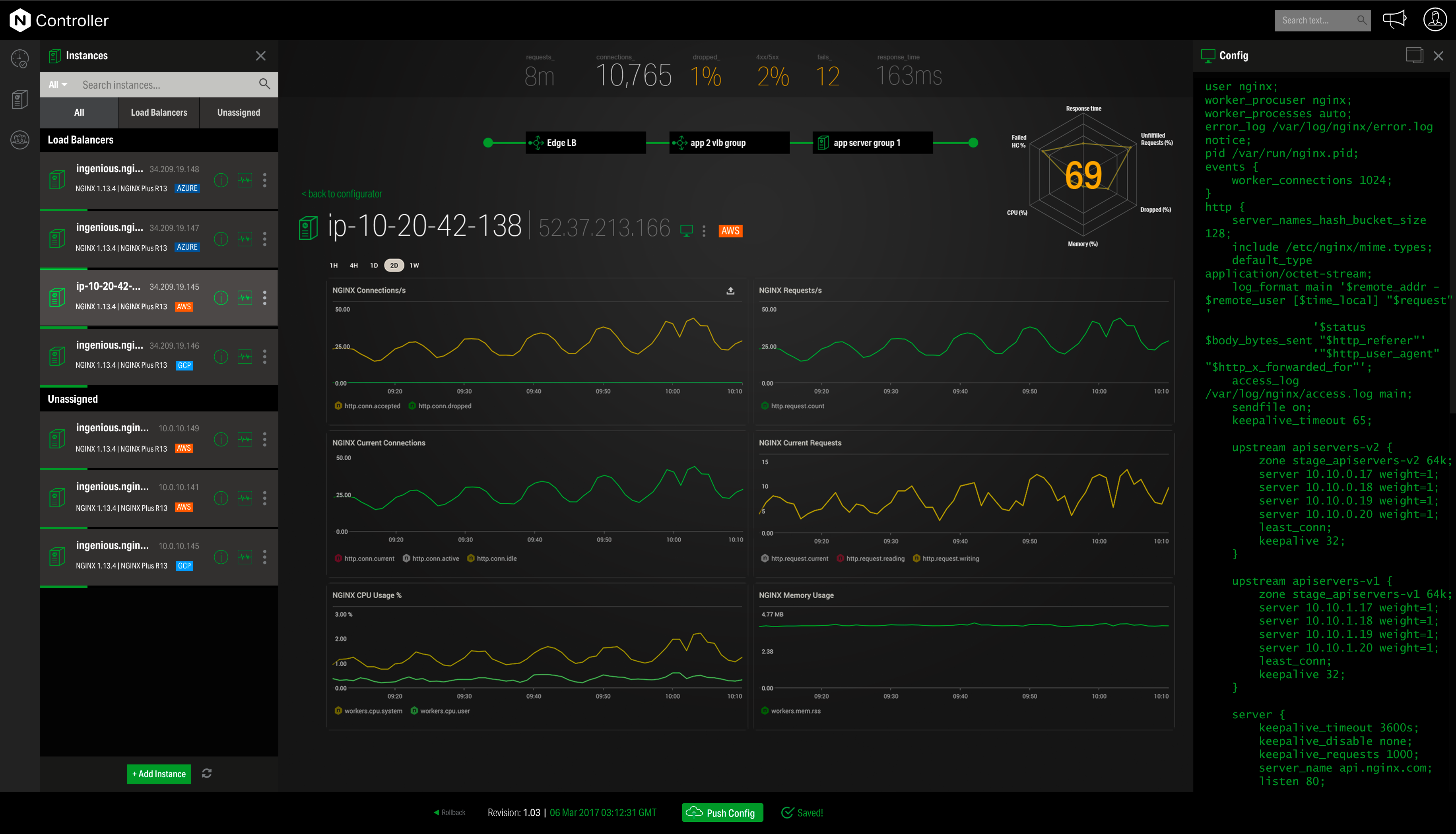
NGINX, a business unit of F5 Networks, powers over 65% of the world's busiest websites and web applications. NGINX started out as an open source web server and reverse proxy, built to be faster and more efficient than Apache. Over the years, NGINX has built a suite of infrastructure software products o tackle some of the biggest challenges in managing high-transaction applications. NGINX offers a suite of products to form the core of what organizations need to create…
N/A
TIBCO ActiveSpaces
Score7 out of 10
N/A
ActiveSpaces from TIBCO supports an application infrastructure.
[NGINX] is very well suited for high performance. I have seen it used on servers with 1k current connections with no issues. Despite seeing it used in many environments I've never seen software developers use it over apache, express, IIS in local dev environments so it may be more difficult to setup. I've also seen it used to load balance again without issues.
A de minimis incentive was given to thank the reviewer for their time. The incentive was not used to bias or drive a particular response, nor was the incentive contingent on a positive endorsement. More Info
TIBCO ActiveSpaces is useful for storing in memory data which enables fetching data quickly and efficiently. We can make use of TIBCO ActiveSpaces APIs for storing and retrieving data. In our organization, we store user session details in TIBCO ActiveSpaces and this session detail is used for authentication and authorizing user. We have integration TIBCO ActiveSpaces with React UI and TIBCO Business Works.
A de minimis incentive was given to thank the reviewer for their time. The incentive was not used to bias or drive a particular response, nor was the incentive contingent on a positive endorsement. More Info
A de minimis incentive was given to thank the reviewer for their time. The incentive was not used to bias or drive a particular response, nor was the incentive contingent on a positive endorsement. More Info
Like all other IMDG solutions, Tibco ActiveSpaces provides a scalable and distributed cache solution, which is supposed to have high throughput and high availability.
As it is under the Tibco umbrella, it is seamlessly integrated with other Tibco products.
It breaks the traditional "local cache" boundary and limitation, instead unifies many "local physical memory" to create one huge "In-Memory Data Grid", and serves the data provider/consumer application logically as one "Memory Cloud."
A lot of non-frequently updated data can be cached in this IMDG, to allow fast access, which saves the I/O latency caused by many traditional file system-backed storage solutions.
A de minimis incentive was given to thank the reviewer for their time. The incentive was not used to bias or drive a particular response, nor was the incentive contingent on a positive endorsement. More Info
Customer support can be strangely condescending, perhaps it's a language issue?
I find it a little weird how the release versions used for Nginx+ aren't the same as for open source version. It can be very confusing to determine the cross-compatibility of modules, etc., because of this.
It seems like some (most?) modules on their own site are ancient and no longer supported, so their documentation in this area needs work.
It's difficult to navigate between nginx.com commercial site and customer support. They need to be integrated together.
I'd love to see more work done on nginx+ monitoring without requiring logging every request. I understand that many statistics can only be derived from logs, but plenty should work without that. Logging is not an option in many environments.
ActiveSpaces 3.2 is not compatible with the latest version of TIBCO Business Event 5.x. And ActiveSpaces 2.x is not compatible with ActiveSpaces 3.x hence there is a big difference in the BusinessEvents supported version of AS and the latest.
ActiveSpaces takes more disc space and TIBCO does not offer data compression logic out of the box. Developers need to do extra coding to use java snippets to compress and decompress the payload. Although the data compression gives must better performance and speed to the system.
The compression and decompression API are not offered by TIBCO out of the box, which is a shame. These are so easy and simple to implement, still TIBCOdoes not provide them as an option out of the box.
A de minimis incentive was given to thank the reviewer for their time. The incentive was not used to bias or drive a particular response, nor was the incentive contingent on a positive endorsement. More Info
A de minimis incentive was given to thank the reviewer for their time. The incentive was not used to bias or drive a particular response, nor was the incentive contingent on a positive endorsement. More Info
Front end proxy and reverse proxy of Nginx is always useful. I always prefer to Nginx in overall usability when you have application server and database or multiple application servers and single database i.e. clustered application. Nginx provides really good features and flexibility which helps the system administrator in case of troubleshooting and also from the administration perspective. Also, Nginx doesn't delay any request because of internal performance issues.
A de minimis incentive was given to thank the reviewer for their time. The incentive was not used to bias or drive a particular response, nor was the incentive contingent on a positive endorsement. More Info
TIBCO ActiveSpaces is easy to install and integrate with other product suites. It is easy to understand and implement as well. TIBCO ActiveSpaces supports multiple databases for storing the data(we are using Oracle Database). All the master data related to the users is being stored using TIBCO ActiveSpaces which keeps the data in memory and help to retrieve it quickly. It has helped to prevent concurrent login sessions by the same user as session details are stored in TIBCO ActiveSpaces and we override the existing user session with the new session details.
A de minimis incentive was given to thank the reviewer for their time. The incentive was not used to bias or drive a particular response, nor was the incentive contingent on a positive endorsement. More Info
Community support is great, and they've also had a presence at conferences. Overall, there is no shortage of documentation and community support. We're currently using it to serve up some WordPress sites, and configuring NGINX for this purpose is well documented.
A de minimis incentive was given to thank the reviewer for their time. The incentive was not used to bias or drive a particular response, nor was the incentive contingent on a positive endorsement. More Info
We have used Traffic, Apache, Google Cloud Load Balancing and other managed cloud-based load balancers. When it comes to scale and customization nothing beats Nginx. We selected Nginx over the others because
we have a large number of services and we can manage a single Nginx instance for all of them
we have high impact services and Nginx never breaks a sweat under load
individual services have special considerations and Nginx lets us configure each one uniquely
A de minimis incentive was given to thank the reviewer for their time. The incentive was not used to bias or drive a particular response, nor was the incentive contingent on a positive endorsement. More Info
Actually, we are gradually replacing the Tibco ActiveSpaces with Redis (for caching purpose only) or Hazelcast (for embedded mode and also for in-memory distributed computation purpose + in-memory distributed IPC purpose).
A de minimis incentive was given to thank the reviewer for their time. The incentive was not used to bias or drive a particular response, nor was the incentive contingent on a positive endorsement. More Info
Nginx has decreased the burden of web server administration and maintenance, and we are spending less time on server issues than when we were using Apache.
Nginx has allowed more people in our company to get involved with configuring things on the web server, so there's no longer a single point of failure ("the Apache guy").
Nginx has given us the ability to handle a larger number of requests without scaling up in hardware quite so quickly.
A de minimis incentive was given to thank the reviewer for their time. The incentive was not used to bias or drive a particular response, nor was the incentive contingent on a positive endorsement. More Info
Developers with basic knowledge of TIBCO and general data knowledge can easily design and develop an ActiveSpaces based cached solution. As the ActiveSpaces concepts are very simple and easy to understand.
Some business areas can predict the high influx of a service usage during a certain period. Business will be highly rewarded if they can identify these business areas and provide a cached solution using TIBCO AS.
Again, this is not a TIBCO ActiveSpaces only advantage and this is true for any/all caching products.
Some examples for the previous points are
a. telecom company pre-loading (eager load) customer's usage for the last month, right before releasing/issuing the bills to the customers.
b. Airline industry loading the customer's itinerary a week before his travel start date. Hence the last minute scrambling to fetch the customer's itinerary travel plans can be avoided.
A de minimis incentive was given to thank the reviewer for their time. The incentive was not used to bias or drive a particular response, nor was the incentive contingent on a positive endorsement. More Info