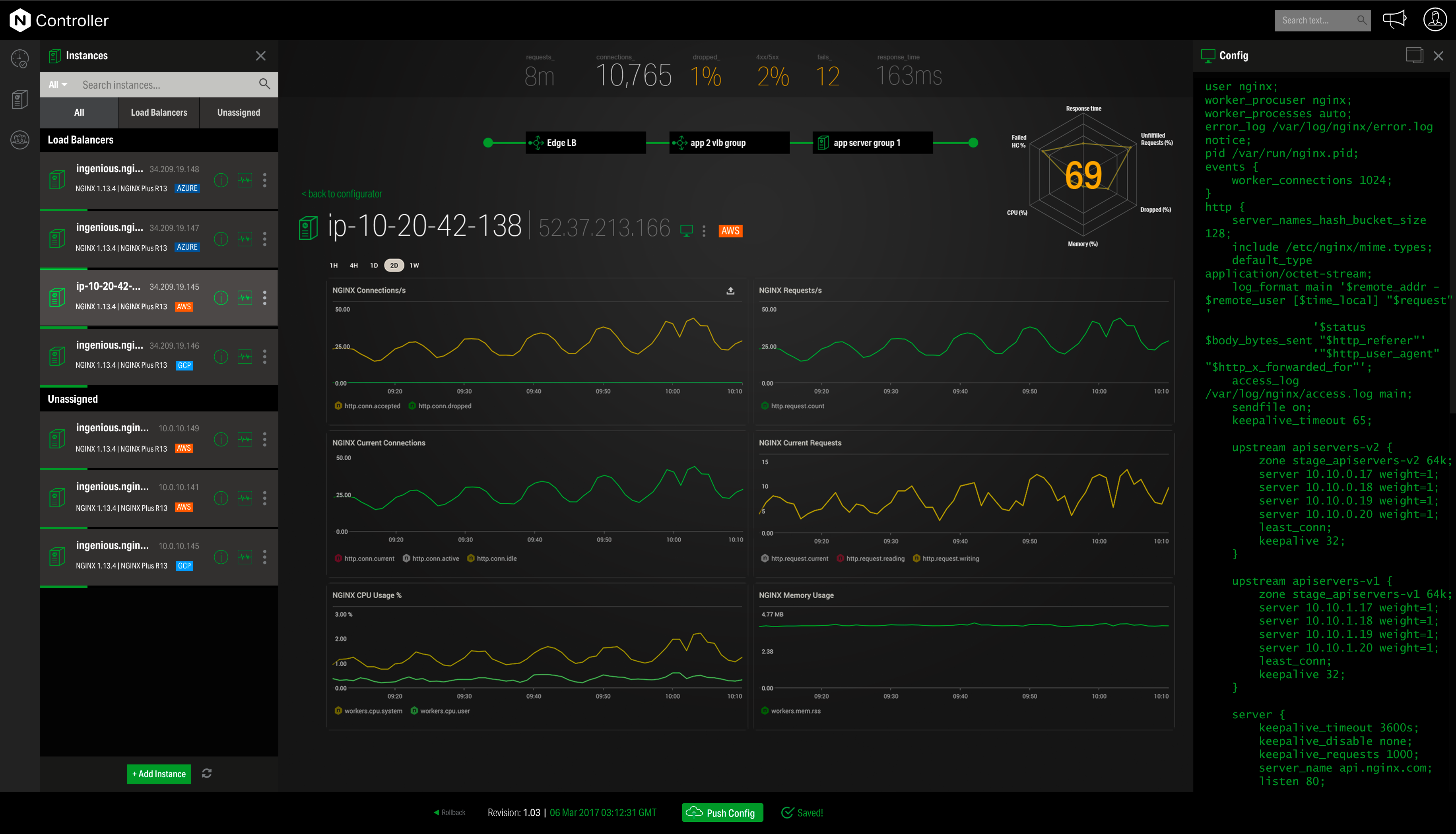
NGINX, a business unit of F5 Networks, powers over 65% of the world's busiest websites and web applications. NGINX started out as an open source web server and reverse proxy, built to be faster and more efficient than Apache. Over the years, NGINX has built a suite of infrastructure software products o tackle some of the biggest challenges in managing high-transaction applications. NGINX offers a suite of products to form the core of what organizations need to create…
N/A
Portainer
Score9.6 out of 10
N/A
Portainer is a centralized container management platform for containerized apps and IoT device management. It helps accelerate container adoption and reduce time-to-value on Kubernetes, Docker, and Swarm with a management portal, allowing users to deliver and manage containerized applications from the data center to the edge. Portainer helps - Reduce the operational complexity associated with multi-cluster management Bridge the skills gap and facilitate feature…
A de minimis incentive was given to thank the reviewer for their time. The incentive was not used to bias or drive a particular response, nor was the incentive contingent on a positive endorsement. More Info
[NGINX] is very well suited for high performance. I have seen it used on servers with 1k current connections with no issues. Despite seeing it used in many environments I've never seen software developers use it over apache, express, IIS in local dev environments so it may be more difficult to setup. I've also seen it used to load balance again without issues.
A de minimis incentive was given to thank the reviewer for their time. The incentive was not used to bias or drive a particular response, nor was the incentive contingent on a positive endorsement. More Info
Many developers, especially lesser experienced developers, don't have a really good background in setting up containers from the command line. Portainer is invaluable to them. Giving a UI to them gives them much more confidence and allows them to learn properties and capabilities of containers under far less stress. On the flip side of this, giving then a UI on a production system can lead to chaos...never give junior developers access to production servers.
A de minimis incentive was given to thank the reviewer for their time. The incentive was not used to bias or drive a particular response, nor was the incentive contingent on a positive endorsement. More Info
A de minimis incentive was given to thank the reviewer for their time. The incentive was not used to bias or drive a particular response, nor was the incentive contingent on a positive endorsement. More Info
Separating server maintenance with application development, providing a clear user interface for developers who don't want to worry about the underlying server.
RBAC for container deployment linked to a SAML IDP, not something particularly easy in a native Docker instance but point and shoot in Portainer, allowing the use of Azure / Okta etc to provide user access.
Image management with multiple repositories is super clear and reduces incidents
A de minimis incentive was given to thank the reviewer for their time. The incentive was not used to bias or drive a particular response, nor was the incentive contingent on a positive endorsement. More Info
Customer support can be strangely condescending, perhaps it's a language issue?
I find it a little weird how the release versions used for Nginx+ aren't the same as for open source version. It can be very confusing to determine the cross-compatibility of modules, etc., because of this.
It seems like some (most?) modules on their own site are ancient and no longer supported, so their documentation in this area needs work.
It's difficult to navigate between nginx.com commercial site and customer support. They need to be integrated together.
I'd love to see more work done on nginx+ monitoring without requiring logging every request. I understand that many statistics can only be derived from logs, but plenty should work without that. Logging is not an option in many environments.
When setting up static IPs for a new container, having the used ones for a specific network at hand would be cool or something like a mini IPAM of some sort...
Using the developertools to see "oh, it's a 40x or 500" when something doesn't seem to load because the ui just states "Didn't work" is kinda annoying. expandable toasts or something would be nice.
A de minimis incentive was given to thank the reviewer for their time. The incentive was not used to bias or drive a particular response, nor was the incentive contingent on a positive endorsement. More Info
A de minimis incentive was given to thank the reviewer for their time. The incentive was not used to bias or drive a particular response, nor was the incentive contingent on a positive endorsement. More Info
Front end proxy and reverse proxy of Nginx is always useful. I always prefer to Nginx in overall usability when you have application server and database or multiple application servers and single database i.e. clustered application. Nginx provides really good features and flexibility which helps the system administrator in case of troubleshooting and also from the administration perspective. Also, Nginx doesn't delay any request because of internal performance issues.
A de minimis incentive was given to thank the reviewer for their time. The incentive was not used to bias or drive a particular response, nor was the incentive contingent on a positive endorsement. More Info
Accessibility for Non-Experts: even with some people having a bit longer on-boarding it is still very simple Quick setup is insanely useful, we can get it running in 10 seconds after installing docker Portainer has once again super clean UI and is very user friendly. Deployment/monitoring and management are super easy. I can tell just from a glance if something is out of date (watching at you Watchtower not doing your job for some reason)
A de minimis incentive was given to thank the reviewer for their time. The incentive was not used to bias or drive a particular response, nor was the incentive contingent on a positive endorsement. More Info
Community support is great, and they've also had a presence at conferences. Overall, there is no shortage of documentation and community support. We're currently using it to serve up some WordPress sites, and configuring NGINX for this purpose is well documented.
A de minimis incentive was given to thank the reviewer for their time. The incentive was not used to bias or drive a particular response, nor was the incentive contingent on a positive endorsement. More Info
One of their staff members jumped on a video call immediately with me and led me through the problem and solution during a quick session of screen sharing. In this day and age that is above and beyond, especially when it comes to software. It took approximately 5-10 minutes to diagnose and fix, including pleasantries!
A de minimis incentive was given to thank the reviewer for their time. The incentive was not used to bias or drive a particular response, nor was the incentive contingent on a positive endorsement. More Info
We have used Traffic, Apache, Google Cloud Load Balancing and other managed cloud-based load balancers. When it comes to scale and customization nothing beats Nginx. We selected Nginx over the others because
we have a large number of services and we can manage a single Nginx instance for all of them
we have high impact services and Nginx never breaks a sweat under load
individual services have special considerations and Nginx lets us configure each one uniquely
A de minimis incentive was given to thank the reviewer for their time. The incentive was not used to bias or drive a particular response, nor was the incentive contingent on a positive endorsement. More Info
Portainer takes the cup in terms of usability and features. It is also more useful for smaller deployments, whereas Kubernetes in our opinion and experience, could probably be more suited to certain other use cases. Portainer is also a fresh feel among all the preexisting container management solutions and brings positivity and a new breeze in the industry.
Nginx has decreased the burden of web server administration and maintenance, and we are spending less time on server issues than when we were using Apache.
Nginx has allowed more people in our company to get involved with configuring things on the web server, so there's no longer a single point of failure ("the Apache guy").
Nginx has given us the ability to handle a larger number of requests without scaling up in hardware quite so quickly.
A de minimis incentive was given to thank the reviewer for their time. The incentive was not used to bias or drive a particular response, nor was the incentive contingent on a positive endorsement. More Info
Increased productivity: Portainer's user-friendly interface and streamlined container management can help increase the productivity of IT teams.
Cost savings: By simplifying container management, Portainer can help reduce the time and resources required to manage container environments, potentially leading to cost savings.
A de minimis incentive was given to thank the reviewer for their time. The incentive was not used to bias or drive a particular response, nor was the incentive contingent on a positive endorsement. More Info