NativeScript is an open source framework that allows
you to create native iOS and Android apps, with one codebase, using the web
skills you already have (JavaScript and CSS) and the libraries you already
love.
N/A
Swiftify
Score 9.0 out of 10
Small Businesses (1-50 employees)
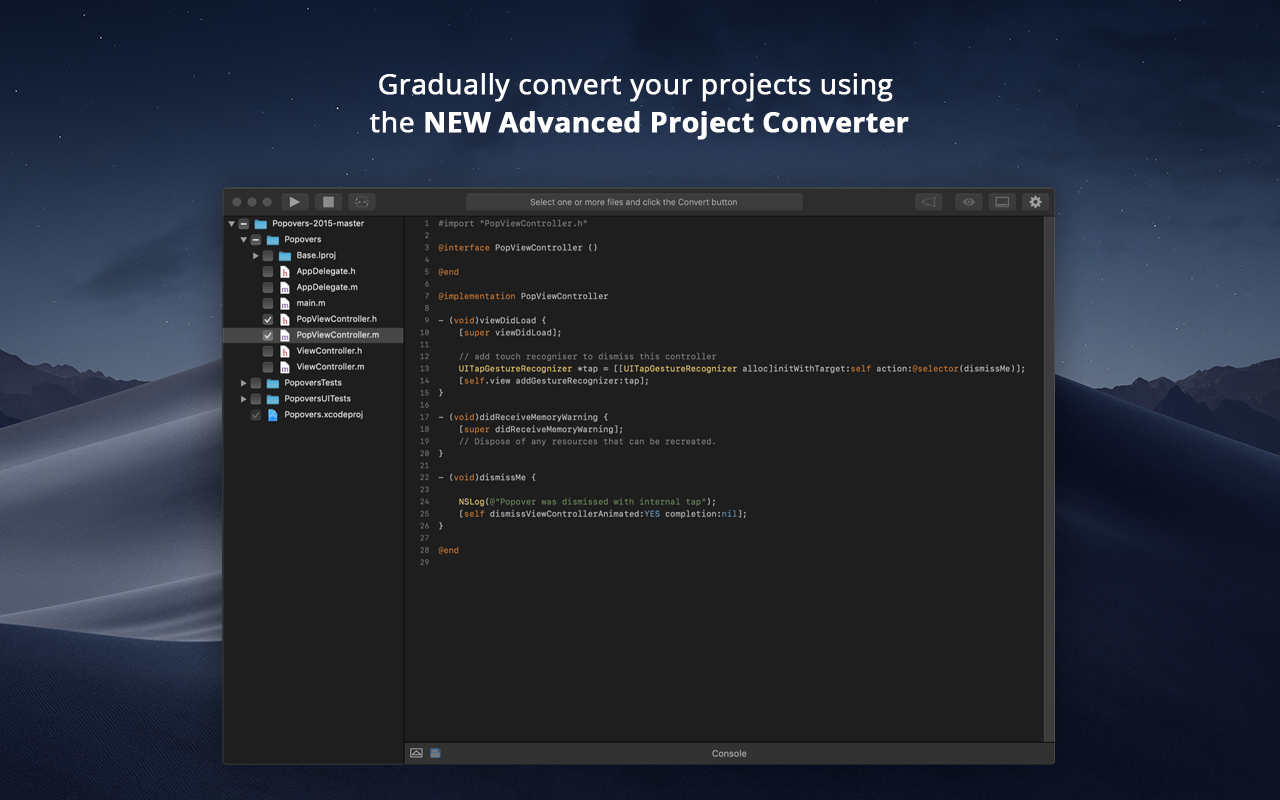
When Apple rolled out Swift back in 2014, Objective-C was set to be replaced. Even nowadays, however, there are plenty of apps and projects that still use Objective-C, and developers are faced with the prospect of either starting again from scratch or attempting to convert them to Swift. Swiftify for Xcode is designed to automate much of the conversion process, handling the task of replacing syntax while letting you focus on other aspects of migrating your project to…
$5
per file
Pricing
NativeScript
Swiftify
Editions & Modules
No answers on this topic
Pay As You Go
$5
per file
Cloud 30 (Monthly)
$49
30 files per month
Cloud 100 (Monthly)
$99
100 files per month
Cloud 300 (Monthly)
$199
300 files per month
Cloud 1000 (Monthly)
$299
1000 files per month
Cloud 30 (Yearly)
$399
300 files per year
Cloud 100 (Yearly)
$799
1000 files per year
Cloud 300 (Yearly)
$1,599
3000 files per year
Cloud 1000 (Yearly)
$2,399
10000 files per year
Offline Converter
custom pricing
per seat
Offerings
Pricing Offerings
NativeScript
Swiftify
Free Trial
Yes
Yes
Free/Freemium Version
Yes
Yes
Premium Consulting/Integration Services
No
No
Entry-level Setup Fee
No setup fee
No setup fee
Additional Details
The NativeScript framework and CLI are completely free and open source. NativeScript Sidekick is a free download to improve developer productivity with optional paid tiers for power users.
NativeScript allows to easily integrate with native APIs by threading models. Moreover, the framework itself can be integrated with Angular, VueJS and JavaScript due to the fact that it was built on based on these frameworks. It allows you to easily maintain if you projects are based on these frameworks. Therefore, for the development of cross-platform applications it can be very handy!
For me as a picky person I never used the file convertor but for a small portion of code, it is good. With the classes that have more than one initializer, it got confusing and I had to dig to find the exact issue to fix.
True native app. The app uses native components and that is quite noticeable in the overall performance of the app. NativeScript is also awesome in the way we can access the native APIs, so we are never really constrained by the framework. If we need, we can just dive into the native APIs without leaving our environment and language (JS).
Cross-platform. Builds for Android and iOS. It deals with the platforms differences very well.
Support for Vue.js. Even though it is just a community effort, the NativeScript-Vue plugin is the best alternative to build native Apps with Vue.js. That was a major factor to go with NativeScript.
Nativescript runs everything on a single thread. i.e., the UI thread. If you want to offload some processing, you have to use web workers. This experience can be improved in the future releases.
Currently NativeScript only have hot reload when you change the UI file or Css file. There is no hot reload when you change Js/Ts file, unlike Google's Flutter. This is also something which NativeScript will get in the future releases.
In current version of NativeScript, there is no livesync when building with webpack. This feature will be added with NativeScript 4.x. (an RC version for 4.x is already available)
The hybrid is ok but native is better for performance and the right use case I want to go for is the performance without dealing with too many development tools.
My focus has been, and must remain, with obtaining support from web resources over that of paid support programs. Many companies, including those of government agencies, do not have a budget sufficient for paying large sums of money to other organizations to answer questions. Even in cases where an organization did purchase support programs, developers often found that the delays in obtaining responses to development issues was excessive. I give NativeScript the lowest possible rating, due to the fact that their website content is severely outdated and of little use to a developer in a crunch. The NativeScript environment may be far better than I have been able to report, but held back from excelling due to poor support content. Being that I am often asked to push the boundaries in various areas, improper documentation is highly detrimental to a development team, and thuss a review. I would be more than happy to improve this review as the content of the support documentation provided by the NativeScript team makes its way to their website in the form of real-world examples which are applicable to all versions, or at least the most recent versions, of their product.
NativeScript was indeed a better experience at first than Ionic. But the real game-changer in 2022 for cross-platform applications is Flutter now. We changed to it shorty after NativeScript, as it is much more stable, more widely supported, has a ton of extra features, and does not rely on JavaScript and Android knowledge as much as NativeScript.
Swiftify tries to convert the code even if the code can not be executed in a real situation. I chose Swiftify because most of the times you just need to convert one line, one method... That of course, it is using and used by other code that you didn't add in the conversion code, but you just need to convert that for now. In this situation, Swiftify converts the code, other ones such as iSwift will report an error in the code and will not convert it.
We had built this particular app once already, during a 6 month time frame, using Ionic. When we hit the wall, we chose NativeScript, and built the whole app from scratch. We estimated another 6 months, but completed the work in 4 months due to the ease of use.
We have found collaboration with our client much easier because of the simplicity of releases and speed of development.
Having a tool like NativeScript has allowed us to make competitive quotes for mobile app development contracts, where previously that would have been closed to us due to our lack of native development experience. Being able to build iOS apps without a Swift-code expert has opened those doors for us.