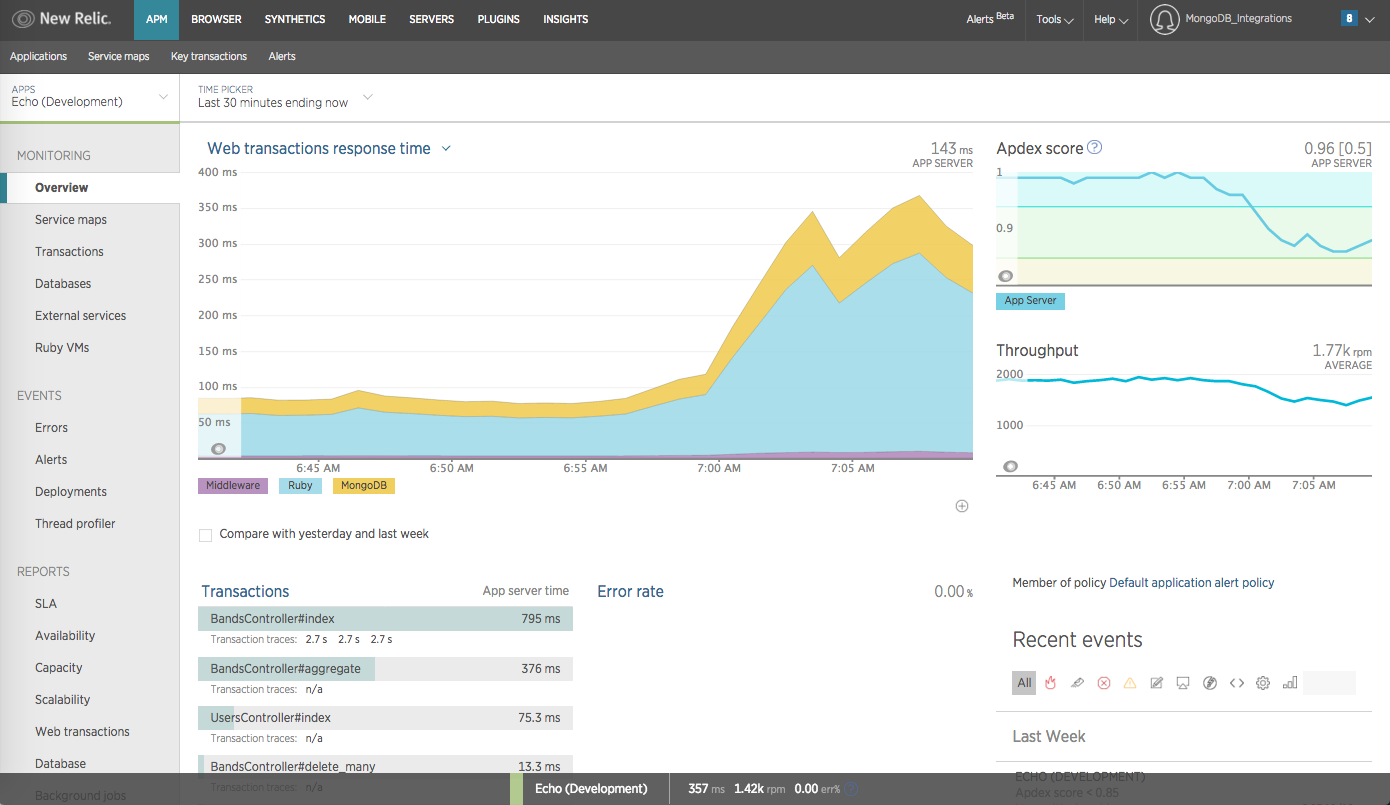
MongoDB is an open source document-oriented database system. It is part of the NoSQL family of database systems. Instead of storing data in tables as is done in a "classical" relational database, MongoDB stores structured data as JSON-like documents with dynamic schemas (MongoDB calls the format BSON), making the integration of data in certain types of applications easier and faster.
$0
per month
SAP HANA Cloud
Score 8.9 out of 10
N/A
SAP HANA is an application that uses in-memory database technology to process very large amounts of real-time data from relational databases, both SAP and non-SAP, in a very short time. The in-memory computing engine allows HANA to process data stored in RAM as opposed to reading it from a disk which means that the data can be accessed in real time by the applications using HANA. The product is sold both as an appliance and as a cloud-based software solution.
N/A
Pricing
MongoDB
SAP HANA Cloud
Editions & Modules
Shared
$0
per month
Serverless
$0.10million reads
million reads
Dedicated
$57
per month
No answers on this topic
Offerings
Pricing Offerings
MongoDB
SAP HANA Cloud
Free Trial
Yes
Yes
Free/Freemium Version
Yes
No
Premium Consulting/Integration Services
No
No
Entry-level Setup Fee
No setup fee
Optional
Additional Details
Fully managed, global cloud database on AWS, Azure, and GCP
Includes a one year free trial.
More Pricing Information
Community Pulse
MongoDB
SAP HANA Cloud
Features
MongoDB
SAP HANA Cloud
NoSQL Databases
Comparison of NoSQL Databases features of Product A and Product B
MongoDB [is] great at storing JSON data grouped into "collections". In this format, you can store any JSON documents and conveniently categorize them by collections. The JSON document contained in MongoDB is called binary JSON or BSON and, like any other document in this format, is unstructured. Therefore, unlike traditional DBMS, any kind of data can be stored in collections, and this flexibility is combined with the horizontal scalability of the database. It should be noted that MongoDB does not have links between documents and “collections” (this is partially compensated by the Database Reference - links in the DBMS, but this does not completely solve the problem). As a result, a situation arises in which there is a certain set of data that is not related to other information in the database, and there is no way to combine data from different documents. In SQL systems, this would be an elementary task.
SAP HANA Cloud works effectively with SMBs or small to medium-sized enterprises and requires an affordable, scalable ERP system. Companies that must implement SAP S/4 HANA as soon as possible. Companies looking to take advantage of the newest innovation from SAP are looking to cut expenses on their IT infrastructure. SAP HANA CLOUD is not suitable for 1. Large companies with intricate operational procedures. 2. Companies with stringent policies regarding data residency. 3. Businesses with a sizable SAP landscape on premises 4. Companies must closely integrate SAP HANA CLOUD with non-SAP systems.
Easy to learn. When I picked up MongoDB for the first time, I had little background in database management or modeling. If you have a background in javascript (and JSON)... then you can figure out how to use MongoDB pretty fast.
Fast performance.
It's relatively easy to set up in certain environments because there are lots of ready-made solutions out there.
There's a lot of support in the existing ecosystem for it —, especially in the node.js realm.
Query syntax is pretty simple to grasp and utilize.
Aggregate functions are powerful.
Scaling options.
Documentation is quite good and versioned for each release.
Requires higher processing power, otherwise it won't fly. How ever computing costs are lower. Incase you are migrating to cloud please do not select the highest config available in that series . Upgrading it later against a reserved instance can cost you dearly with a series change
Lack of clarity on licensing is one major challenge
Unless S/4 with additional features are enabled mere migration HANA DB is not a rewarding journey. Power is in S/4
MongoDB is one of the most famous non-relational databases in the world, there are famous active projects that use this database. I think that the same company that develops the database gives you the online induction totally free is something that really is very positive. Accounts with a first-class support to be able to relate the correct implementation of the database, in addition to teaching you the best practices to optimize your projects, I believe that with this decision it is more than obvious which is the best decision at the time of seeing with which database to work.
At this moment we are not focusing on SAP, however would love to in the future. This is primarily because of our limited ability to generate more revenue to fund for SAP partnerships and products. Our initial tryst with SAP Partneredge open ecosystem didn't go as planned and we have shelved that for now. Hope we can revive in the future
It is one of the reasons why we prefer it to store documents in a JSON-style format, to access the desired document very quickly regardless of its size, to be readable by human eyes, and to be easily scalable and manageable.
SAP HANA Cloud requires significant expertise on technical side to admin and manage it.It surely is lot of improvement over previous versions of SAPThe modern, role-based SAP Fiori interface has enhanced the user experience for applications like S/4HANA, though the complexity of the underlying database remains. For the average business user, the usability of SAP solutions running on the HANA database has seen a major transformation, largely thanks to the Fiori user interface.
I have reached multiple times to the MongoDB community for the help and they have provided each and easy solution for every problem. Over the internet and on stack overflow many people responds over the challenges. Now this tool is very much used in every company and projects so internally many people are there to give a support.
One specific example of how the support for SAP HANA Cloud impacted us is in our efforts to troubleshoot and resolve technical issues. Whenever we encountered an issue or had a question, the support team was quick to respond and provided us with clear and actionable guidance. This helped us avoid downtime and keep our analytics operations running smoothly.
While the setup and configuration of MongoDB is pretty straight forward, having a vendor that performs automatic backups and scales the cluster automatically is very convenient. If you do not have a system administrator or DBA familiar with MongoDB on hand, it's a very good idea to use a 3rd party vendor that specializes in MongoDB hosting. The value is very well worth it over hosting it yourself since the cost is often reasonable among providers.
Professional GIS people are some of the most risk-averse there are, and it's difficult to get them to move to HANA in one step. Start with small projects building to 80% use of HANA spatial over time.
The environment I work in is somewhat unique in that we use both MySQL and MongoDB. However, each is used for specific purposes that the other is not well suited for. MongoDB is not a relational database like MySQL, so it serves as the perfect place to dump key bits of data for quick retrieval later. This is something we can't easily do with MySQL. On this smaller database, MongoDB also lets us retrieve data more quickly with its fast and efficient querying.
It enables preview and better cloud service than other cloud platforms. Easy document transfer and faster document transfer are the key points for the selection of the HANA cloud server. The preview of data before its execution is also one of the factors in the selection of the HANA server.
We can make more open and flexible systems due to its easy adaptation to new evolutions in web applications.
In the latest versions it offers support for different transactions and we could carry out real tests related to the concurrency of the application.
MongoDB allows you to have distributed clusters, which improves the speed of the queries by reducing the latency that exists between the database cluster and the service that executes the query.