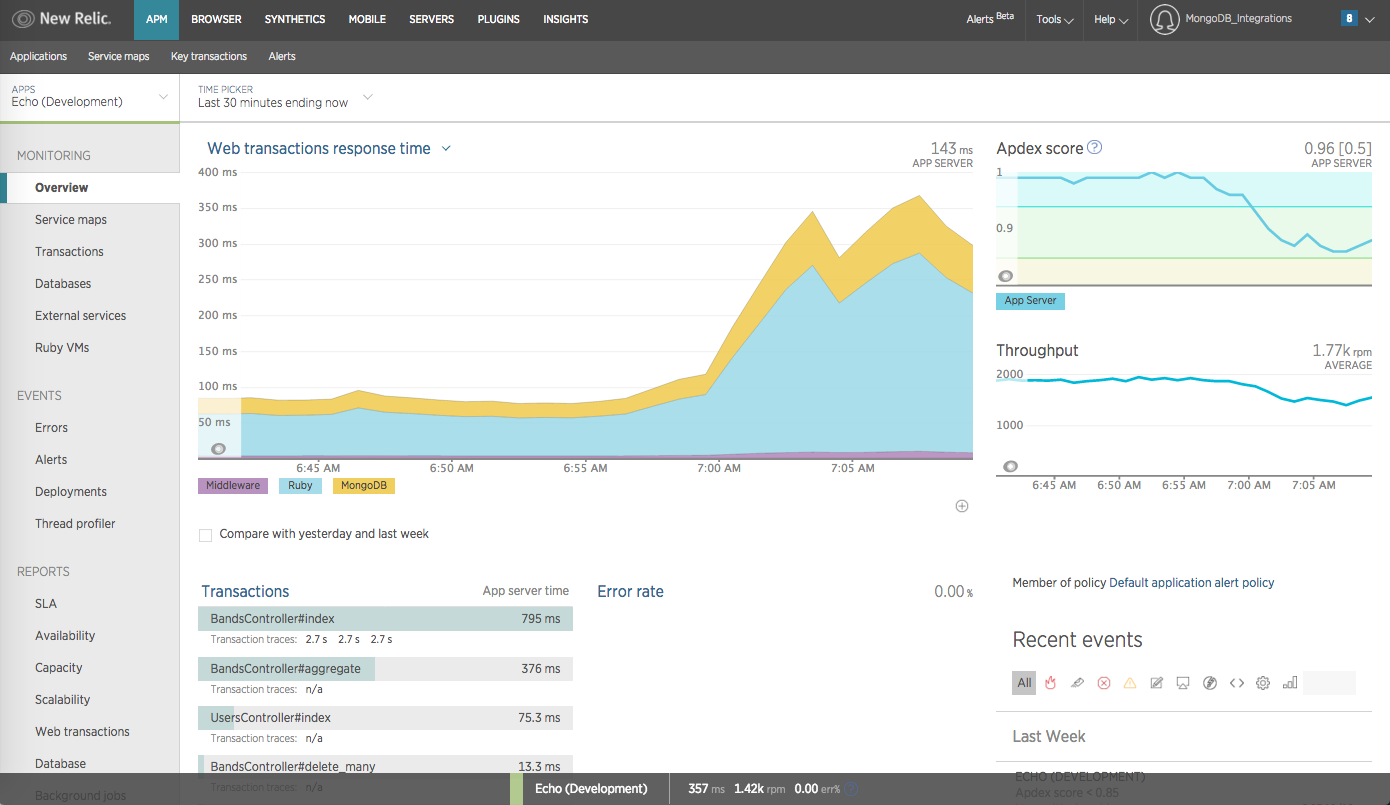
MongoDB is an open source document-oriented database system. It is part of the NoSQL family of database systems. Instead of storing data in tables as is done in a "classical" relational database, MongoDB stores structured data as JSON-like documents with dynamic schemas (MongoDB calls the format BSON), making the integration of data in certain types of applications easier and faster.
$0.10
million reads
MarkLogic Server
Score9 out of 10
N/A
MarkLogic Server is a multi-model database that has both NoSQL and trusted enterprise data management capabilities. The vendor states it is the most secure multi-model database, and it’s deployable in any environment. They state it is an ideal database to power a data hub.
$0.01
per MCU/per hour + 0.10 per GB/per month
Pricing
MongoDB
MarkLogic Server
Editions & Modules
Shared
$0
per month
Serverless
$0.10million reads
million reads
Dedicated
$57
per month
Low Priority Fixed
$0.01
per MCU/per hour + 0.10 per GB/per month
Standard Reserved
$0.07
per MCU/per hour + 0.10 per GB/per month
Standard On-Demand
$0.13
per MCU/per hour + 0.10 per GB/per month
Offerings
Pricing Offerings
MongoDB
MarkLogic Server
Free Trial
Yes
No
Free/Freemium Version
Yes
No
Premium Consulting/Integration Services
No
No
Entry-level Setup Fee
No setup fee
No setup fee
Additional Details
Fully managed, global cloud database on AWS, Azure, and GCP
A de minimis incentive was given to thank the reviewer for their time. The incentive was not used to bias or drive a particular response, nor was the incentive contingent on a positive endorsement. More Info
Senior Software Engineering in Information Technology at Mindtree (Information Technology and Services, 10,001+ employees)
Chose MarkLogic Server
In comparison to both Mongo and HBase, MarkLogic wins in terms of integration to other systems, while loosing in terms of pricing. In terms of documentation all will be in same range putting MarkLogic a bit forward.
A de minimis incentive was given to thank the reviewer for their time. The incentive was not used to bias or drive a particular response, nor was the incentive contingent on a positive endorsement. More Info
Web Application Developer in Information Technology at Aloompa (Hospital & Health Care, 51-200 employees)
Chose MarkLogic Server
MarkLogic is good at what it does: storing and searching XML with a REST interface. The amount of support out there for the other NoSQL products is what gives them the best advantage. Many plugins exist for those, none exist for MarkLogic. Even the proprietary ones like …
A de minimis incentive was given to thank the reviewer for their time. The incentive was not used to bias or drive a particular response, nor was the incentive contingent on a positive endorsement. More Info
Principal Consultant in Information Technology at Avalon Consulting, LLC (Information Technology and Services, 51-200 employees)
Chose MarkLogic Server
There's no other single product that directly compares to all the features that are packed into MarkLogic. Generally speaking, you're looking at a combination of many products to build a stack that competes feature-for-feature. Even if you're leveraging only a limited set of …
A de minimis incentive was given to thank the reviewer for their time. The incentive was not used to bias or drive a particular response, nor was the incentive contingent on a positive endorsement. More Info
Search Engineer in Engineering at Catalyst Repository Systems (Information Technology and Services, 201-500 employees)
Chose MarkLogic Server
I have used most of the common RDBMS databases (SQL Server, Oracle, MySQL, etc.). MarkLogic is more dependable, faster, and flexible. I would not willingly go back to RDBMS. As far as open source competition to MarkLogic such as MongoDB, I haven't used it myself so I don't have …
A de minimis incentive was given to thank the reviewer for their time. The incentive was not used to bias or drive a particular response, nor was the incentive contingent on a positive endorsement. More Info
Senior Director, IT Architecture and Publishing Solutions in Information Technology at American Psychological Association (Publishing, 501-1000 employees)
Chose MarkLogic Server
We had Fast in place when Microsoft had bought it up and was going to change / deprecate it. One of the biggest advantages of MarkLogic for search actually had to do with the rest of the content pipeline - it allowed us to have it all in one technology. On the NoSQL side, we …
A de minimis incentive was given to thank the reviewer for their time. The incentive was not used to bias or drive a particular response, nor was the incentive contingent on a positive endorsement. More Info
If asked by a colleague I would highly recommend MongoDB. MongoDB provides incredible flexibility and is quick and easy to set up. It also provides extensive documentation which is very useful for someone new to the tool. Though I've used it for years and still referenced the docs often. From my experience and the use cases I've worked on, I'd suggest using it anywhere that needs a fast, efficient storage space for non-relational data. If a relational database is needed then another tool would be more apt.
A de minimis incentive was given to thank the reviewer for their time. The incentive was not used to bias or drive a particular response, nor was the incentive contingent on a positive endorsement. More Info
If you are storing META data then MarkLogic is super useful as it retrieves everything so fast, while storing the whole data shows performance issues some times. If you have legacy systems then migrating from it would really require sweat and blood, on the other hand if you are in systems like Node.js you can simply integrate two systems easily. If you don't know how in the end your your data schema will look like then it's better to make a prototype using MarkLogic.
A de minimis incentive was given to thank the reviewer for their time. The incentive was not used to bias or drive a particular response, nor was the incentive contingent on a positive endorsement. More Info
Being a JSON language optimizes the response time of a query, you can directly build a query logic from the same service
You can install a local, database-based environment rather than the non-relational real-time bases such a firebase does not allow, the local environment is paramount since you can work without relying on the internet.
Forming collections in Mango is relatively simple, you do not need to know of query to work with it, since it has a simple graphic environment that allows you to manage databases for those who are not experts in console management.
A de minimis incentive was given to thank the reviewer for their time. The incentive was not used to bias or drive a particular response, nor was the incentive contingent on a positive endorsement. More Info
A de minimis incentive was given to thank the reviewer for their time. The incentive was not used to bias or drive a particular response, nor was the incentive contingent on a positive endorsement. More Info
An aggregate pipeline can be a bit overwhelming as a newcomer.
There's still no real concept of joins with references/foreign keys, although the aggregate framework has a feature that is close.
Database management/dev ops can still be time-consuming if rolling your own deployments. (Thankfully there are plenty of providers like Compose or even MongoDB's own Atlas that helps take care of the nitty-gritty.
A de minimis incentive was given to thank the reviewer for their time. The incentive was not used to bias or drive a particular response, nor was the incentive contingent on a positive endorsement. More Info
MarkLogic still has a long way to go in fostering the developer community. Many developers are gravitating to the simple integrations and do not delve into the deeper capabilities. They have made tremendous strides in recent months and I am sure this will improve over time.
Many of the best features are left on the floor by enterprises who end up implementing MarkLogic as a data store. MarkLogic needs to help customers find ways to better leverage their investment and be more creative in how they use the product.
Licensing costs become a major hurdle for adoption. The pricing model has improved for basic implementations, but the costs seem very prohibitive for some verticals and for some of the most advanced features.
A de minimis incentive was given to thank the reviewer for their time. The incentive was not used to bias or drive a particular response, nor was the incentive contingent on a positive endorsement. More Info
I am looking forward to increasing our SaaS subscriptions such that I get to experience global replica sets, working in reads from secondaries, and what not. Can't wait to be able to exploit some of the power that the "Big Boys" use MongoDB for.
A de minimis incentive was given to thank the reviewer for their time. The incentive was not used to bias or drive a particular response, nor was the incentive contingent on a positive endorsement. More Info
MarkLogic is expensive but solid. While we use open source for almost everything else, the backend database is too critically important. At this point, re-tooling for a different back end would take too much time to be a viable option.
A de minimis incentive was given to thank the reviewer for their time. The incentive was not used to bias or drive a particular response, nor was the incentive contingent on a positive endorsement. More Info
NoSQL database systems such as MongoDB lack graphical interfaces by default and therefore to improve usability it is necessary to install third-party applications to see more visually the schemas and stored documents. In addition, these tools also allow us to visualize the commands to be executed for each operation.
A de minimis incentive was given to thank the reviewer for their time. The incentive was not used to bias or drive a particular response, nor was the incentive contingent on a positive endorsement. More Info
Very little about it can be done better or with greater ease. Even things that seem difficult aren't really that bad. There's multiple ways to accomplish any admin task. MarkLogic requires a fraction of administrative effort that you see with enterprise RDBMS like Oracle. MarkLogic is continually improving the tools to simplify cluster configuration and maintenance.
A de minimis incentive was given to thank the reviewer for their time. The incentive was not used to bias or drive a particular response, nor was the incentive contingent on a positive endorsement. More Info
Finding support from local companies can be difficult. There were times when the local company could not find a solution and we reached a solution by getting support globally. If a good local company is found, it will overcome all your problems with its global support.
A de minimis incentive was given to thank the reviewer for their time. The incentive was not used to bias or drive a particular response, nor was the incentive contingent on a positive endorsement. More Info
There's always room for improvement. Some problems get solved faster than others, of course. MarkLogic's direct support is very responsive and professional. If they can't help immediately, they always have good feedback and are eager to receive information and details to work to replicate the problem. They are quick to escalate major support issues and production show-stopping problems. In addition to MarkLogic's direct support, there are several employees who are very active among the community and many questions and common issues get quick attention from helpful responses to email and StackOverflow questions.
A de minimis incentive was given to thank the reviewer for their time. The incentive was not used to bias or drive a particular response, nor was the incentive contingent on a positive endorsement. More Info
While the setup and configuration of MongoDB is pretty straight forward, having a vendor that performs automatic backups and scales the cluster automatically is very convenient. If you do not have a system administrator or DBA familiar with MongoDB on hand, it's a very good idea to use a 3rd party vendor that specializes in MongoDB hosting. The value is very well worth it over hosting it yourself since the cost is often reasonable among providers.
A de minimis incentive was given to thank the reviewer for their time. The incentive was not used to bias or drive a particular response, nor was the incentive contingent on a positive endorsement. More Info
We have [measured] the speed in reading/write operations in high load and finally select the winner = MongoDBWe have [not] too much data but in case there will be 10 [times] more we need Cassandra. Cassandra's storage engine provides constant-time writes no matter how big your data set grows. For analytics, MongoDB provides a custom map/reduce implementation; Cassandra provides native Hadoop support.
We had Fast in place when Microsoft had bought it up and was going to change / deprecate it. One of the biggest advantages of MarkLogic for search actually had to do with the rest of the content pipeline - it allowed us to have it all in one technology. On the NoSQL side, we looked at MongoDB a couple years back. At that time, MarkLogic came in stronger on indexing, transaction reliability, and DR options. For us, that was worth using a commercial product.
A de minimis incentive was given to thank the reviewer for their time. The incentive was not used to bias or drive a particular response, nor was the incentive contingent on a positive endorsement. More Info
Open Source w/ reasonable support costs have a direct, positive impact on the ROI (we moved away from large, monolithic, locked in licensing models)
You do have to balance the necessary level of HA & DR with the number of servers required to scale up and scale out. Servers cost money - so DR & HR doesn't come for free (even though it's built into the architecture of MongoDB
MarkLogic reduced the amount of time that the DevOps team needed to dedicate to database updates, as the engineering team was mostly able to easily design and maintain database upgrades without requiring specialists such as database architects on the DevOps side. This capability flowed from the product's speed and the versatility of its XQuery language and libraries.
MarkLogic required significant education and buy-in time for the engineering team.
A de minimis incentive was given to thank the reviewer for their time. The incentive was not used to bias or drive a particular response, nor was the incentive contingent on a positive endorsement. More Info