monday.com Work OS is an open platform designed so that anyone can create the tools they need to run all aspects of their work. It includes ready-made templates or the ability to customize any work solution ranging from sales pipelines to marketing campaigns, CRMs, and project tracking.
$12
per month per user
Workamajig
Score 6.0 out of 10
N/A
Workamajig is a project management system with capabilities such as file sharing, resource management, and revenue projection.
Here, I will suggest that it is best to create employees, clients, or project reports. Easy to track with the dashboards. I did many integrations and developments. I can not list each of them here. I will say the best tool for management. I couldn't see criteria of unsuitable. But yes It will depend on the client's requirements. I will suggest it as very user-friendly tool for CEOs, CTOs, Managers, and company owners also for team.
I think this holds true to almost any CRM, but if you want to truly utilize it you sort of need to go all in. This can become tough with WMJ because it doesn't offer some critical options that many other CRMs do, like the ability to create and send emails, e-newsletters, to throttle and invite outside clients to look at projects, etc. As such we're pairing Workamajig with Hubspot (and slowly phasing out Mailchimp) and trying to keep the data clean and flowing between them all is pretty tough. I'm also not aware of any API bridge from Wordpress to Workamajig so while I can program and feed my leads from my site into the other spaces, Workamajig remains a manual entry for any insertions you want, even if simply as a CSV import.
But - if you're not worried about that and simply want to manage projects, budget time, and scope things, it's a robust system allowing you to do so.
Ensuring I have set up a Private board vs public board is not clear - it would be useful to have an additional alert when creating a board as I work with sensitive information. It will eventually be used in a team based environment but while I test the boards, they needs to be private.
Time tracking is clumsy, could be easier to record
Auto-schedule population - The most inconvenient thing about using JIG was that the dates wouldn't auto-populate. Example: I move the review date but the rest of the dates stay the same. Depending on each project level, if one date is adjusted the rest should update as well. That way we aren't spending a lot of time moving dates around manually.
Notifications - JIG should have desktop notifications so we can see when tasks are on us even when we aren't in JIG.
Teams involved in content creation, such as marketing or editorial teams, could use monday.com to manage the entire content lifecycle. Boards might track content ideas, assignments, drafts, reviews, approvals, and publication schedules, helping teams collaborate and keep content production on track.
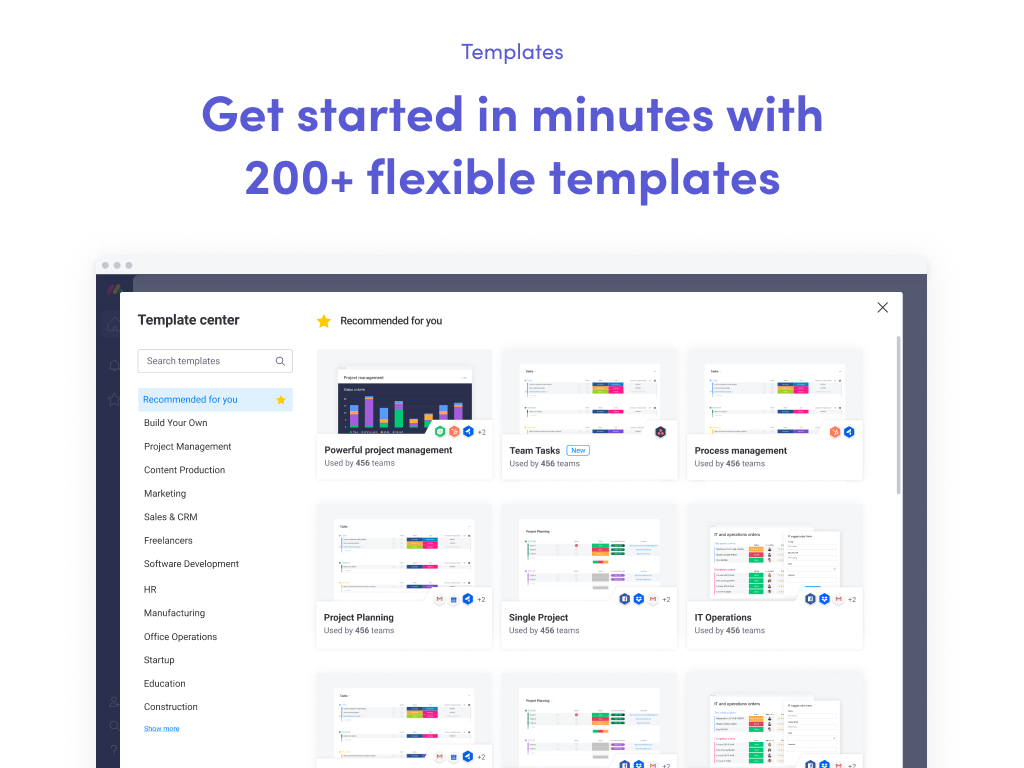
It's straightforward to use and simple to understand. They have tutorials on different elements of the system that you can learn. The workflow there is very intuitive, drag and drop, which doesn't require a learning curve for most people. Templates that also make things more accessible can be found.
Everything performs fairly well. Every now and then there are user errors where an employee will not click "ok" on a note they've created and simply exit out (I do wish that something was in place to prevent this, such as a pop "are you finished?")
monday.com only really care about accounts that have 20 seats or more. While this is great for monday.com, it pushes smaller organisations to evaluate alternatives. We rate monday.com highly in our organisation because key staff have already got good experience with the application and we know we will get to 20+ seats one day. But, till then the billing model and lack of permanent enterprise features is a dread.
To have someone walk you thru the features and capabilities of Monday.com is priceless. Someone also coming along later in the contract to see if you are maximizing the program to suit your company needs is beyond helpful. The staff that have provided this training are fun, creative and very patient.
We signed up for the accounts. Created the accounts. Ran the trial version and tested it live while we were running multiple projects and found that it was fitting our needs perfectly. When the trial ended and we were asked to purchase the full version, we did. We have found other ways to use it and it's a breeze.
We decided to go with monday.com because they offered a free tier for nonprofits and because they are easier to use and offered additional features that we could not find on the other choices. Hands down, there was no better choice for us than monday.com.
We've used QuickBooks and it didn't align well with our business, so there were a lot of insights I wanted from the numbers, but couldn't get. We use Basecamp, which is easy, but can get disorganized pretty quickly and takes discipline to stay structured.
For it to work across multiple departments and sites, I would like to see improvements made with integrations and automation. For this question, I am acknowledging not only the addition of internal triggers/automation, but also an expansion on external ones.
By using monday.com as an enablement tool for templated onboarding plans, we have been able to begin calculating the number of manager hours saved through our work (not defined yet).
monday.com's reporting tools also allow us to more easily report on the productivity and output of our team since we keep up with all projects and subitems in monday.com.
The subscription expense and IT overhead has been substantial. That being said at the time of implementation, most other competing platforms were in line with their pricing.
As more competitive alternatives have come to market we would have probably gone with an entirely cloud base alternative at a lower price.
We ended up with ClickUp as our primary project management platform. If our finance/accounting software wasn't already so integrated with Workamjig we would probably switch to it entirely.