Mitel MiCollab is a collaboration and conferencing tool for enterprises, from Canadian company Mitel.
N/A
Unify Office by RingCentral, from Atos
Score 8.0 out of 10
N/A
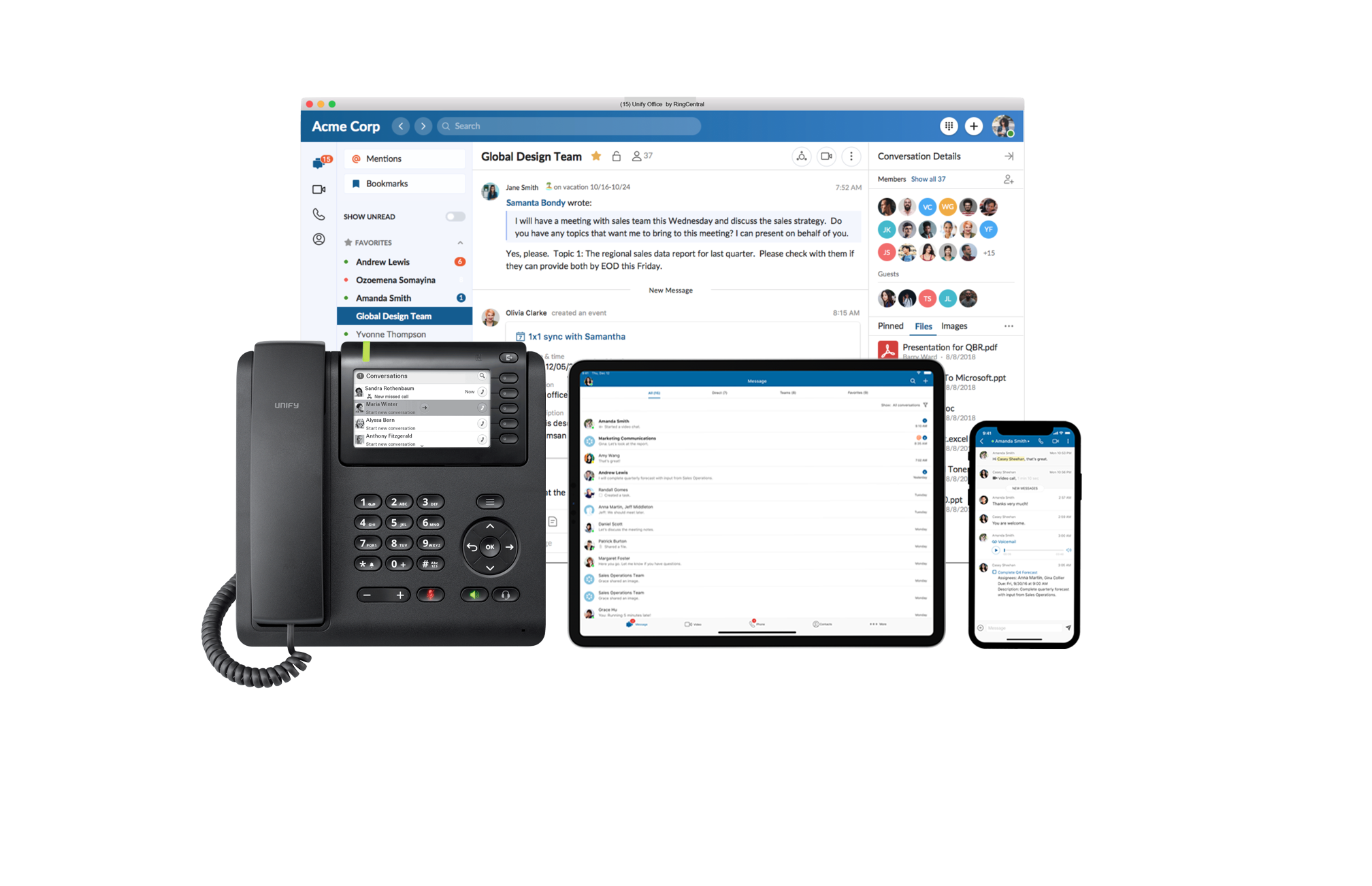
Unify Office is a cloud team collaboration and communications service delivered by Atos Unify in partnership with RingCentral, a market leader in UCaaS.
$16.99
per user per month
Pricing
Mitel MiCollab
Unify Office by RingCentral, from Atos
Editions & Modules
No answers on this topic
Standard
€16.99
per user per month
Premium
€22.99
per user per month
Ultimate
€33.99
per user per month
Offerings
Pricing Offerings
Mitel MiCollab
Unify Office by RingCentral, from Atos
Free Trial
No
No
Free/Freemium Version
No
No
Premium Consulting/Integration Services
No
No
Entry-level Setup Fee
No setup fee
No setup fee
Additional Details
—
—
More Pricing Information
Community Pulse
Mitel MiCollab
Unify Office by RingCentral, from Atos
Features
Mitel MiCollab
Unify Office by RingCentral, from Atos
Project Management
Comparison of Project Management features of Product A and Product B
Mitel MiCollab
5.6
Ratings
32% below category average
Unify Office by RingCentral, from Atos
-
Ratings
Task Management
5.00 Ratings
00 Ratings
Gantt Charts
6.00 Ratings
00 Ratings
Scheduling
6.00 Ratings
00 Ratings
Workflow Automation
5.00 Ratings
00 Ratings
Mobile Access
7.00 Ratings
00 Ratings
Search
5.00 Ratings
00 Ratings
Visual planning tools
5.00 Ratings
00 Ratings
Communication
Comparison of Communication features of Product A and Product B
Mitel MiCollab
6.7
Ratings
17% below category average
Unify Office by RingCentral, from Atos
-
Ratings
Chat
9.00 Ratings
00 Ratings
Notifications
7.00 Ratings
00 Ratings
Discussions
6.00 Ratings
00 Ratings
Surveys
4.00 Ratings
00 Ratings
Internal knowledgebase
4.00 Ratings
00 Ratings
Integrates with GoToMeeting
7.80 Ratings
00 Ratings
Integrates with Gmail and Google Hangouts
8.00 Ratings
00 Ratings
Integrates with Outlook
8.00 Ratings
00 Ratings
File Sharing & Management
Comparison of File Sharing & Management features of Product A and Product B
MiCollab is great for a large office to get users working from home and being able to use their home phone or cell phone like the desk phone at the office. This allows our live operators the ability to see if the end-user is on an active call before sending a new call to them. If you have a very small company of fewer than 10 people this might not be worth the investment as cell phones would work just as well.
If you are looking for a tool for Teams to use where they can keep everything together, then this will work really well. A complete package than tools such as WhatsApp or Skype for Business when it comes to documenting handling and more polished than the likes of Slack or HipChat for the team working and communication element.
Easy deployment to end users, which assists with client deployment. Their email that provides access to download the software via multiple methods helps tremendously on the consulting side.
Easy interface for collaboration and voice. End users like the clean interface and ease of use.
An all-in-one solution for voice and collaboration. It delivers voicemail, chat, voice services, and mobility.
The mobile use of the platform is very powerful. To be able to answer a video call on your phone and them simply swipe when you get to your desktop to have a seamless transfer is impressive.
The simple interface makes it easy for new users. There is nothing to make them feel overwhelmed.
Keeping all the information in the threads of conversations makes it easy to find. There is also a search tool, so as long as you know what you need, you can look accross all your conversation to find the information you are looking for.
We would like to see the ability to break out to Group video conferencing systems. We understand that this is on its way in a software update in the near future.
It is easy to you for existig Mitel UC users, who are familiar with the Mitel way of things, but for green field enterprises, might be a ramp up period which in most cases would not be worth it as its competitor TEAMS is much easier and intuity to use.
Support is typically handled by a reseller. Buyers should evaluate the reseller as much as they evaluate Mitel for the product suite. The few times when the reseller was not able to handle the issue directly, Mitel did step up and quickly answer/address the question/issue.
I feel like it's hard to compare them, as the Yealink system we just implemented is a modern VOIP system, whereas the Mitel MiCollab system we had (even though we upgraded it once over the 12-years of usage) still wasn't as user-friendly for us as Yealink now is to us. In our experience, our user support from MetroNet is also lightyears better than that of Integra/Frontier. So that also adds a lot to our Yealink experience.
Each of the tools above does something well. We have found that the Unify solution simply does a better job of combining all the features of the other services. \easy to start using, while remaining a powerful tool is a tricky task to pull off, but Unify have done this and they have done it well.
A shortening of timescales as information is not stuck on an internal server somewhere - we can include it as part of the thread. This also applies to updates and revisions. You automatically know which the latest revision is, as it is the most recent in the timeline.
The relative cost of implementation is low and there is a wide range of solutions for phones and clients, from software based solutions running on desktop and smartphone or quality hardware to make your desk phone a powerful tool in itself.